


The death toll from wildfires that raged through southeastern Australia rose to 189 yesterday, as a suspected arsonist accused of lighting a firestorm that killed 11 was named in court.
Police said the body count from Australia’s worst wildfire disaster would rise further, with forensic experts continuing the grim search for bodies through the charred rubble of houses, towns and devastated countryside.
Australian Prime Minister Kevin Rudd said it was time for the nation to grieve and called a national day of mourning, but police also acknowledged intense community anger against arsonists believed to be behind some of the blazes.
Victoria state Police Deputy Commissioner Kieran Walshe said police had identified all the bodies found in open areas of countryside and were now combing through “difficult” areas of razed towns searching for more victims.
Providing the first update to a death toll that had officially remained static at 181 for almost a week, Walshe said it would take time before an accurate count of the number of inferno victims emerged.
“I don’t think it’s in the best interests of the community or anybody else for me to speculate what the numbers might be at some point in time,” he said.
Earlier, state police chief Christine Nixon had appealed for calm as a Melbourne court dealt with the case of a suspected arsonist accused over a fire in the east of Victoria that killed 11 people and razed about 200 homes.
A magistrate lifted an order suppressing the name of 39-year-old Brendan Sokaluk, who did not appear in court at his own request and was remanded in protective custody amid fears angry prisoners will target him.
He was charged with arson causing death, intentionally lighting a bushfire and possession of child pornography, facing a maximum sentence of 25 years on the arson charge.
Sokaluk’s lawyer Helen Spowart said there was a real risk of vigilante attacks against her client and his family if his name was published.
“This is an extraordinary case,” she told the court. “The level of emotion and anger and disgust that the alleged offenses have aroused in the community is unprecedented.”
However, magistrate John Klestadt lifted the suppression order, ruling it would have little practical effect.
Nixon appealed to the public to allow the justice system to deal with the suspect.
“We hope that we don’t have to deal with a gang of people who are angry and concerned about this arrest,” Nixon said.
There was a heavy police presence in court for the hearing yesterday, although no angry protesters turned up.
Police are investigating some of the other fires that raged through Victoria state, with arson suspected in at least one other major blaze that destroyed the town of Marysville and killed up to 100 people.
A memorial service in Melbourne at the Rod Laver Arena, the huge stadium that is the home of the Australian Open tennis tournament, was expected to be broadcast live on television and radio.
Thousands of firefighters were still battling eight blazes burning out of control around Victoria — down from more than 20 a few days ago — but no towns were under direct threat, officials said.

Right-wing political scientist Laura Fernandez on Sunday won Costa Rica’s presidential election by a landslide, after promising to crack down on rising violence linked to the cocaine trade. Fernandez’s nearest rival, economist Alvaro Ramos, conceded defeat as results showed the ruling party far exceeding the threshold of 40 percent needed to avoid a runoff. With 94 percent of polling stations counted, the political heir of outgoing Costa Rican President Rodrigo Chaves had captured 48.3 percent of the vote compared with Ramos’ 33.4 percent, the Supreme Electoral Tribunal said. As soon as the first results were announced, members of Fernandez’s Sovereign People’s Party
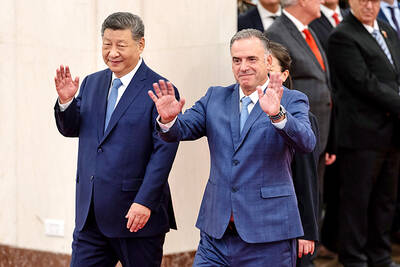
EMERGING FIELDS: The Chinese president said that the two countries would explore cooperation in green technology, the digital economy and artificial intelligence Chinese President Xi Jinping (習近平) yesterday called for an “equal and orderly multipolar world” in the face of “unilateral bullying,” in an apparent jab at the US. Xi was speaking during talks in Beijing with Uruguayan President Yamandu Orsi, the first South American leader to visit China since US special forces captured then-Venezuelan president Nicolas Maduro last month — an operation that Beijing condemned as a violation of sovereignty. Orsi follows a slew of leaders to have visited China seeking to boost ties with the world’s second-largest economy to hedge against US President Donald Trump’s increasingly unpredictable administration. “The international situation is fraught
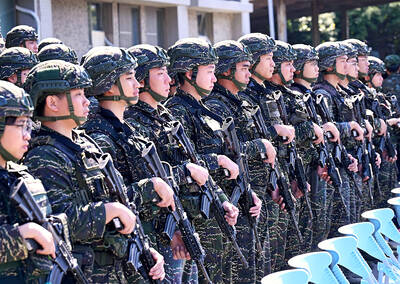
MORE RESPONSIBILITY: Draftees would be expected to fight alongside professional soldiers, likely requiring the transformation of some training brigades into combat units The armed forces are to start incorporating new conscripts into combined arms brigades this year to enhance combat readiness, the Executive Yuan’s latest policy report said. The new policy would affect Taiwanese men entering the military for their compulsory service, which was extended to one year under reforms by then-president Tsai Ing-wen (蔡英文) in 2022. The conscripts would be trained to operate machine guns, uncrewed aerial vehicles, anti-tank guided missile launchers and Stinger air defense systems, the report said, adding that the basic training would be lengthened to eight weeks. After basic training, conscripts would be sorted into infantry battalions that would take
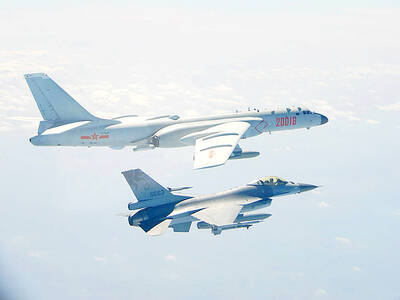
GROWING AMBITIONS: The scale and tempo of the operations show that the Strait has become the core theater for China to expand its security interests, the report said Chinese military aircraft incursions around Taiwan have surged nearly 15-fold over the past five years, according to a report released yesterday by the Democratic Progressive Party’s (DPP) Department of China Affairs. Sorties in the Taiwan Strait were previously irregular, totaling 380 in 2020, but have since evolved into routine operations, the report showed. “This demonstrates that the Taiwan Strait has become both the starting point and testing ground for Beijing’s expansionist ambitions,” it said. Driven by military expansionism, China is systematically pursuing actions aimed at altering the regional “status quo,” the department said, adding that Taiwan represents the most critical link in China’s


 RSS
RSS