


Immigration officials at Taiwan Taoyuan International Airport scrambled to hand-record travel information for thousands of passengers yesterday after the National Immigration Agency (NIA) computer system crashed.
The NIA’s main and backup systems experienced sporadic malfunctions throughout the day. At press time, the system was undergoing repair and was not expected to be back online until noon today, NIA Deputy Director-General Huang Bi-hsia (黃碧霞) said.
Kaohsiung International Airport and Kinmen Airport, which mostly caters to passengers traveling to China via the three mini-links, also reported system malfunctions.
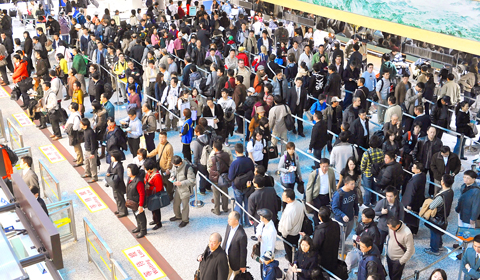
PHOTO: YAO KAI-SHIOU, TAIPEI TIMES
The NIA cited faulty computer hardware, but said the main computer system at the agency was working normally, though it was not accessible at the airport.
The hardware had been replaced and the agency would have more information about the nature of the problems once they were resolved, Huang said.
The Central News Agency reported that the NIA had recently terminated its contract with its computer system maintenance company, which was replaced on Thursday.
The report suggested that a bug could have been planted by a disgruntled individual.
All travel documents were being hand-checked by immigration officers yesterday, causing long lineups and leaving thousands of passengers frustrated. Officers wrote down passengers’ travel information, which the NIA said would be entered into the system once the computers had been fixed.
Taiwan Taoyuan International Airport opened 40 immigration windows to handle the backlog of passengers, Huang said.
Repair work began immediately after the system malfunction was discovered at 6:45am, a peak travel hour. Technicians were still battling with the problematic hardware at 2pm, Huang said.
Yesterday was a particularly busy travel day as the first working day following the four-day New Year holiday weekend.
Many passengers feared delays would prevent them from making connecting flights, but the NIA said no passengers had missed their flights because of the glitch.
Huang acknowledged the breakdown could result in a security breach, and said the NIA would not be able to ascertain whether anyone had slipped in or out of the country illegally until the system was up and running.
As of 1pm yesterday, approximately 20,000 people had exited the country through Taiwan Taoyuan International airport.
Minister of the Interior Liao Liou-yi (廖了以) and NIA Director-General Hsieh Li-kung (謝立?urveyed the situation at the airport yesterday afternoon and stayed for 20 minutes after being updated on the situation by airport officials.
One day earlier, hundreds of travelers departing from Taiwan Taoyuan airport on 11 different flights had to leave without their checked-in luggage when a conveyor belt broke down for almost two hours.

The Tourism Administration yesterday announced that it would reward repeat international visitors with incentives of up to NT$8,000 to boost inbound tourism. The incentives are available to all international tourists, it said, adding that repeat visitors would be rewarded with NT$5,000 and would receive an additional NT$3,000 if they bring travel companions. The nation received 2,990,657 inbound visitors during the first quarter, marking a 3.8 percent increase from the same period last year, agency data showed. Japanese nationals are among groups visiting Taiwan the most. About 1.48 million Japanese tourists arrived last year, a year-on-year increase of more than 12
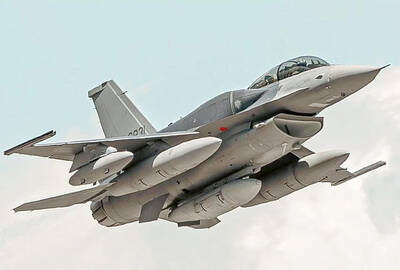
66 FIGHTER JETS: The aircraft is likely undergoing preparations for its transfer to Taiwan — a significant step forward in the nation’s modernization program, a lawmaker said The first of Taiwan’s order of F-16V Block 70 aircraft has been sighted in Texas ahead of delivery, Democratic Progressive Party (DPP) Legislator Wang Ting-yu (王定宇) said. Taiwan’s first F-16V Block 70 two-seat aircraft, tail number 6831, was seen flying from Lockheed Martin’s production facility in Greenville, South Carolina, to Naval Air Station Joint Reserve Base Fort Worth in Texas, Wang wrote on Facebook yesterday. The plane is likely undergoing preparations for its transfer to Taiwan, marking a significant step forward in the Republic of China Air Force’s modernization program, Wang said, citing military analysts. The F-16V Block 70 is a new-build version
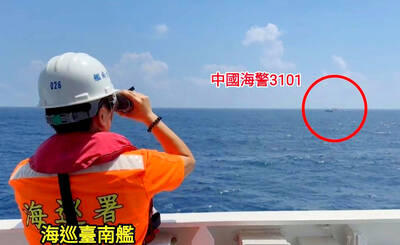
‘BRAZEN’: The holiday did not stop China from activities that infringe on Taiwan’s maritime jurisdiction, but the CGA is ready to defend the nation, Kuan Bi-ling said Beijing is intensifying maritime pressure on Taiwan, but the nation will never yield, Ocean Affairs Council Deputy Minister Sung Chen-en (宋承恩) said. The Coast Guard Administration (CGA) has adopted a “shadowing and monitoring” approach to avoid falling into a Chinese trap to escalate tensions and deepen the conflict, Sung said in an interview published yesterday in the Chinese-language Liberty Times (the Taipei Times’ sister newspaper). China Coast Guard formations patrolling waters east of Taiwan, as well as official Chinese vessels entering areas around Itu Aba Island (Taiping Island, 太平島) and Pratas Islands (Dongsha Islands, 東沙群島) show Beijing’s attempts to significantly step up
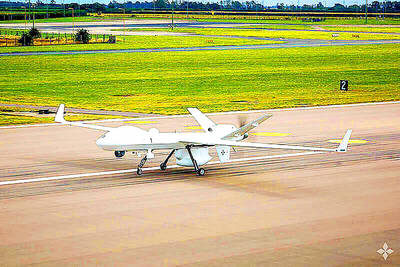
BOOST: By operating the same advanced systems as the US military, Taiwan would be better positioned to share and integrate intelligence with partners, an expert said The first batch of MQ-9B SkyGuardian drones has arrived in Taiwan, and is being assembled and tested by drone manufacturer General Atomics and the military ahead of flight trials as part of the air force’s acquisition to bolster its aerial surveillance capabilities, a source said yesterday. The air force allocated a budget of NT$21.7 billion (US$687 million) from 2022 to 2029 to procure four MQ-9B uncrewed aerial vehicles (UAVs) manufactured by General Atomics along with associated equipment such as ground control stations. The US has agreed to deliver the four MQ-9Bs to Taiwan in two batches this year and next


 RSS
RSS