


Several hundred angry union members gathered in front of the Council of Labor Affairs (CLA) building yesterday to urge the council to penalize businesses that force employees to take unpaid leave.
Labor associations from all over Taiwan participated in the protest, including the National Federation of Independent Trade Unions (NAFITU), Tainan County’s Federation of Trade Unions, the Confederation of Taipei Trade Unions and the Youth Labor Unions, shouting slogans and holding placards reading: “Stop unpaid leave,” “Government, help businesses, Workers are losing their jobs,” “Help workers, stop unemployment,” “Bail-out fund should put workers first” and “Protect nationals, stop using foreign labor.”
The protesters demanded the council act against businesses that illegally force workers to take unpaid leave.
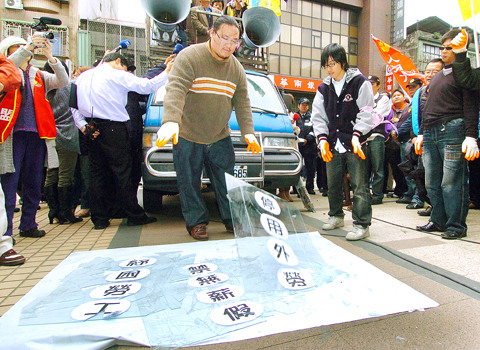
PHOTO: FANG PIN-CHAO, TAIPEI TIMES
The consent of workers and unions must be required, the groups said. They also demanded that unpaid leave not be allowed to affect a worker’s labor insurance and other benefits
They also urged the council to subsidize individual workers, not businesses, when the workers’ unpaid leave resulted in salaries dipping below the minimum monthly wage of NT$17,280.
The council came under fire after it said that a worker may be paid below the minimum wage when on unpaid leave.
The council reversed that decision a day later, but so far has failed to provide satisfactory answers to union representatives, the group said.
On Friday, CLA Minister Jennifer Wang (王如玄) said that the council had been mulling whether and how to subsidize employees or businesses to ensure that workers who are on unpaid leave are not laid off because the company could not afford to pay even the minimum wage.
The council met with union representatives at the Legislative Yuan on Monday, but the meeting failed to reach any consensus.
The council has not made any official announcements on the issues raised, including providing subsidies during unpaid leave or making adjustments to quotas for foreign laborers.
One employee from Wintek Corporation (勝華科技) accused the company of violating the Labor Standards Law (勞工基準法) by laying off pregnant women. The employee said the company had also forced workers to sign a contract agreeing to take unpaid leave while still being required to work.
“Workers are vulnerable against businesses,” shouted Chu Wei-li (朱維立), president of NAFITU. “When a company tells its workers to sign a contract agreeing to unpaid leave, how can a worker refuse to sign?”
They demanded Wang come out and listen to them, but the council told them that Wang was at the legislature, and that CLA deputy minister Pan Shih-wei (潘世偉) was at a meeting in Beitou.
At one point, about 100 of the protesters attempted to break the line of police guarding the entrance to the CLA building and force their way in.
About 200 police officers were standing guard outside the building.
The angry protesters managed to push the police line against the glass doors, but the protesters backed down shortly afterwards.
Mao Chen-fei (毛振飛), chairman of the Confederation of Taoyuan Trade Unions and one of the people directing the protest, urged protesters not to use violence because “people from the Chinese Nationalist Party [KMT] would call us ‘violent’ ... Let’s not do anything that would give them a chance to make us look bad.
After more than an hour, the council’s senior counselor, Lin Jenn-yeu (林振裕), came out to address the protesters.
“The council will call a meeting with local government officials to discuss the establishment of a system for businesses to report unpaid leave,” Lin said.
The council would also hold meetings soon to discuss how to make adjustments to businesses quotas for foreign labor, he said.
The protesters were not satisfied with this response and smashed glass panels on the ground to symbolize the council crushing their hopes.
Before they left, the protesters vowed to demonstrate again at the Presidential Office during the Lunar New Year if their demands were not met.
Meanwhile, official statistics released on Monday showed that more workers — especially those in the photonic, semiconductor and computer manufacturing industries — had been forced by their employers to take unpaid leave last month.
The statistics, compiled by the Directorate-General of Budget, Accounting and Statistics (DGBAS), showed that as a result of the practice, 741,000 people worked less than 35 hours per week last month, an increase of 205,000 over October’s total.
DGBAS official Huang Chien-chung (黃建中) said that the mandatory unpaid leave plans being implemented by the high-tech sector were expected to increase and lead to a further decline in the nation’s already contracting wages.
Previous statistics from the DGBAS showed that Taiwan recorded nominal wage growth of minus 0.27 in October — the third negative monthly growth rate in a row.
ADDITIONAL REPORTING BY CNA
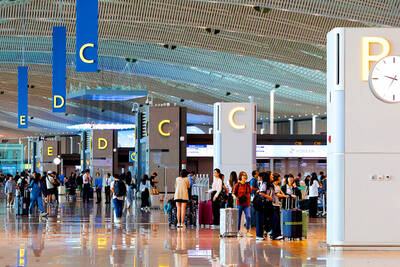
South Korea has adjusted its electronic arrival card system to no longer list Taiwan as a part of China, a move that the Ministry of Foreign Affairs said would help facilitate exchanges between the two sides. South Korea previously listed “Taiwan” as “Taiwan (China)” in the drop-down menus of its online arrival card system, where people had to fill out where they came from and their next destination. The ministry had requested South Korea make a revision and said it would change South Korea’s name on Taiwan’s online immigration system from “Republic of Korea” to “Korea (South),” should the issue not be

Tainan, Taipei and New Taipei City recorded the highest fines nationwide for illegal accommodations in the first quarter of this year, with fines issued in the three cities each exceeding NT$7 million (US$220,639), Tourism Administration data showed. Among them, Taipei had the highest number of illegal short-term rental units, with 410. There were 3,280 legally registered hotels nationwide in the first quarter, down by 14 properties, or 0.43 percent, from a year earlier, likely indicating operators exiting the market, the agency said. However, the number of unregistered properties rose to 1,174, including 314 illegal hotels and 860 illegal short-term rental
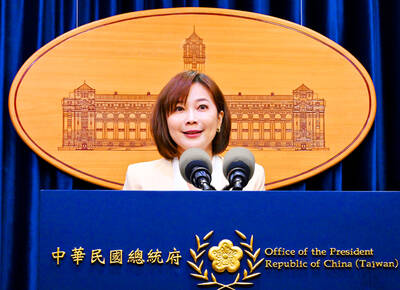
ECONOMIC COERCION: Such actions are often inconsistently applied, sometimes resumed, and sometimes just halted, the Presidential Office spokeswoman said The government backs healthy and orderly cross-strait exchanges, but such arrangements should not be made with political conditions attached and never be used as leverage for political maneuvering or partisan agendas, Presidential Office spokeswoman Karen Kuo (郭雅慧) said yesterday. Kuo made the remarks after China earlier in the day announced 10 new “incentive measures” for Taiwan, following a landmark meeting between Chinese President Xi Jinping (習近平) and Chinese Nationalist Party (KMT) Chairwoman Cheng Li-wun (鄭麗文) in Beijing on Friday. The measures, unveiled by China’s Xinhua news agency, include plans to resume individual travel by residents of Shanghai and China’s Fujian
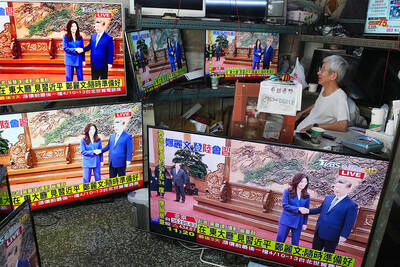
Chinese President Xi Jinping (習近平) and Chinese Nationalist Party (KMT) Chairwoman Cheng Li-wun (鄭麗文) met in Beijing yesterday, where they vowed to bring people on both sides of the Taiwan Strait closer to facilitate the “great rejuvenation of the Chinese nation.” The meeting was held in the East Hall of the Great Hall of the People, a venue typically reserved for meetings between Xi and foreign heads of state. In public remarks prior to a closed-door meeting, Xi, in his role as head of the Chinese Communist Party (CCP), said that Taiwan is historically part of China, and remains an “inalienable” and


 RSS
RSS