


Students staging silent sit-ins nationwide in protest at how the government dealt with demonstrations against visiting Chinese envoys last week said yesterday that they would not compromise their demand of apologies from the president and the premier.
The student protesters issued a statement on their Web blog, action1106.blogspot.com, accusing Premier Liu Chao-shiuan (劉兆玄) of being arrogant.
“Premier Liu Chao-shiuan, as the head of the Executive Yuan, is arrogant and never engages in introspection. His remarks show his patriarchal arrogance toward the students and his attitude is no different from that of former premiers during the Martial Law era,” the students said.
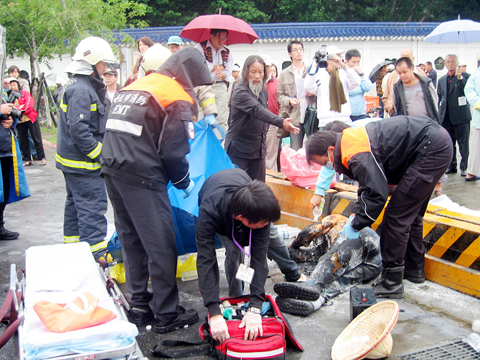
PHOTO: CNA
Their condemnation of the premier was removed from the blog for an unknown reason last night.
The students were referring to an interview with Liu aired on ETTV on Monday night.
In the interview, Liu said the students’ demands — that President Ma Ying-jeou (馬英九) and Liu apologize and that National Police Agency Director-General Wang Cho-chun (王卓鈞) and National Security Bureau Director-General Tsai Tsao-ming (蔡朝明) step down for what they called the use of “excessive force” by police last week — were not in line with mainstream public opinion.
The Chinese-language Liberty Times (the Taipei Times’ sister newspaper) reported yesterday that Liu had told ETTV anchorwoman Lu Hsiu-fang (盧秀芳) during a break in the interview that he had not even offered an apology when lawmakers urged him to do so in the legislature last week.
“Things like this will soon be over if [I] hang in there,” Liu was quoted as saying.
The students said this demanded an immediate apology from Liu.
Dubbing themselves the Wild Strawberry Student Movement, the students began a sit-in in front of the Executive Yuan last Thursday, arguing that the police resorted to excessive force against protesters opposing the visit of China’s Association for Relations Across the Taiwan Strait Chairman Chen Yunlin (陳雲林) last week.
They called on the government to amend the Assembly and Parade Law (集會遊行法) to lift the requirement forcing rally organizers to seek government approval before staging a demonstration.
The students reconvened their demonstration at Liberty Square at the National Taiwan Democracy Memorial Hall on Saturday after they were evicted by police on Friday night.
Different groups of students have held sit-ins in central and southern Taiwan in support of their Taipei counterparts since Sunday.
Some 500 academics also initiated a signature campaign on Monday in support of the students, demanding that the nation’s schools fully guarantee students’ freedom of speech.
The academics also urged the Ministry of Justice and the Control Yuan to launch an immediate probe into what they called the use of violence and human rights violations by police in their protection of Chen last week.
“We are furious about the Ma administration’s recent use of violence to limit people’s basic human rights in the name of protection [of Chen]. We believe freedom of speech and the rights to assemble and parade are the bottom line of Taiwan’s democracy and should not be compromised,” the academics’ joint statement said.
Meanwhile, an elderly man claiming to be a member of the Chinese Nationalist Party (KMT) set himself on fire around 1pm at Liberty Square yesterday.
The 80-year-old man left a note at the scene, claiming that he had been a KMT member since 1950 and saying he wanted to show his dissatisfaction with how the police mistreated pedestrians carrying the national flag last week.
He was rushed to the nearby National Taiwan University Hospital.
Doctors said he had suffered third-degree burns to 80 percent to 90 percent of his body and was being treated in the hospital’s intensive care unit.
President Ma Ying-jeou (馬英九) yesterday urged the public to fully discuss legal revisions to the Assembly and Parade Law before the legislation is amended.
Ma said it had been one of his campaign pledges to amend the law, and added that he agreed the law should be amended to allow protest organizers to report planned rallies to law enforcement authorities, rather than having to apply for permission from the police.
The two approaches were practically identical, as rally applications were almost never rejected, he said.
Ma said the students’ concern for public affairs and human rights deserved recognition.
As both the ruling and opposition parties supported amending the law, Ma said the public should have an open mind and strike a balance between civil liberty and public order.
To ensure adherence to the principles of democracy, Ma said, the public, including the students protesting at Liberty Square, should exhaustively discuss the issue and listen to different opinions before the law is amended.
He said he had faith in Taiwan’s democracy because democracy was not only the foundation of Taiwan’s political security, but also a pillar of economic development.
The legislature yesterday scheduled a review of proposed amendments to the Assembly and Parade Law for next Wednesday.
The legislature’s Procedure Committee decided that draft amendments from the KMT and Democratic Progressive Party (DPP) would be reviewed in a meeting of the Internal Administration Committee.
DPP Legislator Tsai Huang-liang (蔡煌瑯) said at the Procedure Committee meeting that the DPP caucus hoped the KMT caucus would not block its version.
KMT Legislator Wu Yu-sheng (吳育昇) said the KMT caucus supported amending the law, but opposed the DPP draft because it would allow protests at the Presidential Office, the Executive Yuan, the presidential residence, airports, important military facilities and embassies or offices of foreign countries.
Both parties’ draft amendments would eliminate the need to seek approval from law-enforcement authorities for public rallies.
Wu said the Internal Administration Committee would hold a public hearing on the amendment on Nov. 27, and would invite students to participate.
DPP caucus whip William Lai (賴清德) told reporters the DPP caucus had requested that the amendment be allowed to skip a preliminary review so that it could pass its third reading by Friday’s plenary session.
If the KMT caucus blocked such an arrangement, the caucus hoped that the amendments could pass a preliminary review next Wednesday and pass the third reading at the Nov. 28 plenary session, Lai said.
The Assembly and Parade Law, which took effect under the KMT administration in 1988, has come under fire from several rights groups over the years as an instrument used by the government to control the public and curb freedom of expression.

‘NO SECURITY RISK’: The Railway Bureau reassured the public that the technicians’ activities were limited to technical guidance and did not involve sensitive systems The Railway Bureau yesterday said it had invited eight Chinese technicians to assist with an airport MRT construction project. The bureau issued the confirmation after an Internet user said Chinese nationals had entered the construction zone of Taiwan Taoyuan International Airport’s Terminal 3 project. They asked why “individuals from an enemy state” were allowed access to such a major national infrastructure project, which raised serious concerns over Taiwan’s industrial safety, sensitive systems and information security. The bureau’s Northern Region Engineering Branch Office said subcontractor Taiwan Handle Industrial Co (台灣手把工業) of the Taoyuan airport MRT’s “Contract No. CU05 Project A14 Station Civil, MEP &

A US uncrewed surface vessel (USV) encountered multiple Chinese warships during an autonomous transit of the Taiwan Strait, US defense company Seasats said in a statement on Wednesday. Seasats announced that a Lightfish USV had completed the first autonomous transit of the Taiwan Strait. Over five days, the USV traversed the entire length of the Strait while constantly monitoring surface vessel traffic, the company said. The Lightfish encountered multiple Chinese warships, one of which was a Chinese People’s Liberation Army Navy (PLAN) Type 056 corvette, it said. The Chinese vessels were operating “well within Taiwan’s exclusive economic zone without transmitting their identity via the
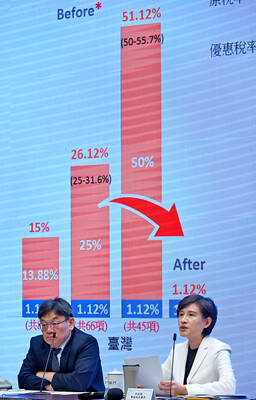
GREATER REACH? Auto parts and wood products would face tariffs of up to 15%, matching those targeting the EU, Japan and South Korea, Vice Premier said The US has announced that preferential tariff treatment for Taiwan’s non-semiconductor Section 232 goods would take effect retroactively from May 1, the Executive Yuan said yesterday. The US government yesterday posted a notice on the Federal Register’s public inspection Web site previewing tariff concessions for Taiwan under a memorandum of understanding (MOU) on Taiwan-US investment after two months of negotiations. The MOU signed on Jan. 15 stipulated three major preferential tariff arrangements: a 15 percent “reciprocal” tariff rate for Taiwan without stacking most-favored nation (MFN) rates; preferential Section 232 treatment for semiconductors and related products; and preferential Section 232 treatment for non-semiconductor

TIT-FOR-TAT: The US allegedly revoked the visa of a Chinese national working at Xinhua News Agency in the US in response to Beijing’s expulsion of Vivian Wang The Presidential Office yesterday condemned China for expelling a New York Times correspondent from Beijing following the newspaper’s interview with President William Lai (賴清德), saying the move highlighted Beijing’s suppression of press freedom and its threat to international news media. Taiwan has noted a series of recent incidents in which Beijing used similar tactics to “threaten and pressure international media outlets and journalists,” Presidential Office spokeswoman Karen Kuo (郭雅慧) said in a statement. “This concerns not only press freedom and freedom of expression, but also the safety of journalists, and Taiwan and relevant partners are paying close attention to the situation,” she


 RSS
RSS