


Warren Fox is a kung fu practitioner with a mission to save martial arts.
Fox, 29, said he began learning kung fu when he was four years old. His father wanted him and his two brothers to be able to protect themselves in an area of Cincinnati, Ohio, where racism was a problem, he said.
As they grew older, the situation got worse and the family moved to Seattle where there were more minorities and their race was no longer a problem.
Fox’s father was a barber and his mother delivered newspapers when he was little. The family did not have much money but he said they never knew they were poor, because their lives were full of laughter.
His father, a former boxing champion, started practicing martial arts after becoming friends with a Korean man who was into taekwondo. He then wanted his sons to learn the best way to protect themselves, Fox said.
At the beginning, Fox did not like kung fu.
“I thought kung fu was stressful, like homework,” he said. “[But] when we got older, when we had a choice, it was already something that we learned to love.”
Fox admits he got into quite a few fights when he was younger, saying he thought he was trying to protect himself and his honor: the honor of black people when people called him names.
“And then I realized that after a while, I was just protecting my pride,” he said. “Pride is a step away from arrogance.”
MATURE
Fox said as he matured, he realized there were many ways to resolve situations without actually having to get into a fight.
Later on, he became more of a protector, he said. When he was working as security, he was more concerned with people around him.
“I think it’s just like being a lifeguard, if someone is drowning, you want to get in there, you want to help them. And that’s the same way I feel about it now,” he said. “I don’t want to see anybody in front of me get hurt.”
He started practicing and teaching tianwudao (天武道) at high school and grew to love teaching it.
“I loved watching people change. I loved watching someone go from weak to getting strong and confident, especially children and women,” he said.
Fox went to Kunming, China, in 2001 as an exchange student and stayed there for six months. It was then the Chinese major began to learn the roots of baguazhang (八卦掌), or Eight Trigram Palm, a form of martial arts with an emphasis on internal power and hand movements.
He then came to Taiwan and met his master, Wu Guo-zheng (吳國正), who Fox said has selflessly shared his knowledge with his students.
For Fox, kung fu is a skill that takes a lifetime to perfect.
“As soon as you think you are doing something well, you keep practicing and you keep practicing, you realize, whoa, I just start doing it well today,” he said. “It’s an ongoing process, but that’s what makes it fun.”
He said that many people distanced themselves from kung fu because they felt it was something that they could not be a part of.
“But it’s something that everybody should know how to do, at least a little bit,” he said.
“Like swimming, everybody should know how to swim. You don’t have to be a professional swimmer and you may not live around water, but one day you might need swimming just to save your life,” Fox said.
And kung fu is the same: One day if something happens, you should be able to protect yourself,” he said.
Practicing kung fu benefits Fox in every aspect of his life, from mental to physical to staying motivated, he said.
“It’s not always fun to do kung fu,” he said. “There’re days you wake up, it’s raining outside and it’s so easy to say, today, no, I’m not going to do it. But before I finish that sentence, I say, get up, do it, you’ll feel better when it’s done.”
Kung fu has shown him how to make his dreams become reality, he said, and that’s why he is in Taiwan.
Likening his dream to kung fu novelist Jin Yong’s (金庸) Tian Long Ba Bu (天龍八部), or Demi-Gods and Semi-Devils, Fox said his dream is to take the culture and beauty of Taiwan and show people the real kung fu through films, fashion and music.
MASTER
He would like to become a kung fu master, make kung fu movies, have his own taekwondo academy and pass on the knowledge he has learned. He would also like to meet Jackie Chan (成龍) and Jet Li (李連杰), work for them and be able to truly combine East and West.
“It’s all related to kung fu, but it’s a lot of different dreams. It’s one dream with nine parts,” he said.
In addition to teaching English, Fox is musical, performing as an MC.
“No matter what your dream is, if you really want to support it, if you really want to be real about it, you have to find a regular job and you have to put it together,” he said.
“I think that the secret is working enough to have the time that you need to fulfill your dream,” Fox said.
While he began learning kung fu at four, Fox said he wants his children to start when they are three because he wants them to be better than him. And, of course, his future wife must do kung fu.
“In order for my wife to understand me, she has to do kung fu. Kung fu is 70 percent of my personality, so if she doesn’t do kung fu, she won’t really understand 70 percent of me,” he said. “Kung fu is so big that it’s not a man thing, it’s not a woman thing. It’s just a life thing.”

Right-wing political scientist Laura Fernandez on Sunday won Costa Rica’s presidential election by a landslide, after promising to crack down on rising violence linked to the cocaine trade. Fernandez’s nearest rival, economist Alvaro Ramos, conceded defeat as results showed the ruling party far exceeding the threshold of 40 percent needed to avoid a runoff. With 94 percent of polling stations counted, the political heir of outgoing Costa Rican President Rodrigo Chaves had captured 48.3 percent of the vote compared with Ramos’ 33.4 percent, the Supreme Electoral Tribunal said. As soon as the first results were announced, members of Fernandez’s Sovereign People’s Party

EMERGING FIELDS: The Chinese president said that the two countries would explore cooperation in green technology, the digital economy and artificial intelligence Chinese President Xi Jinping (習近平) yesterday called for an “equal and orderly multipolar world” in the face of “unilateral bullying,” in an apparent jab at the US. Xi was speaking during talks in Beijing with Uruguayan President Yamandu Orsi, the first South American leader to visit China since US special forces captured then-Venezuelan president Nicolas Maduro last month — an operation that Beijing condemned as a violation of sovereignty. Orsi follows a slew of leaders to have visited China seeking to boost ties with the world’s second-largest economy to hedge against US President Donald Trump’s increasingly unpredictable administration. “The international situation is fraught
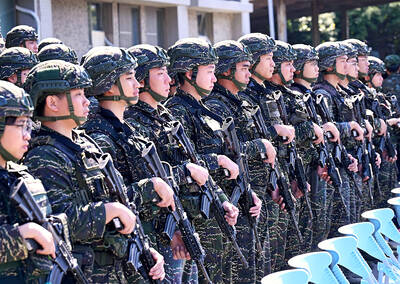
MORE RESPONSIBILITY: Draftees would be expected to fight alongside professional soldiers, likely requiring the transformation of some training brigades into combat units The armed forces are to start incorporating new conscripts into combined arms brigades this year to enhance combat readiness, the Executive Yuan’s latest policy report said. The new policy would affect Taiwanese men entering the military for their compulsory service, which was extended to one year under reforms by then-president Tsai Ing-wen (蔡英文) in 2022. The conscripts would be trained to operate machine guns, uncrewed aerial vehicles, anti-tank guided missile launchers and Stinger air defense systems, the report said, adding that the basic training would be lengthened to eight weeks. After basic training, conscripts would be sorted into infantry battalions that would take

GROWING AMBITIONS: The scale and tempo of the operations show that the Strait has become the core theater for China to expand its security interests, the report said Chinese military aircraft incursions around Taiwan have surged nearly 15-fold over the past five years, according to a report released yesterday by the Democratic Progressive Party’s (DPP) Department of China Affairs. Sorties in the Taiwan Strait were previously irregular, totaling 380 in 2020, but have since evolved into routine operations, the report showed. “This demonstrates that the Taiwan Strait has become both the starting point and testing ground for Beijing’s expansionist ambitions,” it said. Driven by military expansionism, China is systematically pursuing actions aimed at altering the regional “status quo,” the department said, adding that Taiwan represents the most critical link in China’s


 RSS
RSS