


Heavy rain brought by Typhoon Sinlaku pummeled the nation yesterday, causing injuries and disrupting traffic nationwide.
The National Disaster Protection and Prevention Commission reported yesterday that 17 people were injured and two were missing. More than 1,000 people were temporarily placed in shelters.
About 18,000 households were without electricity, while 800 households had no water.
The Council of Agriculture said agricultural damages had exceeded NT$114 million (US$3.57 million). As many as 200 rivers were listed as “alerts” for flooding.
All schools and businesses were expected to return to normal today, except for Jenai (仁愛), Hsinyi (信義) Kuohsing (國姓) and Yuchih (魚池) townships in Nantou County, Alishan Township (阿里山) in Chiayi County and Heping (和平) Township in Taichung County.
The Ministry of Transportation and Communications said that road sections on 13 provincial and county highway were damaged. Seventeen sections had been repaired as of 2pm yesterday, while six sections will not be fixed until next week.
Howfeng Bridge (后豐大橋), connecting Howli (后里) and Fengyuan (豐原) in Taichung County, collapsed yesterday, causing three cars to fall into the Dachia River and to be washed away.
Uni Air canceled all of its flights between Taipei and Matsu. Flights from both China Airlines and Mandarin Airlines were delayed.
The Taiwan Railway Administration canceled its service before 12pm but resumed services yesterday afternoon.
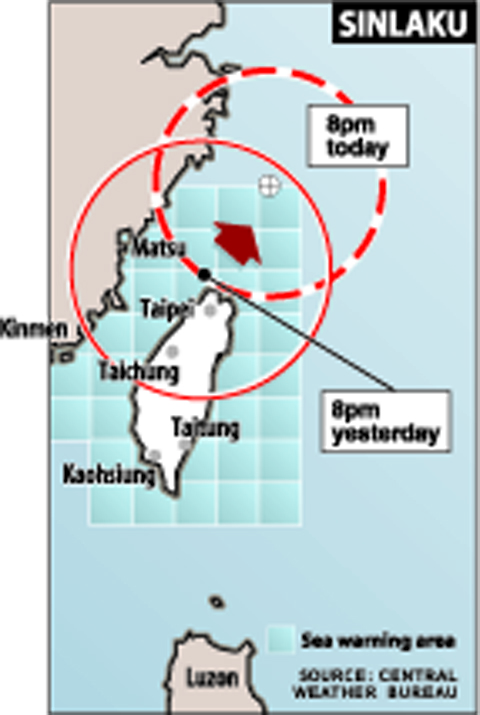
After lingering off the east coast for a day, Sinlaku finally made landfall at 1:50am in Ilan County yesterday.
Tsai Fu-dien (蔡甫甸), a section chief at the Central Weather Bureau, said the typhoon remained stationary from 2pm to 5pm, when it moved off the coast.
At 7pm, the center of Sinlaku was 40km northwest of Keelung. It was moving northeast at a speed of 7kph with a radius of 250km.
Foehn winds were reported in the Taitung County, which continued for at least 18 hours.
Shipanlong (石磐龍) in Chiayi County had experienced the biggest accumulation of rain as of press time, topping 1,158mm. It was followed by Taipingshan (太平山) in Ilan County and Niaotsuishan (鳥嘴山) in Hsinchu County, with 1,028mm and 1,011mm respectively. The bureau estimated that rain in Chiayi may have exceeded 1,500mm.
Tsai said that because the typhoon lingered off the north coast for more than six hours, the continuous interaction between the typhoon’s circumfluence and the landforms had caused the rainfall in the central and southern Taiwan to increase drastically.
Sinlaku was expected to leave the nation by this evening.
CHINA
Meanwhile, a typhoon warning was sounded by officials for China’s eastern coast, leading to the evacuation of about 170,000 people yesterday.
Chinese media said Sinlaku could pummel Fujian and Zhejiang provinces with strong winds and torrential rains.
In Fujian, more than 30,000 fishermen were called into port, and all schools have been ordered closed for the next two days.
Flood warnings were issued for Zhejiang where waves of up to 6m were expected.
Sinlaku was downgraded to a tropical storm at 8pm last night.

PROVOCATIVE: Chinese Deputy Ambassador to the UN Sun Lei accused Japan of sending military vessels to deliberately provoke tensions in the Taiwan Strait China denounced remarks by Japan and the EU about the South China Sea at a UN Security Council meeting on Monday, and accused Tokyo of provocative behavior in the Taiwan Strait and planning military expansion. Ayano Kunimitsu, a Japanese vice foreign minister, told the Council meeting on maritime security that Tokyo was seriously concerned about the situation in the East China and South China seas, and reiterated Japan’s opposition to any attempt to change the “status quo” by force, and obstruction of freedom of navigation and overflight. Stavros Lambrinidis, head of the EU delegation to the UN, also highlighted South China Sea
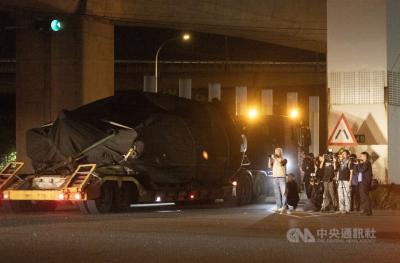
The final batch of 28 M1A2T Abrams tanks purchased from the US arrived at Taipei Port last night and were transported to the Armor Training Command in Hsinchu County’s Hukou Township (湖口), completing the military’s multi-year procurement of 108 of the tanks. Starting at 12:10am today, reporters observed more than a dozen civilian flatbed trailers departing from Taipei Port, each carrying an M1A2T tank covered with black waterproof tarps. Escorted by military vehicles, the convoy traveled via the West Coast Expressway to the Armor Training Command, with police implementing traffic control. The army operates about 1,000 tanks, including CM-11 Brave Tiger

Taiwan Semiconductor Manufacturing Co (TSMC, 台積電), the world’s largest contract chipmaker, said it expects its 2-nanometer (2nm) chip capacity to grow at a compound annual rate of 70 percent from this year to 2028. The projection comes as five fabs begin volume production of 2-nanometer chips this year — two in Hsinchu and three in Kaohsiung — TSMC senior vice president and deputy cochief operating officer Cliff Hou (侯永清) said at the company’s annual technology symposium in Silicon Valley, California, last week. Output in the first year of 2-nanometer production, which began in the fourth quarter of last year, is expected to

Taiwan’s drone exports surged past US$100 million in the first quarter, exceeding last year’s full-year total, with the Czech Republic emerging as the largest buyer, the Ministry of Economic Affairs said. Exports of complete drones reached US$115.85 million in the period, about 1.2 times the total recorded for all of last year, the ministry said in a report. Exports to the Czech Republic accounted for about US$100 million, far outpacing other markets. Poland, last year’s top destination, recorded about US$11.75 million in the first quarter. Taiwan’s drone exports have expanded rapidly in the past few years, with last year’s total


 RSS
RSS