


Chinese courts jailed 12 more rioters for their roles in unrest in Tibet, state media said, weeks before the Beijing Olympics and after Beijing deported a Tibetan British woman it accused of anti-government activism earlier this week.
China’s Xinhua news agency said late on Thursday that to date the country has convicted 42 people for their role in the riots while another 116 await trial.
Some 953 people were detained by the police, Xinhua said, quoting Palma Trily, the No. 1 vice chairman of the Tibet Autonomous Region government.
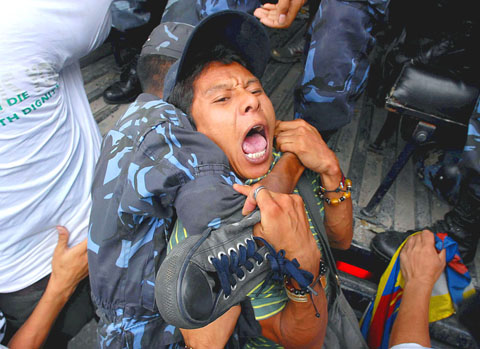
PHOTO: EPA
He did not give details on the length of the latest 12 sentences handed down on June 19 and June 20 but said neither these rioters nor 30 people convicted earlier had received death sentences.
“But whether or not the death penalty will be applied for suspects still being investigated has to be determined based on Chinese laws,” Palma Trily was quoted as saying.
Meanwhile, China is offering rewards of up to 500,000 yuan (US$73,000) to anyone who provides information on major security threats during the Olympic Games, state media reported yesterday.
The rewards aim to “mobilize the enthusiasm of the masses in maintaining public security, as well as to control and eliminate hidden dangers to the Olympic Games,” Xinhua news agency said, citing Beijing authorities.
The move, part of an increasingly strict security drive in China’s capital ahead of the Games next month, urged residents in the city to report information on major threats until Oct. 31, Xinhua said.
They would be given between 10,000 yuan and 500,000 yuan for credible tips, the notice said.
Examples of what police are looking for included information on terrorist attacks, sabotage by illegal organizations such as the Falun Gong and plots to attack Olympic-related people and foreigners, Xinhua reported.
The announcement comes a day after China claimed it faced a serious threat of terrorism in the Xinjiang autonomous region ahead of the Olympics.
Authorities said 82 suspected “terrorists” had been detained and five organizations that had been planning to attack the Games had been cracked there this year.
Human rights groups and other critics say the government has fabricated or exaggerated the terrorist threat as an excuse to crush all forms of dissent before the showpiece event.

A signaling system malfunction disrupted high-speed rail (HSR) services beginning at 8am today, with trains temporarily reduced to three northbound and three southbound trains per hour as authorities conduct inspections. The malfunction occurred on a section of track in Miaoli County during pre-operation checks early this morning, forcing northbound and southbound trains to use a single track, the HSR operator said. The regular schedule has been replaced with three hourly trains offering only nonreserved seating in each direction, stopping at every station, it said, adding that business class cars would still have reserved seating. Departures from terminal stations are scheduled at the top

Taiwan is still in the process of assessing the possibility of recruiting workers from Eswatini, the Ministry of Foreign Affairs said yesterday, adding that its goal is to help Eswatini upgrade its vocational training centers. If there are plans to recruit workers from Eswatini, safeguarding national security, protecting public health and ensuring the employment rights of Taiwanese would be prerequisites, Department of West Asian and African Affairs Director-General Yen Chia-liang (顏嘉良) told a news conference. Key considerations would also include filling labor shortages in specific industries, and fostering bilateral professional and technical exchanges, he said. Yen was asked about the progress of labor

VERBOSE VESSELS: A CGA cutter and a China Coast Guard exchanged verbal barbs for more than a day in Taiwanese-controlled waters before the Chinese vessel left The Taiwanese and Chinese coast guards had a standoff near the strategically located Pratas Islands (Dongsha Islands, 東沙群島) in the north of the South China Sea, the Coast Guard Administration (CGA) said yesterday. The two sides engaged in intense radio exchanges over sovereignty claims during the 33-hour standoff. China Coast Guard vessel 3501 eventually left the restricted waters, 26.6 nautical miles (49.2km) west of the Pratas Islands, at 5pm yesterday, the CGA said. Lying approximately between southern Taiwan and Hong Kong, the Taiwan-controlled Pratas are seen by some security experts as vulnerable to Chinese attack due to their distance — more than
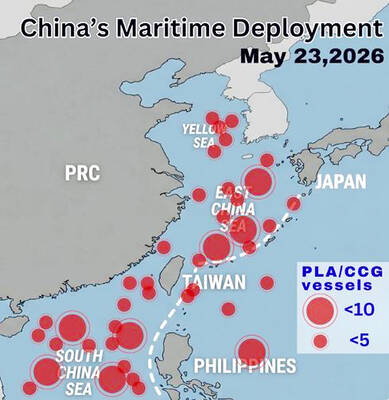
WARNING: China should stop engaging in actions that undermine regional peace and stability, as it would only build resentment among people across the Strait, the CGA said China has deployed more than 100 navy, coast guard and other vessels in waters from the Yellow Sea to the South China Sea and the western Pacific since US President Donald Trump and Chinese President Xi Jinping (習近平) met in Beijing, National Security Council Secretary-General Joseph Wu (吳釗燮) said yesterday. “In this part of the world, #China is the one & only PROBLEM wrecking the #StatusQuo & threatening regional peace & stability,” Wu wrote on X. In a separate post, he said Beijing was coercing Taiwan’s maritime domain, calling it illegal and provocative, after the Coast Guard Administration (CGA) expelled a


 RSS
RSS