


Residents of the rocket-scarred southern Israeli town of Sderot enjoyed a bright summer day made brighter still by the silence of the public air-raid system yesterday, the first day of a truce between Israel and Islamic militants across the border in the Gaza Strip.
In Gaza, the promise of a lull in Israeli air and artillery strikes emboldened youngsters on bicycles to ride closer than usual to the border fence. Militants often launch rockets and mortar shells from the area, drawing Israeli fire in response.
“It’s peace today,” said Osama Helas, a 16-year-old Palestinian, as he rode along the Gaza side with two friends. “This is the first time that there is no sound of shelling or shooting. I hope that we will be able to enjoy our lives like this every day.”
The truce — meant to last six months — took effect early yesterday between Israel and Hamas, which rules the Gaza Strip.
The ceasefire, which Egypt labored for months to conclude, obliges Hamas to halt attacks from its territory and says Israel must cease its raids. If the quiet holds, Israel will ease its blockade of Gaza on Sunday to allow the shipment of some supplies to resume. A week later Israel is to further ease restrictions at cargo crossings.
Sderot, less than 1.5km from the Gaza frontier, has borne the brunt of Palestinian attacks over the past seven years, during which rocket and mortar fire has killed 13 people, wounded dozens more, caused millions of dollars in damage and made daily life unbearable. More than 1,000 projectiles have exploded in the town of around 20,000 people over the past year alone.
Yesterday morning, one local man who did not give his name, showed reporters his brand new car, hit by a mortar shell the day before as it stood outside his house. With only 100km on the clock, its windows were blown out and the bodywork gouged and ripped by shrapnel. The house and its occupants were unscathed.
Another resident, Motti Lishar, said he was confident that Hamas, which rules Gaza with an iron hand, would keep militants in line.
“I believe that there will be quiet for the next six months, because anyone who tries to fire will get his hand chopped off,” he said. “When Hamas makes a promise, they keep it.”
Dropping his granddaughter at a neighborhood kindergarten, Eliezer Ashurov said he hoped for the best, but feared the worst.
“If there is a chance of a ceasefire then that is always a good thing, a truce is always the right thing,” he said. “But it needs to stand the test of time, time will tell.”
Across the border in Gaza, civilians have also paid dearly for the Israeli-Palestinian conflict, with women, children and the elderly repeatedly caught in crossfire or killed in Israeli strikes aimed at nearby militant targets.
Six-year-old Hadeel al-Smari was killed last week by a missile fired from an Israeli aircraft in the southern Gaza Strip.
Her cousin Ahmad, 38, said the collapse of past ceasefires left him with little confidence in the latest attempt.
“I don’t know how long this calm will last and how many hours, days we will have without shootings, shelling and tanks coming in and out,” he said.
“We want a real end to all violence, to feel like we are human, to sleep without fear and to farm without fear, to eat, drink, study, travel. I don’t think that Israel is ready to give that to us now,” he said.
Also See: Angry Palestinians accuse Israel of more confiscations
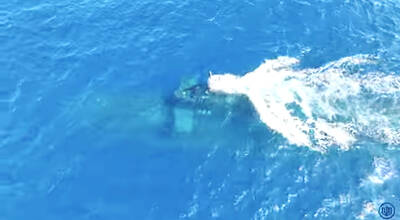
CSBC Corp, Taiwan (台灣國際造船) yesterday released the first video documenting the submerged sea trials of Taiwan’s indigenous defense submarine prototype, the Hai Kun (海鯤), or Narwhal, showing underwater navigation and the launch of countermeasures. The footage shows the vessel’s first dive, steering and control system tests, and the raising and lowering of the periscope and antenna masts. It offered a rare look at the progress in the submarine’s sea acceptance tests. The Hai Kun carried out its first shallow-water diving trial late last month and has since completed four submerged tests, CSBC said. The newly released video compiles images recorded from Jan. 29 to
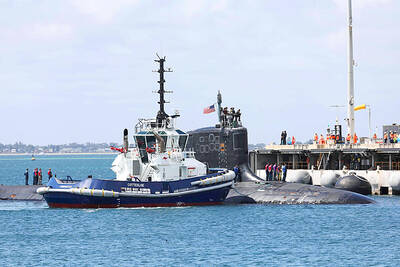
DETERRENCE EFFORTS: Washington and partners hope demonstrations of force would convince Beijing that military action against Taiwan would carry high costs The US is considering using HMAS Stirling in Western Australia as a forward base to strengthen its naval posture in a potential conflict with China, particularly over Taiwan, the Wall Street Journal reported on Saturday. As part of its Indo-Pacific strategy, Washington plans to deploy up to four nuclear-powered submarines at Stirling starting in 2027, providing a base near potential hot spots such as Taiwan and the South China Sea. The move also aims to enhance military integration with Pacific allies under the Australia-UK-US trilateral security partnership, the report said. Currently, US submarines operate from Guam, but the island could

RESTRAINTS: Should China’s actions pose any threat to Taiwan’s security, economic or social systems, China would be excluded from major financial institutions, the bill says The US House of Representatives on Monday passed the PROTECT Taiwan Act, which states that Washington would exclude China from participating in major global financial organizations if its actions directly threaten Taiwan’s security. The bill, proposed by Republican Representative Frank Lucas, passed with 395 votes in favor and two against. It stipulates that if China’s actions pose any threat to Taiwan’s security, economic or social systems, the US would, “to the maximum extent practicable,” exclude Beijing from international financial institutions, including the G20, the Bank for International Settlements and the Financial Stability Board. The bill makes it clear that China must be prepared

Taiwanese trade negotiators told Washington that Taipei would not relocate 40 percent of its semiconductor production to the US, and that its most advanced technologies would remain in the nation, Vice Premier Cheng Li-chiun (鄭麗君) said on Sunday. “I told the US side very clearly — that’s impossible,” Cheng, who led the negotiation team, said in an interview that aired on Sunday night on Chinese Television System. Cheng was referring to remarks last month by US Secretary of Commerce Howard Lutnick, in which he said his goal was to bring 40 percent of Taiwan’s chip supply chain to the US Taiwan’s almost


 RSS
RSS