


China declared an end yesterday to the crisis over a brimming lake formed by a massive earthquake that had threatened to flood downstream communities.
Sichuan Province's top official, Liu Qibao (劉奇葆), claimed a “decisive victory” after water flowed from Tangjiashan lake and its level dropped rapidly, Xinhua news agency said.
Liu is Chinese Communist Party chief of the southwestern province that was hardest-hit by the May 12 quake that has killed almost 70,000 people.
Towns downstream had been placed on alert for possible flooding in case of an uncontrolled breaching of the lakes unstable banks.
However, Xinhua said more than half of the 250 million cubic meters of water in the lake had been drained off by 5pm, establishing a balance between inflow and outflow and easing pressure on the dam.
State broadcaster CCTV showed water flowing quickly out of Tangjiashan lake, flooding low-lying areas of the devastated town of Beichuan just downstream. Residents in the area were previously evacuated and others along the river were preparing to leave if waters rose too high, CCTV said.
Flood waters seeped into riverside houses in the largely evacuated town of Qinglian, a resident said.
“Everybody feels lucky that it didn’t submerge the streets and the neighborhood,” Wu Zhenxing said.
In the city of Mianyang, where residents had been practicing evacuation drills, the Fujiang river flowed high and swifly under a key railway bridge, but stayed within its course.
For days, troops have been using dynamite and anti-tank weapons to blast boulders and other obstacles in a man-made diversion canal, trying to speed the flow of water and relieve pressure on the lake’s unstable mud and rock banks.
More than 250,000 people downstream had already moved to high ground over concerns that the barrier holding back the lake could break apart. A total of about 1.3 million people live in the downstream area.
Xinhua said trees, barrels, TV sets, refrigerators “and the occasional dead bodies of quake victims” were seen in waters pouring out of the mountains.
Also yesterday, state media said searchers have discovered the wreckage of an air force helicopter that crashed in deep mountains in the southwest while ferrying people injured in last month’s quake.
The remains of the five-person crew and 14 quake victims were found at the crash site near the town of Yingxiu, Xinhua said. It said the wreckage was spread over a wide area of deep vegetation.
The Russian-designed Mi-171 crashed on May 31 near the epicenter of the quake in Wenchuan, after flying into fog and turbulence.
Meanwhile, staff at Wolong, the world’s most famous panda reserve, buried a nine-year-old female panda that was killed in a landslide triggered by the quake.
Another Wolong panda, Xiao Xiao, has been missing since the quake. Forty-seven other pandas still live at Wolong, while others have been moved to Chengdu and Beijing.
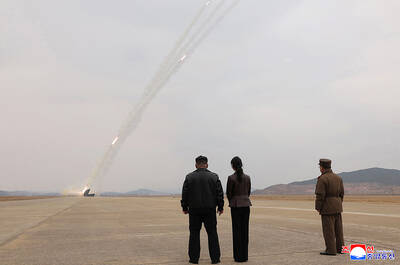
North Korea tested nuclear-capable rocket launchers, state media reported yesterday, a day after Seoul detected the launch of about 10 ballistic missiles. The test comes after South Korean and US forces launched their springtime military drills, due to run until Thursday. North Korean leader Kim Jong-un on Saturday oversaw the testing of the multiple rocket launcher system (MRLS), the Korean Central News Agency (KCNA) said. The test involved 12 600mm-caliber ultra-precision multiple rocket launchers and two artillery companies, it said. Kim said the drill gave Pyongyang’s enemies, within the 420km striking range, a sense of “uneasiness” and “a deep understanding
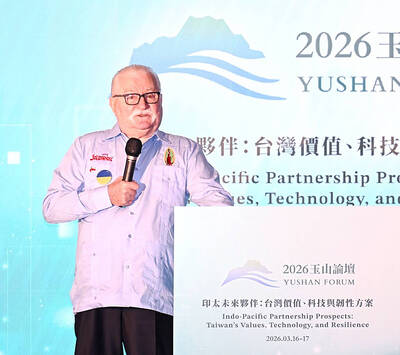
RECOGNITION: Former Fijian prime minister Mahendra Chaudhry said that Taiwan’s New Southbound Policy serves as a stabilizing force in the Indo-Pacific region Taiwan can lead the unification of the Chinese people, Nobel Peace Prize laureate and former Polish president Lech Walesa said in Taipei yesterday, adding that as the world order is changing, peaceful discussion would find good solutions, and that the use of force and coercion would always fail. Walesa made the remarks during his keynote address at a luncheon of the Yushan Forum in Taipei, titled “Indo-Pacific Partnership Prospects: Taiwan’s Values, Technology and Resilience,” organized by the Taiwan-Asia Exchange Foundation with the Ministry of Foreign Affairs. Walesa said that he had been at the forefront of a big peaceful revolution and “if

North Korea yesterday fired about 10 ballistic missiles to the sea toward Japan, the South Korean Joint Chiefs of Staff (JCS) said, days after Pyongyang warned of “terrible consequences” over ongoing South Korea-US military drills. Pyongyang recently dashed hopes of a diplomatic thaw with Seoul, Washington’s security ally, describing its latest peace efforts as a “clumsy, deceptive farce.” Seoul’s military detected “around 10 ballistic missiles launched from the Sunan area in North Korea toward the East Sea [Sea of Japan] at around 1:20pm,” JCS said in a statement, referring to South Korea’s name for the body of water. The missiles

‘UNWAVERING FRIENDSHIP’: A representative of a Japanese group that co-organized a memorial, said he hopes Japanese never forget Taiwan’s kindness President William Lai (賴清德) yesterday marked the 15th anniversary of the Tohoku earthquake and tsunami, urging continued cooperation between Taiwan and Japan on disaster prevention and humanitarian assistance. Lai wrote on social media that Taiwan and Japan have always helped each other in the aftermath of major disasters. The magnitude 9 earthquake struck northeastern Japan on March 11, 2011, triggering a massive tsunami that claimed more than 19,000 lives, according to data from Japanese authorities. Following the disaster, Taiwan donated more than US$240 million in aid, making it one of the largest contributors of financial assistance to Japan. In addition to cash donations and


 RSS
RSS