


A man went on a stabbing spree yesterday in a Tokyo neighborhood famed for comic-book subculture, killing at least seven people and leaving around a dozen injured in Japan’s deadliest crime in years.
The assailant, who later told police he was “tired of living,” drove a truck into a crowd of pedestrians shortly after noon in Tokyo’s bustling Akihabara area before jumping out and stabbing strangers while screaming.
The assailant was identified as Tomohiro Kato, 25, from central Shizuoka Prefecture. He first said he was a gangster before retracting his story.
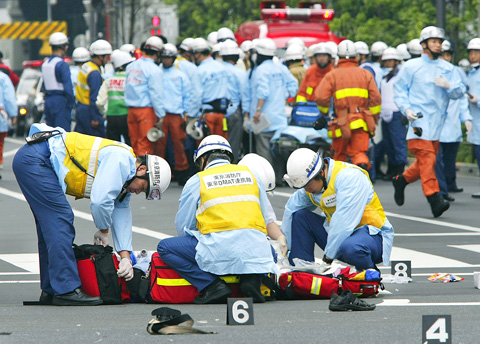
PHOTO: AP
“I came to Akihabara to kill people. It didn’t matter whom I’d kill,” he was quoted by Jiji Press as telling police.
Kato, bespectacled in a beige suit and black-and-white sneakers, was armed with a survival knife and dueled with a police officer who fought back with a baton.
By the time Kato finally dropped his knife with an officer’s gun pointed at him, 17 people lay bloodied on the street of the crowded district, fire department and police officials said.
Kato had blood running down the side of his face as he was taken into custody.
Jiji Press and other Japanese media said seven people were dead — six men aged 19, 20, 29, 33, 47 and 74, and a 21-year-old woman.
The attack fell on the anniversary of the last incident of similar magnitude — a stabbing frenzy that left eight children dead at a Japanese elementary school in 2001.
Ambulances with sirens blaring raced to the scene, where Kato’s rented white Isuzu truck was abandoned with a shattered windshield on streets that were closed to traffic on a balmy yesterday afternoon.
Hundreds of stunned pedestrians stared from a distance as medical workers set up green plastic sheets in the middle of an intersection to ensure privacy as they gave emergency treatment.
“I was shocked to hear the news as I’ve visited this place quite often,” said Wataru Amano, a 26-year-old truck driver who often visits Akihabara. “I could have been a target if I had been here a few hours ago.”
“I’m afraid this will give a negative image of Akihabara, where people are coming from around the world,” he said.
Akihabara is best known for major electronics stores and in recent years has mushroomed into a haven for Japanese subculture, pulling in tourists from home and abroad interested in comic books and video games.
Akihabara’s attractions range from a museum of Japanese animation to cafes where waitresses dress as maids and videogame characters. It is also a major commuter hub.
“When I passed by, I saw a man collapsed on the street. He was stabbed in the chest and bleeding badly,” one young woman said. “He was unconscious.”
It was seven years to the day since a mentally disturbed man went on a rampage with a butcher’s knife at the Ikeda elementary school in the posh suburbs of Osaka.
Mamoru Takuma, who had an apparent grudge against children of the elites, stabbed to death eight youngsters.
At Takuma’s sentencing, the judge called the killings “one of the most heinous cases in Japan’s criminal history.”
Takuma was executed in 2004 at the age of 40.
The elementary school attack stunned Japan, which prides itself on its safety and authorities moved to step up security at schools.
In another knifing spree, a man in 1999 drove into the main train station in the southwestern city of Shimonoseki and stabbed to death five people.

The nation’s fastest supercomputer, Nano 4 (晶創26), is scheduled to be launched in the third quarter, and would be used to train large language models in finance and national defense sectors, the National Center for High-Performance Computing (NCHC) said. The supercomputer, which would operate at about 86.05 petaflops, is being tested at a new cloud computing center in the Southern Taiwan Science Park in Tainan. The exterior of the server cabinet features chip circuitry patterns overlaid with a map of Taiwan, highlighting the nation’s central position in the semiconductor industry. The center also houses Taiwania 2, Taiwania 3, Forerunner 1 and
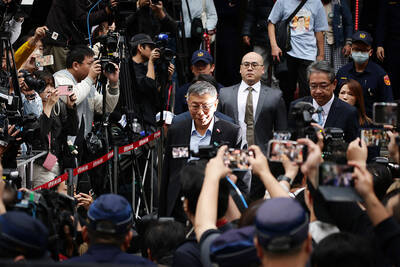
FIRST TRIAL: Ko’s lawyers sought reduced bail and other concessions, as did other defendants, but the bail judge denied their requests, citing the severity of the sentences Former Taipei mayor Ko Wen-je (柯文哲) was yesterday sentenced to 17 years in prison and had his civil rights suspended for six years over corruption, embezzlement and other charges. Taipei prosecutors in December last year asked the Taipei District Court for a combined 28-year, six-month sentence for the four cases against Ko, who founded the Taiwan People’s Party (TPP). The cases were linked to the Core Pacific City (京華城購物中心) redevelopment project and the mismanagement of political donations. Other defendants convicted on separate charges included Chinese Nationalist Party (KMT) Taipei City Councilor Angela Ying (應曉薇), who was handed a 15-year, six-month sentence; Core Pacific

J-6 REMODEL: The converted drones are part of Beijing’s expanding mix of airpower weapons, including bombers with stand-off missiles and UAV swarms, the report said China has stationed obsolete supersonic fighters converted to attack drones at six air bases close to the Taiwan Strait, a report published this month by the Arlington, Virginia-based Mitchell Institute for Aerospace Studies said. Satellite imagery of the airfields from the institute’s “China Airpower Tracker” shows what appear to be lines of stubby, swept-winged aircraft matching the shape of J-6 fighters that first flew with the Chinese People’s Liberation Army (PLA) Air Force in the 1960s. Since their conversion to drones, the aircraft have been identified at five bases in China’s Fujian Province and one in Guangdong Province, the report said. J.

China used fake LinkedIn profiles to harvest sensitive data from NATO and EU institutions by soliciting information from staff, a European security source said on Friday. The operation, allegedly orchestrated by the Chinese Ministry of State Security, targeted dozens of employees at the military alliance or EU organizations through fictitious accounts, the source said, confirming reports in French and Belgian media. Posing as recruiters on the online professional networking platform, Chinese spies would initially request paid reports before later soliciting non-public or even classified information. One particularly active fake profile used the name “Kevin Zhang,” claiming to be the head


 RSS
RSS