


Zimbabwean police detained opposition chief Morgan Tsvangirai for the second time in three days yesterday, as aid agencies expressed outrage at a ban on them working in the stricken country.
Armed officers escorted Tsvangirai to a police station after he ignored orders not to campaign ahead of a presidential runoff, his party’s chairman said.
“We have been instructed to go back to Esigodini police station,” Movement for Democratic Change (MDC) party Chairman Lovemore Moyo said by telephone while traveling with Tsvangirai to the station.
“The police are saying they had told us initially not to proceed as they are saying all the rallies have been canceled,” he said.
At least two police armed with AK rifles escorted Tsvangirai and his entourage to the station, Moyo and witnesses said.
The opposition leader’s latest run-in with authorities came as Mugabe’s government said aid groups would only be allowed to resume operations if they pledged not to interfere in politics.
The government has accused them of openly siding with the opposition in the build-up to the ballot. It also follows a confrontation between police and US and British diplomats at a roadblock on Thursday.
The authorities accused the diplomats, whose detention triggered a furious response from Washington and London, of behaving like “common criminals” by refusing to cooperate with police.
In a country beset by food shortages, aid agencies now play a major role in supplying and distributing staples such as maize and cooking oil.
Relations between Western charities and the Mugabe regime have long been strained, with the government previously forcing aid groups to channel their efforts through local officials.
However, the order to cease all field work marks a dramatic downturn in the relationship.
“As we speak there are no NGOs. All NGOs have been asked to reapply for registration,” Zimbabwean Deputy Information Minister Bright Matonga said.
“They were involved in political activities and behaving like political parties when they were supposed to complement government efforts,” he said.

Right-wing political scientist Laura Fernandez on Sunday won Costa Rica’s presidential election by a landslide, after promising to crack down on rising violence linked to the cocaine trade. Fernandez’s nearest rival, economist Alvaro Ramos, conceded defeat as results showed the ruling party far exceeding the threshold of 40 percent needed to avoid a runoff. With 94 percent of polling stations counted, the political heir of outgoing Costa Rican President Rodrigo Chaves had captured 48.3 percent of the vote compared with Ramos’ 33.4 percent, the Supreme Electoral Tribunal said. As soon as the first results were announced, members of Fernandez’s Sovereign People’s Party
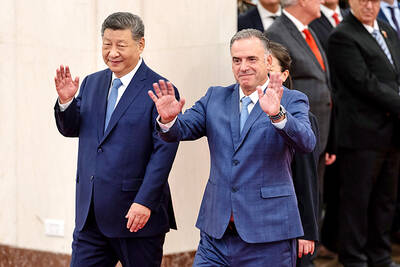
EMERGING FIELDS: The Chinese president said that the two countries would explore cooperation in green technology, the digital economy and artificial intelligence Chinese President Xi Jinping (習近平) yesterday called for an “equal and orderly multipolar world” in the face of “unilateral bullying,” in an apparent jab at the US. Xi was speaking during talks in Beijing with Uruguayan President Yamandu Orsi, the first South American leader to visit China since US special forces captured then-Venezuelan president Nicolas Maduro last month — an operation that Beijing condemned as a violation of sovereignty. Orsi follows a slew of leaders to have visited China seeking to boost ties with the world’s second-largest economy to hedge against US President Donald Trump’s increasingly unpredictable administration. “The international situation is fraught
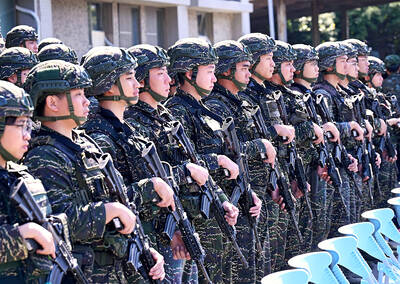
MORE RESPONSIBILITY: Draftees would be expected to fight alongside professional soldiers, likely requiring the transformation of some training brigades into combat units The armed forces are to start incorporating new conscripts into combined arms brigades this year to enhance combat readiness, the Executive Yuan’s latest policy report said. The new policy would affect Taiwanese men entering the military for their compulsory service, which was extended to one year under reforms by then-president Tsai Ing-wen (蔡英文) in 2022. The conscripts would be trained to operate machine guns, uncrewed aerial vehicles, anti-tank guided missile launchers and Stinger air defense systems, the report said, adding that the basic training would be lengthened to eight weeks. After basic training, conscripts would be sorted into infantry battalions that would take
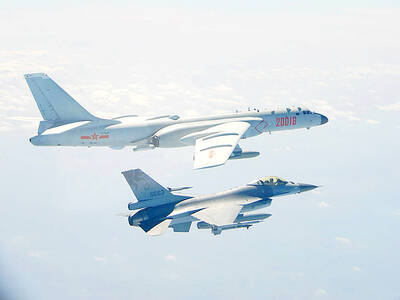
GROWING AMBITIONS: The scale and tempo of the operations show that the Strait has become the core theater for China to expand its security interests, the report said Chinese military aircraft incursions around Taiwan have surged nearly 15-fold over the past five years, according to a report released yesterday by the Democratic Progressive Party’s (DPP) Department of China Affairs. Sorties in the Taiwan Strait were previously irregular, totaling 380 in 2020, but have since evolved into routine operations, the report showed. “This demonstrates that the Taiwan Strait has become both the starting point and testing ground for Beijing’s expansionist ambitions,” it said. Driven by military expansionism, China is systematically pursuing actions aimed at altering the regional “status quo,” the department said, adding that Taiwan represents the most critical link in China’s


 RSS
RSS