


Radical Iraqi Shiite cleric Moqtada al-Sadr yesterday threatened a countrywide campaign of civil revolt as security forces battled his militiamen in the southern city of Basra.
Fighting raged in areas of Basra controlled by Sadr's Mehdi Army from early morning as troops and police launched a major crackdown on armed groups in the oil hub, considered the nerve center of Iraq's national economy.
At least four people were killed and 18 wounded in the clashes, police Major Abbas Youssef said.
Sadr, in a statement read by his representative Hazam al-Aaraji in the holy city of Najaf, said he would launch protests and a nationwide strike if attacks against members of his movement are not halted.
"If the government does not respect these demands, the second step will be general civil disobedience in Baghdad and the Iraqi provinces," the statement said.
The cleric in August ordered his militia to observe a ceasefire following bloody fighting in the shrine city of Karbala blamed on his fighters.
While Iraqi and US officials say most members of the militia have heeded the order, a number of what the US military terms "rogue elements" continue to attack US forces with mortars, rockets and roadside bombs.
British military officials said Iraqi Prime Minister Nouri al-Maliki was in Basra to personally oversee the major security force sweep.
Fighting involving mortars, machine guns and assault weapons erupted soon after the security forces entered the Al-Tamiyah neighborhood, a bastion of Sadr's Mehdi Army, at about 5am. The fighting quickly spread to five other Mehdi Army neighborhoods.
Witnesses said the streets were empty aside from the security forces, emergency vehicles and people in cars fleeing the fighting. Shops and markets were closed.
In the wake of the fighting police also imposed curfews in three other southern Shiite cities -- Kut, Samawa and Nasiriyah -- as precautionary measures.
Liwa Sumaysim, head of Sadr's political bureau in Najaf, denounced the bloodletting.
"We do not want the situation as it is in Basra. We are against bloodshed, especially in this critical period of time," Sumaysim said. "The Sadr movement is being targeted in Basra, that is why this tension has been created. The Iraqi government forces should not use force against poor people."
After touring Basra on Monday, Maliki vowed his government would restore order, saying the city was experiencing a "brutal campaign" by internal and external groups targeting members of the scientific and religious communities "and other innocent men and women."
"This is accompanied by the smuggling of oil, weapons and drugs. The outlaws are finding support from within the state and outside. This is why Basra has become a city where civilians cannot even secure their lives and property," Maliki said in a statement.
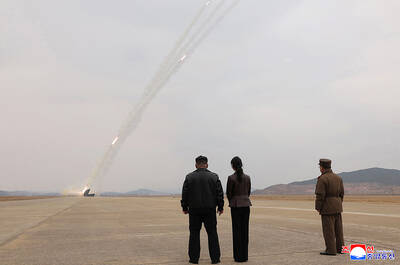
North Korea tested nuclear-capable rocket launchers, state media reported yesterday, a day after Seoul detected the launch of about 10 ballistic missiles. The test comes after South Korean and US forces launched their springtime military drills, due to run until Thursday. North Korean leader Kim Jong-un on Saturday oversaw the testing of the multiple rocket launcher system (MRLS), the Korean Central News Agency (KCNA) said. The test involved 12 600mm-caliber ultra-precision multiple rocket launchers and two artillery companies, it said. Kim said the drill gave Pyongyang’s enemies, within the 420km striking range, a sense of “uneasiness” and “a deep understanding

RECOGNITION: Former Fijian prime minister Mahendra Chaudhry said that Taiwan’s New Southbound Policy serves as a stabilizing force in the Indo-Pacific region Taiwan can lead the unification of the Chinese people, Nobel Peace Prize laureate and former Polish president Lech Walesa said in Taipei yesterday, adding that as the world order is changing, peaceful discussion would find good solutions, and that the use of force and coercion would always fail. Walesa made the remarks during his keynote address at a luncheon of the Yushan Forum in Taipei, titled “Indo-Pacific Partnership Prospects: Taiwan’s Values, Technology and Resilience,” organized by the Taiwan-Asia Exchange Foundation with the Ministry of Foreign Affairs. Walesa said that he had been at the forefront of a big peaceful revolution and “if

North Korea yesterday fired about 10 ballistic missiles to the sea toward Japan, the South Korean Joint Chiefs of Staff (JCS) said, days after Pyongyang warned of “terrible consequences” over ongoing South Korea-US military drills. Pyongyang recently dashed hopes of a diplomatic thaw with Seoul, Washington’s security ally, describing its latest peace efforts as a “clumsy, deceptive farce.” Seoul’s military detected “around 10 ballistic missiles launched from the Sunan area in North Korea toward the East Sea [Sea of Japan] at around 1:20pm,” JCS said in a statement, referring to South Korea’s name for the body of water. The missiles

‘UNWAVERING FRIENDSHIP’: A representative of a Japanese group that co-organized a memorial, said he hopes Japanese never forget Taiwan’s kindness President William Lai (賴清德) yesterday marked the 15th anniversary of the Tohoku earthquake and tsunami, urging continued cooperation between Taiwan and Japan on disaster prevention and humanitarian assistance. Lai wrote on social media that Taiwan and Japan have always helped each other in the aftermath of major disasters. The magnitude 9 earthquake struck northeastern Japan on March 11, 2011, triggering a massive tsunami that claimed more than 19,000 lives, according to data from Japanese authorities. Following the disaster, Taiwan donated more than US$240 million in aid, making it one of the largest contributors of financial assistance to Japan. In addition to cash donations and


 RSS
RSS