


US Secretary of State Condoleezza Rice and British Foreign Secretary David Miliband arrived in Afghan-istan yesterday in a symbolic show of unity, pressing reluctant NATO allies to share the combat burden.
"Frankly, I hope there will be more troop contributions and there needs to be more Afghan forces," Rice told reporters traveling with her on the flight from London.
Rice, speaking against the backdrop of a NATO defense ministers' meeting in Lithuania, said alliance members needed to "come together to give enough military power to do what needs to be done on the front end of the counter-insurgency effort."
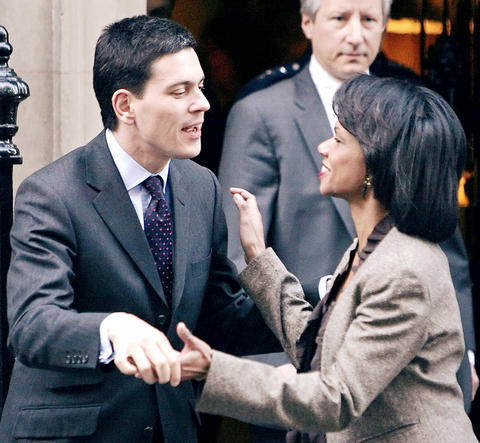
PHOTO: AFP
After flying into the Afghan capital Kabul, Rice and Miliband traveled in a US military plane to a sprawling base in the southern city of Kandahar, the birthplace of the Taliban and the main city in Afghanistan's most volatile region.
"Kandahar does have an iconic status in the history and position of Afghanistan," Miliband said. "I hope we will be able to take a message in what is really a new drive, a new phase in terms of counter-insurgency."
He and Rice were expected to return to Kabul later in yesterday for talks with Afghan President Hamid Karzai.
As they began their tour, a car bomb struck a NATO military vehicle in the eastern province of Khost wounding three soldiers, the alliance's International Security Assistance Force (ISAF) said.
ISAF did not give the nationalities of the wounded but most foreign troops in the east are US nationals. Police said the attack, similar to scores carried out by the Taliban, was a suicide blast and the bomber was the only victim.
Rice and Miliband met NATO commanders in the frontline of the fight against the Taliban and afterward addressed troops. Rice gave a rousing speech praising soldiers' bravery and sacrifice.
"This is a fight which will transform history," she said.
The US and Britain are urging other NATO members to share more of the combat burden in southern Afghanistan where the Taliban insurgency is strongest.
Some NATO countries have bristled at public criticism from Washington over the refusal of a number of alliance members to position their forces in the more dangerous south.
Germany, for example, under its parliamentary mandate can send only 3,500 soldiers to the less dangerous north as part of the 42,000-strong NATO mission.
That means most of the fighting against the Taliban is shouldered by Canada, Britain, the US and the Netherlands. They all want others to contribute more.
Canada has threatened to pull its troops out unless other allies come forward, and Poland's foreign minister has warned against "free-riding" in the alliance.
Rice and Miliband traveled to Afghanistan after talks in London on Wednesday.
"We want to spotlight the fact that we and several other allies are standing up and doing the tough job," said a senior US official, who declined to be identified.
Few NATO officials expect major new contributions to be announced during the two-day meeting in Lithuania's capital Vilnius, but Washington wants to extract promises over coming weeks for reinforcements in the south by year-end.
Specifically, the US wants assurances that allies will fill the gap when some 3,200 US Marines leave the south after a temporary deployment there later this year.
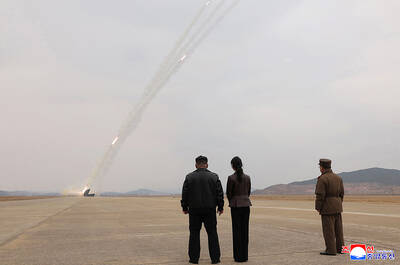
North Korea tested nuclear-capable rocket launchers, state media reported yesterday, a day after Seoul detected the launch of about 10 ballistic missiles. The test comes after South Korean and US forces launched their springtime military drills, due to run until Thursday. North Korean leader Kim Jong-un on Saturday oversaw the testing of the multiple rocket launcher system (MRLS), the Korean Central News Agency (KCNA) said. The test involved 12 600mm-caliber ultra-precision multiple rocket launchers and two artillery companies, it said. Kim said the drill gave Pyongyang’s enemies, within the 420km striking range, a sense of “uneasiness” and “a deep understanding
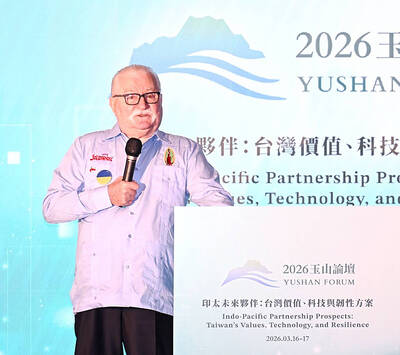
RECOGNITION: Former Fijian prime minister Mahendra Chaudhry said that Taiwan’s New Southbound Policy serves as a stabilizing force in the Indo-Pacific region Taiwan can lead the unification of the Chinese people, Nobel Peace Prize laureate and former Polish president Lech Walesa said in Taipei yesterday, adding that as the world order is changing, peaceful discussion would find good solutions, and that the use of force and coercion would always fail. Walesa made the remarks during his keynote address at a luncheon of the Yushan Forum in Taipei, titled “Indo-Pacific Partnership Prospects: Taiwan’s Values, Technology and Resilience,” organized by the Taiwan-Asia Exchange Foundation with the Ministry of Foreign Affairs. Walesa said that he had been at the forefront of a big peaceful revolution and “if

North Korea yesterday fired about 10 ballistic missiles to the sea toward Japan, the South Korean Joint Chiefs of Staff (JCS) said, days after Pyongyang warned of “terrible consequences” over ongoing South Korea-US military drills. Pyongyang recently dashed hopes of a diplomatic thaw with Seoul, Washington’s security ally, describing its latest peace efforts as a “clumsy, deceptive farce.” Seoul’s military detected “around 10 ballistic missiles launched from the Sunan area in North Korea toward the East Sea [Sea of Japan] at around 1:20pm,” JCS said in a statement, referring to South Korea’s name for the body of water. The missiles

‘UNWAVERING FRIENDSHIP’: A representative of a Japanese group that co-organized a memorial, said he hopes Japanese never forget Taiwan’s kindness President William Lai (賴清德) yesterday marked the 15th anniversary of the Tohoku earthquake and tsunami, urging continued cooperation between Taiwan and Japan on disaster prevention and humanitarian assistance. Lai wrote on social media that Taiwan and Japan have always helped each other in the aftermath of major disasters. The magnitude 9 earthquake struck northeastern Japan on March 11, 2011, triggering a massive tsunami that claimed more than 19,000 lives, according to data from Japanese authorities. Following the disaster, Taiwan donated more than US$240 million in aid, making it one of the largest contributors of financial assistance to Japan. In addition to cash donations and


 RSS
RSS