


Afghan President Hamid Karzai declared three days of mourning for victims of a suicide blast targeting a group of lawmakers and children, as the death toll rose yesterday to 41, making it the deadliest attack in Afghanistan since the 2001 US-led invasion.
Hundreds of mourners gathered at a mosque near the site of the bombing in the town of New Baghlan, 150km north of Kabul, before moving to a simple hilltop graveyard to bury the dead.
"My son was supposed to finish school this year, but yesterday I had to peel off his blood-soaked clothes, and today I buried him," said an elderly man who broke down in tears at one grave site.
He didn't give his name.
Karzai said six members of parliament were killed in the blast on Tuesday and warned that the overall toll could rise further because some victims might have been taken away from the scene without being counted officially.
The president, joined by dozens of other Afghan leaders, watched honor guards carry the coffins of the six lawmakers from a helicopter and down a red carpet at Kabul's main airport yesterday.
After the bombing on Tuesday, shots were fired at the scene, said 20-year-old Bakir, whose cousin, lawmaker Sayed Mustafa Kazimi, was killed in the blast.
Five civilians were treated for bullet wounds at New Baghlan's hospital, said Narmgui, a doctor at the hospital, who like many Afghans goes by only one name.
Karzai ordered an investigation into the attack.
"There is no doubt this was a terrorist attack," Karzai told a news conference in Kabul.
He blamed the bombing on "the enemies of peace and security," a phrase often used for the militant Taliban, and directed authorities to conduct a thorough investigation. Such a spectacular attack also could have been the work of al-Qaeda. The Taliban denied involvement.
The attack occurred as the lawmakers were being greeted by children on a visit to a sugar factory in Afghanistan's normally peaceful north.
Video obtained by AP Television News of the scene just before the blast shows schoolchildren, tribal elders and government officials lining the streets to greet 18 lawmakers as they were about to enter the factory.
Shafiqullah, 18, said he had not seen his younger brother since the attack and was looking for him.
"My brother came here yesterday and after the incident he never returned home," Shafiqullah said. "I checked all the hospitals. I couldn't find him anywhere."
Some of the children shook hands with the guests and one teenager handed red and pink roses to Kazimi -- a former Afghan commerce minister and a powerful member of the opposition party National Front.
Moments later, Kazimi was dead.
At least 42 of the 81 wounded were schoolchildren, said Mohammad Yousuf Fayez, a doctor at Baghlan's main hospital. Several children were among the dead.
The video does not show the explosion. After the blast, it shows dead and wounded schoolchildren on the ground. Shoes, sandals, hats and notebooks were scattered about.
Many victims were taken to the hospital, their legs and faces stained with blood.
The video also shows an Afghan man holding the head of who he said was the suicide attacker, shouting "This is the guy who destroyed everything! This is the guy who killed us!"
No one claimed responsibility for the attack, and a purported Taliban spokesman, Zabiullah Mujahid, denied the militant group was involved.
"The Taliban doesn't target civilians," he said.
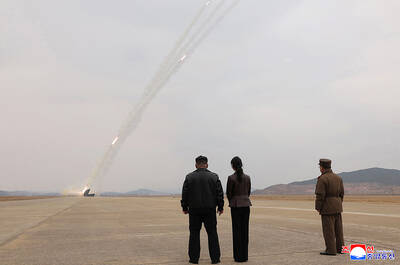
North Korea tested nuclear-capable rocket launchers, state media reported yesterday, a day after Seoul detected the launch of about 10 ballistic missiles. The test comes after South Korean and US forces launched their springtime military drills, due to run until Thursday. North Korean leader Kim Jong-un on Saturday oversaw the testing of the multiple rocket launcher system (MRLS), the Korean Central News Agency (KCNA) said. The test involved 12 600mm-caliber ultra-precision multiple rocket launchers and two artillery companies, it said. Kim said the drill gave Pyongyang’s enemies, within the 420km striking range, a sense of “uneasiness” and “a deep understanding

RECOGNITION: Former Fijian prime minister Mahendra Chaudhry said that Taiwan’s New Southbound Policy serves as a stabilizing force in the Indo-Pacific region Taiwan can lead the unification of the Chinese people, Nobel Peace Prize laureate and former Polish president Lech Walesa said in Taipei yesterday, adding that as the world order is changing, peaceful discussion would find good solutions, and that the use of force and coercion would always fail. Walesa made the remarks during his keynote address at a luncheon of the Yushan Forum in Taipei, titled “Indo-Pacific Partnership Prospects: Taiwan’s Values, Technology and Resilience,” organized by the Taiwan-Asia Exchange Foundation with the Ministry of Foreign Affairs. Walesa said that he had been at the forefront of a big peaceful revolution and “if

North Korea yesterday fired about 10 ballistic missiles to the sea toward Japan, the South Korean Joint Chiefs of Staff (JCS) said, days after Pyongyang warned of “terrible consequences” over ongoing South Korea-US military drills. Pyongyang recently dashed hopes of a diplomatic thaw with Seoul, Washington’s security ally, describing its latest peace efforts as a “clumsy, deceptive farce.” Seoul’s military detected “around 10 ballistic missiles launched from the Sunan area in North Korea toward the East Sea [Sea of Japan] at around 1:20pm,” JCS said in a statement, referring to South Korea’s name for the body of water. The missiles

‘UNWAVERING FRIENDSHIP’: A representative of a Japanese group that co-organized a memorial, said he hopes Japanese never forget Taiwan’s kindness President William Lai (賴清德) yesterday marked the 15th anniversary of the Tohoku earthquake and tsunami, urging continued cooperation between Taiwan and Japan on disaster prevention and humanitarian assistance. Lai wrote on social media that Taiwan and Japan have always helped each other in the aftermath of major disasters. The magnitude 9 earthquake struck northeastern Japan on March 11, 2011, triggering a massive tsunami that claimed more than 19,000 lives, according to data from Japanese authorities. Following the disaster, Taiwan donated more than US$240 million in aid, making it one of the largest contributors of financial assistance to Japan. In addition to cash donations and


 RSS
RSS