


US authorities on Friday announced a recall of 1 million cribs made in China after at least two babies became trapped and died and more than 60 other incidents were reported.
The recall of Simplicity Inc cots was the latest to hit Chinese-made consumer products, after the large-scale recalls of millions of Mattel toys found to contain lead paint or dangerous parts.
The US Consumer Product Safety Commission (CPSC) said on Friday it was recalling older-style Simplicity cots because the drop-side could became detached, creating a gap which could either trap or suffocate a child.
A nine-month-old baby and a six-month-old were known to have died when the drop-side of their cots were installed upside down and collapsed, the commission said in a statement.
The commission was also investigating the death of a one-year-old in a newer Simplicity crib in which the drop-side was installed upside down.
"CPSC is warning parents and caregivers to check all Simplicity cribs to make sure the drop-side is installed right side up," the commission said in a statement.
"The drop-side failures result from both the hardware and crib design, which allow consumers to unintentionally install the drop-side upside down.
"This, in turn, can weaken the hardware and cause the drop-side to detach from the crib. When the drop-side detaches, it creates a gap in which infants can become entrapped," it said.
The commission added it was aware of seven cases where babies had become trapped in their cribs and 55 other incidents. It was also investigating two cases that occurred even though the cot had been correctly put together.
The cribs "were sold in department stores, children's stores and mass merchandisers nationwide from January 1998 through May 2007 for between 100 and 300" US dollars, the commission said.
The recall follows consumer concern about the safety of Chinese products after a series of scares involving popular toys such as Thomas the Tank Engine, Barbies and Polly Pockets.
MATTEL APOLOGY
But earlier on Friday, US toy giant Mattel issued a startling apology to China, saying the vast majority of the recent recalls of Chinese-made products were due to design flaws it had committed itself.
"It is very important for everyone to understand that the vast majority of those products recalled were the result of a design flaw in Mattel, not through the manufacturing flaw in China's manufacturers," said Thomas Debrowski, Mattel's executive vice president of worldwide operations.
"Mattel takes full responsibility for those recalls," Debrowski told Li Changjiang (
"I would like to apologize personally to you, the Chinese people and all of the customers who have received toys that have been manufactured," Debrowski said in a meeting in Beijing.
The unusual move reflects how dependent El Segundo, California-based Mattel has become on China.
"Mattel certainly must have been facing some pressure to do that, because you can't imagine why they would be trying to push this story along any further," said Eric Johnson, a professor of operations management at Tuck School of Business at Dartmouth College in New Hampshire.
He suggested Mattel may want to prevent China from imposing more taxes or regulations.
"China's embarrassment in all this could lead to that, and I think they were trying to head that off with this apology," Johnson said.
Peter Navarro, a business professor at the University of California, Irvine, and the author of The Coming China Wars, also suggested Mattel was trying to avoid punitive measures.
"Mattel is worried that the Chinese government is going to make it difficult for them to produce, put their costs up and hurt their stock price," Navarro said.
In a prepared statement issued later on Friday, the company said some media accounts of its meeting with Chinese officials had been mischaracterized.
"Since Mattel toys are sold the world over, Mattel apologized to the Chinese today just as it has wherever its toys are sold," the company said.

A signaling system malfunction disrupted high-speed rail (HSR) services beginning at 8am today, with trains temporarily reduced to three northbound and three southbound trains per hour as authorities conduct inspections. The malfunction occurred on a section of track in Miaoli County during pre-operation checks early this morning, forcing northbound and southbound trains to use a single track, the HSR operator said. The regular schedule has been replaced with three hourly trains offering only nonreserved seating in each direction, stopping at every station, it said, adding that business class cars would still have reserved seating. Departures from terminal stations are scheduled at the top

Taiwan is still in the process of assessing the possibility of recruiting workers from Eswatini, the Ministry of Foreign Affairs said yesterday, adding that its goal is to help Eswatini upgrade its vocational training centers. If there are plans to recruit workers from Eswatini, safeguarding national security, protecting public health and ensuring the employment rights of Taiwanese would be prerequisites, Department of West Asian and African Affairs Director-General Yen Chia-liang (顏嘉良) told a news conference. Key considerations would also include filling labor shortages in specific industries, and fostering bilateral professional and technical exchanges, he said. Yen was asked about the progress of labor

VERBOSE VESSELS: A CGA cutter and a China Coast Guard exchanged verbal barbs for more than a day in Taiwanese-controlled waters before the Chinese vessel left The Taiwanese and Chinese coast guards had a standoff near the strategically located Pratas Islands (Dongsha Islands, 東沙群島) in the north of the South China Sea, the Coast Guard Administration (CGA) said yesterday. The two sides engaged in intense radio exchanges over sovereignty claims during the 33-hour standoff. China Coast Guard vessel 3501 eventually left the restricted waters, 26.6 nautical miles (49.2km) west of the Pratas Islands, at 5pm yesterday, the CGA said. Lying approximately between southern Taiwan and Hong Kong, the Taiwan-controlled Pratas are seen by some security experts as vulnerable to Chinese attack due to their distance — more than
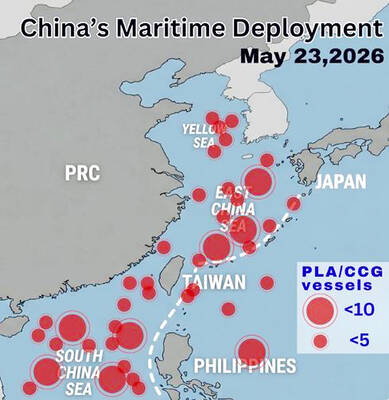
WARNING: China should stop engaging in actions that undermine regional peace and stability, as it would only build resentment among people across the Strait, the CGA said China has deployed more than 100 navy, coast guard and other vessels in waters from the Yellow Sea to the South China Sea and the western Pacific since US President Donald Trump and Chinese President Xi Jinping (習近平) met in Beijing, National Security Council Secretary-General Joseph Wu (吳釗燮) said yesterday. “In this part of the world, #China is the one & only PROBLEM wrecking the #StatusQuo & threatening regional peace & stability,” Wu wrote on X. In a separate post, he said Beijing was coercing Taiwan’s maritime domain, calling it illegal and provocative, after the Coast Guard Administration (CGA) expelled a


 RSS
RSS