


Pacific Rim leaders yesterday said the world needs to "slow, stop and then reverse" greenhouse gas emissions, and adopted modest goals to curb global warming as thousands of demonstrators rallied to demand they do more.
Some experts and activists dismissed as ineffective the program adopted by the presidents of the US, China, Russia and leaders of other Asia-Pacific economies at the annual summit -- which did not set goals for cutting countries' output of polluting gases.
But it sets a precedent because it applies to all of the group's mix of rich and developing members, and could influence upcoming UN negotiations on climate change.
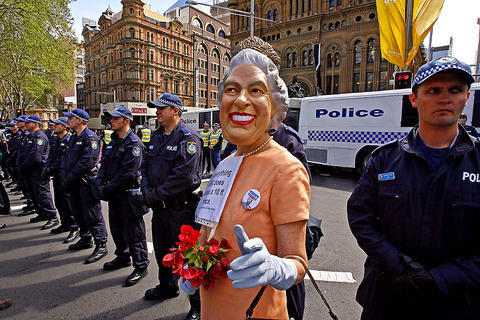
PHOTO: AFP
Leaders "charted a new international consensus for the region and the world," summit host Australian Prime Minister John Howard said outside the Sydney Opera House, where the leaders adopted the declaration on the first of two days of talks.
A dozen blocks away and on the other side of a 3m metal fence fortified by concrete barriers and a police cordon, about 3,000 protesters held a colorful, mostly peaceful march and rally. Causes included protests against US President George W. Bush, the Iraq war and ending poverty.
Kerry Nettle, a senator from the Greens party, demanded that the Pacific Rim leaders take "real action" on global warming, drawing cheers. One protester wore a T-shirt that read: "Climate Change is not Cool."
Another was dressed as a polar bear.
Police, who had warned of potential violence and been given special search powers by the local government, had only minor scuffles with demonstrators, arresting 17 protesters. Two officers were also injured, police said.
The APEC climate change program brings together some of the world's powerhouse economies and some of its biggest polluters. As such, it could influence upcoming negotiations before the end of the year in Washington, New York and Indonesia to devise a successor to the UN-backed Kyoto Protocol when it expires in 2012.
"If you have APEC, especially the largest emitters -- the US, China, Russia, Japan -- sign up to an agreement like that, it would be hard to ignore at the global level," said Malcolm Cook of Sydney-based think tank the Lowy Institute.
Environmental groups and some climate change experts said the agreement was weak.
"In practical terms, that will mean almost nothing," said Frank Jotzo, an Australian National University expert in climate change economics. "It is very unambitious."
The energy intensity target sets a rate that most economies are naturally meeting as they get richer and shift out of power-intensive manufacturing, he said.
"If the APEC statement is the platform for future action on climate change, then the world is in trouble," Greenpeace energy campaigner Catherine Fitzpatrick said.
In the plodding bargaining this past week, officials tried to bridge differences between richer and developing nations.
The targets, a demand of Australia and the US, apply to all countries. Under Kyoto, China, India and other developing countries were largely exempted from emissions targets applied to industrial countries. At APEC, developing nationss got richer members to reaffirm that they should bear most of the costs in solving global warming.
"In diplomacy, we cannot be 100 percent satisfied because it is a product of negotiations, and in the end we have to live with it," Indonesian Foreign Minister Hassan Wirayuda, whose government had earlier opposed the target, told reporters. "Any product of negotiation, whatever document we call it, it is a product of compromise."
US presidential aide Dan Price said the APEC declaration was a "very ambitious statement" that forged "quite a bold new direction" on climate change.
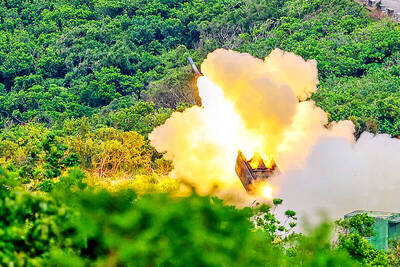
PRECISION STRIKES: The most significant reason to deploy HIMARS to outlying islands is to establish a ‘dead zone’ that the PLA would not dare enter, a source said A High Mobility Artillery Rocket System (HIMARS) would be deployed to Penghu County and Dongyin Island (東引) in Lienchiang County (Matsu) to force the Chinese military to retreat at least 100km from the coastline, a military source said yesterday. Taiwan has been procuring HIMARS and Army Tactical Missile Systems (ATACMS) from the US in batches. Once all batches have been delivered, Taiwan would possess 111 HIMARS units and 504 ATACMS, which have a range of 300km. Considering that “offense is the best defense,” the military plans to forward-deploy the systems to outlying islands such as Penghu and Dongyin so that
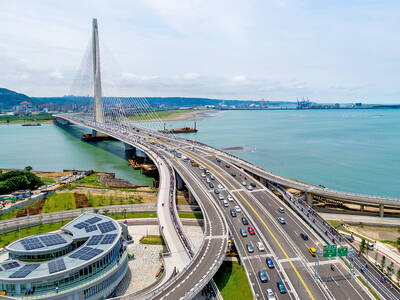
The Ministry of Transportation and Communications yesterday inaugurated the Danjiang Bridge across the Tamsui River in New Taipei City, saying that the structure would be an architectural icon and traffic artery for Taiwan. Feted as a major engineering achievement, the Danjiang Bridge is 920m long, 211m tall at the top of its pylon, and is the longest single-pylon asymmetric cable-stayed bridge in the world, the government’s Web site for the structure said. It was designed by late Iraqi-British architect Zaha Hadid. The structure, with a maximum deck of 70m, accommodates road and light rail traffic, and affords a 200m navigation channel for boats,

WHAT WAS ALL THAT FOR? Jaw Shaw-kong said that Cheng Li-wen had pushed for more drastic cuts and attacked him, just for the outcome to be nearly identical to his bill The legislature yesterday passed a supplementary budget bill to fund the purchase of separate packages of US military equipment, with the combined amount of spending capped at NT$780 billion (US$24.8 billion). The Chinese Nationalist Party (KMT) and Taiwan People’s Party (TPP) used their legislative majority to pass the bill, which runs until 2033 and has two main funding provisions. One was for NT$300 billion of arms sales already approved by the US for Taiwan on Dec. 17 last year, the other was for NT$480 billion for another arms package expected to be announced by Washington. The bill, which fell short of the NT$1.25

‘CLEAR MESSAGE’: The bill would set up an interagency ‘tiger team’ to review sanctions tools and other economic options to help deter any Chinese aggression toward Taiwan US Representative Young Kim has introduced a bill to deter Chinese aggression against Taiwan, calling for an interagency “tiger team” to preplan coordinated sanctions and economic measures in response to possible Chinese military or political action against Taiwan. “[Chinese President] Xi Jinping [習近平] has directed the People’s Liberation Army to be ready to invade Taiwan by 2027. China has a plan. America should have one too,” Kim said in a news release on Thursday last week. She introduced the “Deter PRC [People’s Republic of China] aggression against Taiwan act” to “ensure the US has a coordinated sanctions strategy ready should


 RSS
RSS