


Ehud Olmert yesterday became the first Israeli prime minister to visit a Palestinian town since the outbreak of fighting seven years ago, meeting under heavy guard with Palestinian President Mahmoud Abbas in Jericho to talk about the creation of a Palestinian state.
Olmert took a security risk in coming to the biblical desert town, but also gave a symbolic boost to Abbas, who stands to gain stature by hosting Olmert on his own turf.
Accompanied by two helicopters, Olmert arrived by motorcade at a five-star hotel just a few hundred meters from a permanent Israeli army checkpoint on the outskirts of Jericho.
The meeting was held in one of the West Bank's most peaceful areas. However, it still posed a challenge to Olmert's security detail, since the West Bank cities are controlled by Abbas' weak police forces, which in June failed to prevent Hamas militants from seizing the Gaza Strip by force.
The meeting also tested renewed Israeli-Palestinian security coordination in the West Bank, following the fall of Gaza to Hamas. The Israeli army sealed checkpoints around Jericho, while Palestinian police blocked roads around the hotel.
The Abbas-Olmert meeting is one in a series of sessions meant to prepare for an international Middle East conference in the US in November.
However, both sides appear to have conflicting expectations.
The Palestinians hope the two leaders will sketch the outlines of a final peace deal to be presented to the US conference, Palestinian negotiator Saeb Erekat said yesterday.
The four core issues of a future peace deal are the final borders of a Palestinian state, a division of Jerusalem, a removal of Israeli settlements and the fate of Palestinian refugees.
"What they need to do is to establish the parameters for solving all these issues," Erekat said.
However, David Baker, an official in Olmert's office, said the core issues would not be discussed now.
The leaders will discuss humanitarian aid to the Palestinians and Israeli security concerns, as well as the institutions of a future Palestinian state, Baker said.
Baker said the meeting was a signal of Israeli good will, adding that Olmert "intends for this to be a productive meeting to enable progress with the Palestinians."
Both sides said the meeting will also deal with easing the conditions of daily life in the West Bank, including the removal of some of the checkpoints erected after the outbreak of the second Palestinian uprising in September 2000.
Abbas and Olmert previously agreed to try to restore the situation to what it was before the uprising, including returning full Palestinian control over West Bank towns and cities.
Meanwhile, Israel yesterday warned that Lebanon's Shiite Hezbollah militia is seeking to kidnap Israelis who visit Muslim countries.
Israel's anti-terror headquarters issued a warning ahead of the Jewish holidays in the middle of next month, repeating its call for Israelis not to travel to any Arab country.
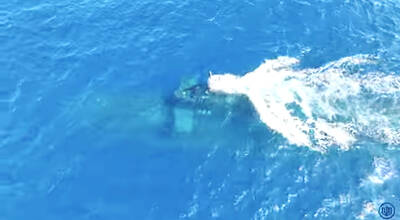
CSBC Corp, Taiwan (台灣國際造船) yesterday released the first video documenting the submerged sea trials of Taiwan’s indigenous defense submarine prototype, the Hai Kun (海鯤), or Narwhal, showing underwater navigation and the launch of countermeasures. The footage shows the vessel’s first dive, steering and control system tests, and the raising and lowering of the periscope and antenna masts. It offered a rare look at the progress in the submarine’s sea acceptance tests. The Hai Kun carried out its first shallow-water diving trial late last month and has since completed four submerged tests, CSBC said. The newly released video compiles images recorded from Jan. 29 to
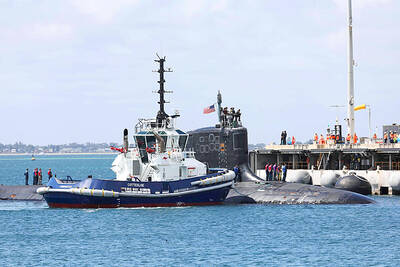
DETERRENCE EFFORTS: Washington and partners hope demonstrations of force would convince Beijing that military action against Taiwan would carry high costs The US is considering using HMAS Stirling in Western Australia as a forward base to strengthen its naval posture in a potential conflict with China, particularly over Taiwan, the Wall Street Journal reported on Saturday. As part of its Indo-Pacific strategy, Washington plans to deploy up to four nuclear-powered submarines at Stirling starting in 2027, providing a base near potential hot spots such as Taiwan and the South China Sea. The move also aims to enhance military integration with Pacific allies under the Australia-UK-US trilateral security partnership, the report said. Currently, US submarines operate from Guam, but the island could
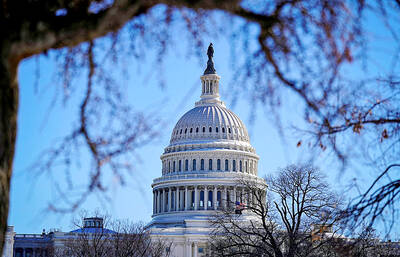
RESTRAINTS: Should China’s actions pose any threat to Taiwan’s security, economic or social systems, China would be excluded from major financial institutions, the bill says The US House of Representatives on Monday passed the PROTECT Taiwan Act, which states that Washington would exclude China from participating in major global financial organizations if its actions directly threaten Taiwan’s security. The bill, proposed by Republican Representative Frank Lucas, passed with 395 votes in favor and two against. It stipulates that if China’s actions pose any threat to Taiwan’s security, economic or social systems, the US would, “to the maximum extent practicable,” exclude Beijing from international financial institutions, including the G20, the Bank for International Settlements and the Financial Stability Board. The bill makes it clear that China must be prepared

Taiwanese trade negotiators told Washington that Taipei would not relocate 40 percent of its semiconductor production to the US, and that its most advanced technologies would remain in the nation, Vice Premier Cheng Li-chiun (鄭麗君) said on Sunday. “I told the US side very clearly — that’s impossible,” Cheng, who led the negotiation team, said in an interview that aired on Sunday night on Chinese Television System. Cheng was referring to remarks last month by US Secretary of Commerce Howard Lutnick, in which he said his goal was to bring 40 percent of Taiwan’s chip supply chain to the US Taiwan’s almost


 RSS
RSS