


The head of the world's nuclear watchdog, the International Atomic Energy Agency (IAEA), has warned that the organization is so underfunded it would have difficulty responding to a nuclear accident.
In an unusual and angry appeal, Mohamed ElBaradei also said that the IAEA no longer had reliable equipment to detect covert nuclear activity, nor did it have consistent funding for its efforts to combat nuclear smuggling.
ElBaradei made his remarks to the IAEA's board of governors and delegates from national governments on June 15, but the comments were only made public on Thursday.
"If an accident were to happen tomorrow, we would be hard pressed to carry out core functions. This is a reality," he said.
In the event of an accident like the Chernobyl disaster of 1986, the IAEA's incident and emergency center is supposed to step in immediately, sending technicians to help to limit the spread of radiation, advise on the treatment of casualties and coordinate the international response.
ElBaradei said that the IAEA's "safeguards function is being eroded over time," noting that the organization was using an unreliable 28-year-old instrument to carry out environmental sampling. That sampling is carried out in and around countries such as Iran and North Korea, where covert nuclear programs are suspected. The results often have a decisive influence on UN decisions to impose sanctions or other measures.
Because the agency did not have proper equipment of its own, ElBaradei said, it would have to rely on external laboratories in other countries, which "puts into question the whole independence of the agency's verification system."
"In the nuclear security area, which every world leader is saying is a No. 1 priority, we continue to rely for 90 percent of our security funding on extra budgetary contributions that are heavily conditioned and highly unpredictable," he said.
IAEA officials say the organization has more and more work to do trying to keep up with international demands to monitor nuclear proliferation, while its budget has been frozen on the insistence of rich states such as the US, Japan and Germany.
"The budget is essentially a political statement," ElBaradei said. "What kind of agency do you want to have? You can have a mediocre agency, or you can have an effective and efficient agency."
His comments come at a time when the world is struggling to handle twin proliferation crises over North Korea and Iran, which are defying pressure to halt nuclear programs.
Also see story:

CALL FOR SUPPORT: President William Lai called on lawmakers across party lines to ensure the livelihood of Taiwanese and that national security is protected President William Lai (賴清德) yesterday called for bipartisan support for Taiwan’s investment in self-defense capabilities at the christening and launch of two coast guard vessels at CSBC Corp, Taiwan’s (台灣國際造船) shipyard in Kaohsiung. The Taipei (台北) is the fourth and final ship of the Chiayi-class offshore patrol vessels, and the Siraya (西拉雅) is the Coast Guard Administration’s (CGA) first-ever ocean patrol vessel, the government said. The Taipei is the fourth and final ship of the Chiayi-class offshore patrol vessels with a displacement of about 4,000 tonnes, Lai said. This ship class was ordered as a result of former president Tsai Ing-wen’s (蔡英文) 2018
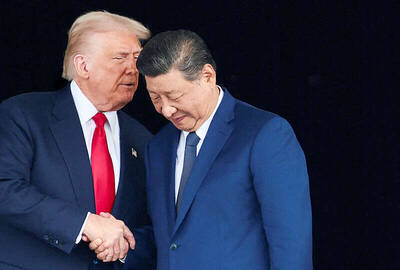
‘SECRETS’: While saying China would not attack during his presidency, Donald Trump declined to say how Washington would respond if Beijing were to take military action US President Donald Trump said that China would not take military action against Taiwan while he is president, as the Chinese leaders “know the consequences.” Trump made the statement during an interview on CBS’ 60 Minutes program that aired on Sunday, a few days after his meeting with Chinese President Xi Jinping (習近平) in South Korea. “He [Xi] has openly said, and his people have openly said at meetings, ‘we would never do anything while President Trump is president,’ because they know the consequences,” Trump said in the interview. However, he repeatedly declined to say exactly how Washington would respond in
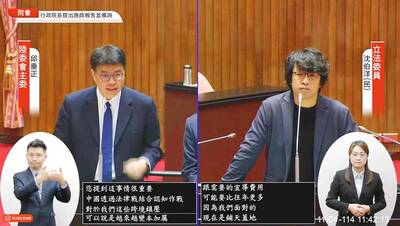
WARFARE: All sectors of society should recognize, unite, and collectively resist and condemn Beijing’s cross-border suppression, MAC Minister Chiu Chui-cheng said The number of Taiwanese detained because of legal affairs by Chinese authorities has tripled this year, as Beijing intensified its intimidation and division of Taiwanese by combining lawfare and cognitive warfare, the Mainland Affairs Council (MAC) said yesterday. MAC Minister Chiu Chui-cheng (邱垂正) made the statement in response to questions by Democratic Progressive Party (DPP) Legislator Puma Shen (沈柏洋) about the government’s response to counter Chinese public opinion warfare, lawfare and psychological warfare. Shen said he is also being investigated by China for promoting “Taiwanese independence.” He was referring to a report published on Tuesday last week by China’s state-run Xinhua news agency,
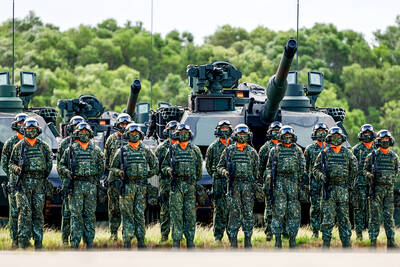
‘NOT SUBORDINATE’: Only Taiwanese can decide the nation’s future, and people preserving their democratic way of life is not a provocation, President William Lai said Taiwan does not want China’s “one country, two systems,” and must uphold its freedom and democracy as well as resolve to defend itself, President William Lai (賴清德) said yesterday, rejecting Beijing’s latest bid to bring the country under Chinese control. The president made the remarks while attending a commissioning ceremony for Taiwan’s first battalion of M1A2T Abrams tanks in Hsinchu County’s Hukou Township (湖口). The tanks are made by General Dynamics, a major US defense contractor. China this week said it “absolutely will not” rule out using force over Taiwan, striking a much tougher tone than a series of articles in state media


 RSS
RSS