


President Jacques Chirac is expected to announce today that he will retire after more than 40 years at the top in French politics.
The 74 year-old leader is to reveal in an address to the nation on radio and television whether he will stand in the presidential election to be held in six weeks.
The content of his declaration has been kept secret by the Elysee palace, but the near universal consensus was that he will explain why he has decided not to seek an unprecedented third mandate.
With official nominations for the race due by Friday, Chirac has kept open till the last moment the option of running again -- despite polls that show he would have no chance of winning again.
But in recent weeks Chirac has given several hints that he intends to step down, telling a television interviewer last month that "there is life after politics" and that he hopes to serve France "in another capacity."
The president has also hosted three international meetings on issues known to be close to his heart -- Lebanon, the environment and French-African relations -- and this week he attended what was widely seen as his farewell EU summit.
If there was little suspense about Chirac's decision, speculation centered on whether he will use the broadcast to endorse the right-wing candidate for the presidency Interior Minister Nicolas Sarkozy, a former protege who heads the ruling Union for a Popular Movement (UMP).
Sarkozy, 52, has a narrow lead in the polls over the socialist Segolene Royal, but now faces a new challenge from the centrist candidate Francois Bayrou, head of the Union for French Democracy, whose ratings have surged in the last month.
Chirac and Sarkozy -- whose relations have long been tense -- had talks last week, and Sarkozy said he was informed what the president plans to say in his broadcast.
Speaking on France 2 televi-sion, the UMP leader said Chirac's public backing "would have a certain weight among some French people who are still uncertain [how to vote]."
However, party insiders said they do not expect the president to make an explicit statement of support.

SILENCING CRITICS: In addition to blocking Taiwan, China aimed to prevent rights activists from speaking out against authoritarian states, a Cabinet department said The Ministry of Foreign Affairs (MOFA) yesterday condemned transnational repression by Beijing after RightsCon, a major digital human rights conference scheduled to be held in Zambia this week, was abruptly canceled due to Chinese pressure over Taiwanese participation. This year’s RightsCon, the world’s largest conference discussing issues “at the intersection of human rights and technology,” was scheduled to take place from tomorrow to Friday in Lusaka, and expected to draw 2,600 in-person attendees from 150 countries, along with 1,100 online participants. However, organizers were forced to cancel the event due to behind-the-scenes pressure from China, the ministry said, expressing its “strongest condemnation”
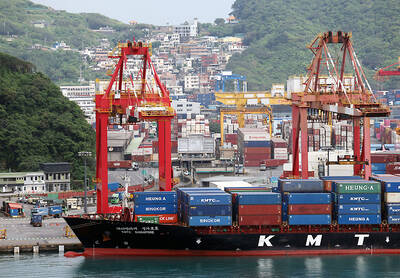
Taiwan’s economy grew far faster than expected in the first quarter, as booming demand for artificial intelligence (AI) applications drove a surge in exports, spilling over into investment and consumption, the Directorate-General of Budget, Accounting and Statistics (DGBAS) said yesterday. GDP growth was 13.69 percent year-on-year during the January-to-March period, beating the DGBAS’ February forecast by 2.23 percentage points and marking the most robust growth in nearly four decades, DGBAS senior official Chiang Hsin-yi (江心怡) told a news conference in Taipei. The result was powered by exports, which remain the backbone of Taiwan’s economy, Chiang said. Outbound shipments jumped 51.12 percent year-on-year to
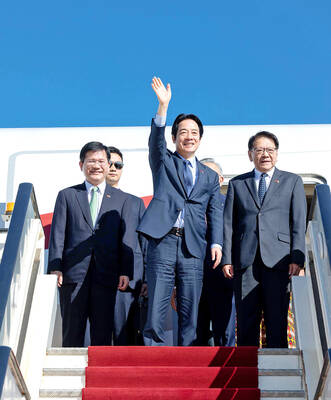
DELAYED BUT DETERMINED: The president’s visit highlights Taiwan’s right to international engagement amid regional pressure from China President Willaim Lai (賴清德) yesterday arrived in Eswatini, more than a week after his planned visit to Taiwan’s sole African ally was suspended because of revoked overflight permits. “The visit, originally scheduled for April 22, was postponed due to unforeseen external factors,” Lai wrote on social media. “After several days of careful arrangements by our diplomatic and national security teams, we successfully arrived today.” Lai said he looked forward to further deepening Taiwan-Eswatini relations through closer cooperation in the economy, agriculture, culture and education, as well as advancing the nation’s international partnerships. The president was initially scheduled to arrive in time to celebrate
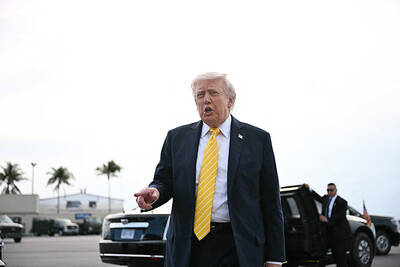
Iran’s Islamic Revolutionary Guard Corp (IRGC) yesterday said the US faced a choice between an “impossible” military operation or a “bad deal” with Tehran, after US President Donald Trump disparaged Iran’s latest peace proposal. Negotiations between the two countries have been deadlocked since a ceasefire came into effect on April 8, with only one round of direct peace talks held so far. Iran’s Tasnim and Fars news agencies reported that Tehran had submitted a 14-point proposal to mediator Pakistan, but Trump was quick to cast doubt on it. “I will soon be reviewing the plan that Iran has just sent to us, but


 RSS
RSS