


Any military action against Iran's nuclear program is likely to backfire and accelerate Tehran's development of a nuclear bomb, a report by a British former nuclear weapons scientist warned yesterday.
In his report, Frank Barnaby argued that air strikes, reportedly being contemplated as an option by the White House, would strengthen the hand of Iranian hardliners, unite the Iranian population behind a bomb, and would almost certainly trigger an underground program to build a small number of warheads as quickly as possible.
"As soon as you start bombing you unite the population behind the government," Barnaby said. "Right now in Iran, there are different opinions about all this, but after an attack you would have a united people and a united scientific community."
In a foreword, Hans Blix, the chief UN weapons inspector at the time of the Iraq War, argued that an assault in Iran could turn out to be every bit as disastrous.
"In the case of Iraq, the armed action launched aimed to eliminate weapons of mass destruction -- that did not exist. It led to tragedy and regional turmoil. In the case of Iran armed action would be aimed at intentions -- that may or may not exist. However, the same result -- tragedy and regional turmoil -- would inevitably follow," Blix wrote.
The report comes amid rapidly rising tension over Iran. The permanent members of the security council, with Germany, are discussing tougher UN sanctions against Tehran after it defied its ultimatum to stop enriching uranium.
Iranian President Mahmoud Ahmadinejad has described his country's nuclear policy as a train with no brakes or reverse gear. His government is reportedly planning to issue a new high-denomination banknote celebrating the program, inscribed with an nuclear symbol and a Koranic quotation: "If the science exists in this constellation, men from Persia will reach it."
Ahmadinejad was in Saudi Arabia on Sunday for talks with King Abdullah aimed at defusing Shiite-Sunni tensions in Iraq and seeking consensus between the region's two great adversaries. But many fear that Iran's nuclear aspirations could trigger a Middle East arms race.
Advocates of military strikes against Iran -- largely confined to hawks in and around the Bush administration and the Israeli government -- argue that Tehran has made a strategic decision to develop a nuclear weapon, which it would then readily use against Israel or the US itself, perhaps contracting a terrorist group to smuggle the warhead to its target. Military strikes, they argue, would at least slow down the development of a weapon and could topple the clerical regime.
Barnaby -- now a consultant for the Oxford Research Group think tank which published his report -- said air strikes would be unlikely to destroy all the centrifuges Iran is using to enrich uranium.
An attack could trigger a walkout by Iran from the non-proliferation treaty and the departure of UN inspectors. It could also lead to the departure of Russian experts at an Iranian reactor at Bushehr, leaving a potential source of plutonium unmonitored, the report warned.

Right-wing political scientist Laura Fernandez on Sunday won Costa Rica’s presidential election by a landslide, after promising to crack down on rising violence linked to the cocaine trade. Fernandez’s nearest rival, economist Alvaro Ramos, conceded defeat as results showed the ruling party far exceeding the threshold of 40 percent needed to avoid a runoff. With 94 percent of polling stations counted, the political heir of outgoing Costa Rican President Rodrigo Chaves had captured 48.3 percent of the vote compared with Ramos’ 33.4 percent, the Supreme Electoral Tribunal said. As soon as the first results were announced, members of Fernandez’s Sovereign People’s Party
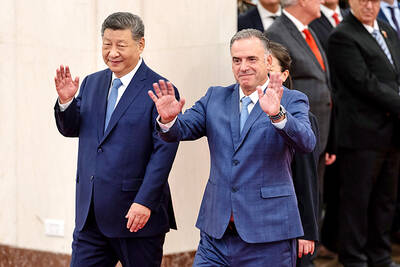
EMERGING FIELDS: The Chinese president said that the two countries would explore cooperation in green technology, the digital economy and artificial intelligence Chinese President Xi Jinping (習近平) yesterday called for an “equal and orderly multipolar world” in the face of “unilateral bullying,” in an apparent jab at the US. Xi was speaking during talks in Beijing with Uruguayan President Yamandu Orsi, the first South American leader to visit China since US special forces captured then-Venezuelan president Nicolas Maduro last month — an operation that Beijing condemned as a violation of sovereignty. Orsi follows a slew of leaders to have visited China seeking to boost ties with the world’s second-largest economy to hedge against US President Donald Trump’s increasingly unpredictable administration. “The international situation is fraught
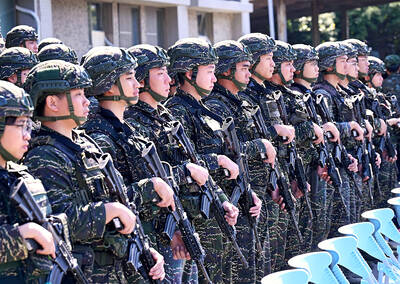
MORE RESPONSIBILITY: Draftees would be expected to fight alongside professional soldiers, likely requiring the transformation of some training brigades into combat units The armed forces are to start incorporating new conscripts into combined arms brigades this year to enhance combat readiness, the Executive Yuan’s latest policy report said. The new policy would affect Taiwanese men entering the military for their compulsory service, which was extended to one year under reforms by then-president Tsai Ing-wen (蔡英文) in 2022. The conscripts would be trained to operate machine guns, uncrewed aerial vehicles, anti-tank guided missile launchers and Stinger air defense systems, the report said, adding that the basic training would be lengthened to eight weeks. After basic training, conscripts would be sorted into infantry battalions that would take
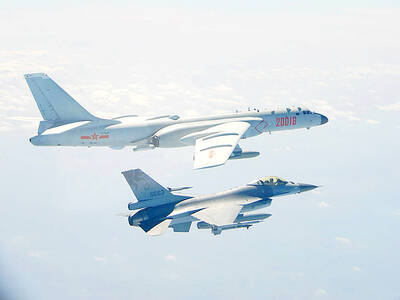
GROWING AMBITIONS: The scale and tempo of the operations show that the Strait has become the core theater for China to expand its security interests, the report said Chinese military aircraft incursions around Taiwan have surged nearly 15-fold over the past five years, according to a report released yesterday by the Democratic Progressive Party’s (DPP) Department of China Affairs. Sorties in the Taiwan Strait were previously irregular, totaling 380 in 2020, but have since evolved into routine operations, the report showed. “This demonstrates that the Taiwan Strait has become both the starting point and testing ground for Beijing’s expansionist ambitions,” it said. Driven by military expansionism, China is systematically pursuing actions aimed at altering the regional “status quo,” the department said, adding that Taiwan represents the most critical link in China’s


 RSS
RSS