


The US on Friday rebutted objections by China to the Pentagon's plan to sell hundreds of advanced missiles to Taiwan, saying the sale comports with the US' obligations under the Taiwan Relations Act to sell defensive weapons to Taiwan.
State Department spokesman Sean McCormack said the sale, announced in Washington on Wednesday, meets "the legitimate self-defense needs" of Taiwan.
He dismissed China's objections, saying that Beijing "apparently do[es] this on a regular basis" whenever US arms sales to Taiwan are announced.
"The Bush administration remains firmly committed to fulfilling the security and arms sales provisions of the Taiwan Relations Act," McCormack said in response to a question during his daily press briefing.
He said that when China complains, "we explain that US arms sales are consistent with our one-China policy, the three joint communiques [between the US and China] and the Taiwan Relations Act."
That act, he added, "requires the US to make available to Taiwan defense articles and services necessary for Taiwan to maintain a sufficient self-defense capability, and we believe that the sale in question is consistent with our responsibility on that policy."
The US Defense Security Cooperation Agency (DSCA), the Pentagon organization in charge of foreign arms sales, announced the sale of 218 AIM-120C-7 AMRAAM air-to-air missiles, 285 AGM-65G2 Maverick missiles, and other items to Taiwan in a sale that could amount to US$421 million, according to the DSCA.
The missiles would be used on Taiwan's fleet of F-16 fighter jets to help repel a possible Chinese military attack on Taiwan.
In response to the sale, Beijing's Foreign Ministry spokesman Qin Gang (秦剛) on Friday voiced China's "strong dissatisfaction and resolute opposition" to the sale, and urged Washington to cancel it. He said that Beijing has "lodged a solemn protest" against the sale. He also linked the sale with US efforts to "encourage pro-independence forces" in Taiwan.
McCormack's statement was aimed to counter Qin's and China's position.
The AMRAAMs, or advanced medium-range air-to-air missiles, are the latest air-to-air missiles, and would be used against an air attack against Taiwan. They began operations earlier this century, fly four times the speed of sound, and have a range of more than 48km, their manufacturer, Raytheon, says.
The Mavericks are air-to-ground guided missiles, designed for close air support and interdiction. According to the manufacturer, they provide "a high probability of strike against a wide range of tactical targets, including armor, air defenses, ships, transportation equipment and fuel storage facilities."
During Operation Desert Storm, the 1990 attack on Iraq by former president George Bush, the Mavericks hit 85 percent of their targets. Each F-16 can carry as many as six of the missiles that can hit targets as far away as 24km.
The sale still must be approved by Congress and the final terms must be approved by Taiwan's government and the Legislative Yuan.

Right-wing political scientist Laura Fernandez on Sunday won Costa Rica’s presidential election by a landslide, after promising to crack down on rising violence linked to the cocaine trade. Fernandez’s nearest rival, economist Alvaro Ramos, conceded defeat as results showed the ruling party far exceeding the threshold of 40 percent needed to avoid a runoff. With 94 percent of polling stations counted, the political heir of outgoing Costa Rican President Rodrigo Chaves had captured 48.3 percent of the vote compared with Ramos’ 33.4 percent, the Supreme Electoral Tribunal said. As soon as the first results were announced, members of Fernandez’s Sovereign People’s Party
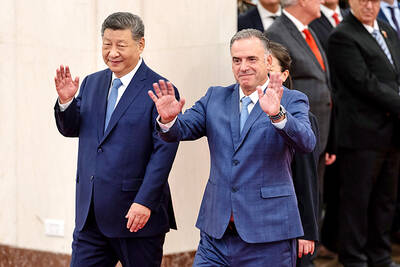
EMERGING FIELDS: The Chinese president said that the two countries would explore cooperation in green technology, the digital economy and artificial intelligence Chinese President Xi Jinping (習近平) yesterday called for an “equal and orderly multipolar world” in the face of “unilateral bullying,” in an apparent jab at the US. Xi was speaking during talks in Beijing with Uruguayan President Yamandu Orsi, the first South American leader to visit China since US special forces captured then-Venezuelan president Nicolas Maduro last month — an operation that Beijing condemned as a violation of sovereignty. Orsi follows a slew of leaders to have visited China seeking to boost ties with the world’s second-largest economy to hedge against US President Donald Trump’s increasingly unpredictable administration. “The international situation is fraught
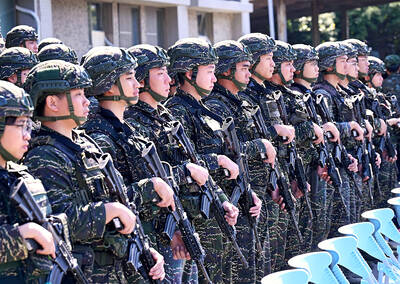
MORE RESPONSIBILITY: Draftees would be expected to fight alongside professional soldiers, likely requiring the transformation of some training brigades into combat units The armed forces are to start incorporating new conscripts into combined arms brigades this year to enhance combat readiness, the Executive Yuan’s latest policy report said. The new policy would affect Taiwanese men entering the military for their compulsory service, which was extended to one year under reforms by then-president Tsai Ing-wen (蔡英文) in 2022. The conscripts would be trained to operate machine guns, uncrewed aerial vehicles, anti-tank guided missile launchers and Stinger air defense systems, the report said, adding that the basic training would be lengthened to eight weeks. After basic training, conscripts would be sorted into infantry battalions that would take
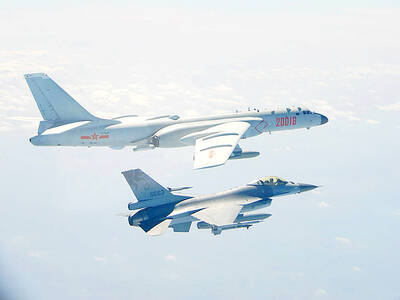
GROWING AMBITIONS: The scale and tempo of the operations show that the Strait has become the core theater for China to expand its security interests, the report said Chinese military aircraft incursions around Taiwan have surged nearly 15-fold over the past five years, according to a report released yesterday by the Democratic Progressive Party’s (DPP) Department of China Affairs. Sorties in the Taiwan Strait were previously irregular, totaling 380 in 2020, but have since evolved into routine operations, the report showed. “This demonstrates that the Taiwan Strait has become both the starting point and testing ground for Beijing’s expansionist ambitions,” it said. Driven by military expansionism, China is systematically pursuing actions aimed at altering the regional “status quo,” the department said, adding that Taiwan represents the most critical link in China’s


 RSS
RSS