

The administration of the nation's two largest municipalities officially changed hands yesterday.
In the nation's capital and largest city, former mayor Ma Ying-jeou (
Meanwhile in Kaohsiung, the nation's second-largest city, Mayor Chen Chu (
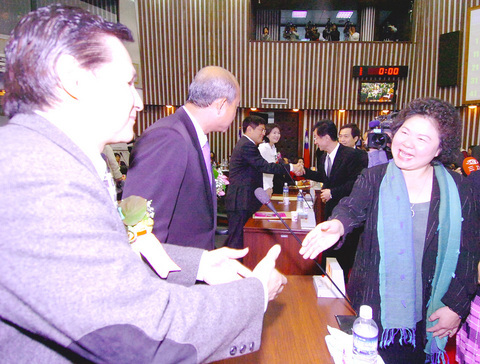
PHOTO: HUANG CHIH-YUAN, TAIPEI TIMES
In Taipei, the ceremony was accompanied by city staffers who urged Ma to enter the 2008 presidential election.
The Taipei ceremony was presided over by Vice Premier Tsai Ing-wen (蔡英文), who lauded Ma's eight-year effort to make Taipei a diverse city.
Tsai also called on Hau to seek closer cooperation with the central government and attend Executive Yuan meetings regularly because, unlike Ma, he does not have the responsibility of serving as the chairman of the Chinese Nationalist Party (KMT).
"We also need help from Mayor Hau to find solutions to the city government's health insurance debt owed to the central government," Tsai said yesterday during the ceremony held at Taipei City Hall.
In his speech at the handover ceremony, Ma, who will now focus on his position as KMT chairman, replied to Tsai's remarks by insisting that the city government had won the lawsuit over the health insurance subsidy dispute.
Ma also urged the central government to return the portion of the money Taipei City had already paid to the health insurance system to the city.
"I also hope that the central government will pay more attention to Taipei City in the future," Ma said.
Detailing his municipal achievements -- from construction of the mass rapid transit system to the improvement of public safety -- Ma said he had fulfilled his promise to bring balanced growth to Taipei.
"I handed over a total of 43 new municipal works to Mayor Hau. This is a treatment I didn't get eight years ago [from former mayor Chen Shui-bian (陳水扁)]," Ma said.
"I expect Mayor Hau to bring Taipei into a better future," he said.
Taking oath of the office, Hau vowed to carry out his campaign promises and push for development in the city.
"I will also insist on the value of integrity and will take disciplinary action against any staff who take bribes," he said.
Hau also promised Tsai that the city government would strengthen ties with the central government and make a list of the city's needs that require the central government's assistance.
"I will make the list immed-iately," he added.
Hau later accompanied Ma as the former mayor walked out of Taipei City Hall as thousands of city staffers and residents swamped the area to send Ma off.
As he left, the crowd serenaded him with chants of "President Ma, go, go," "Mayor Ma, I love you!" and "Go for the president."
Ma later returned to the KMT headquarters but did not say whether he would shuffle personnel or ask some of his municipal aides to assist him with the party's daily operations.
In Kaohsiung, under the supervision of Premier Su Tseng-chang (
In her inauguration speech, Chen Chu said she understood that she shouldered a great responsibility in representing the city's citizens.
"I have to do my best because Kaohsiung citizens have expectations for me and cherish me," she said.
"Only by challenging myself to the fullest in carrying out the city's work can I show my gratitude to everyone," she said.
Although she felt challenged to do a better job than former Kao-hsiung mayors, her administrative team would work closely to achieve that goal, she said.
Yeh told the attendees that she had completed her "rescue mission" of the city successfully, referring to the manner in which she became Kaohsiung's acting mayor after former mayor Chen Chi-mai (陳其邁) stepped down because of the involvement of his father, Chen Che-nan (陳哲男), in brokering Thai workers for the construction of the Kaohsiung Rapid Transit system two years ago.
"I can put down my concerns for Kaohsiung [because] Mayor Chen Chu will assume more responsibility [to the city]. Now I can begin a pleasant and free journey of my own," Yeh said.
"I am a Kaohsiung citizen. Kaohsiung gives me have a better understanding of Taiwan," Chen Chu said.
"It also gives me have a fresh understanding of southern Taiwan," she said.
"It is a quality unique to Kao-hsiung citizens to show their affection. Therefore, I want to be like a typical Kaohsiung citizen. I love Kaohsiung," she said.
Su praised Chen Chu's achievements when she served as minister of the Council of Labor Affairs and as Kaohsiung City's director-general of the Bureau of Social Affairs.
"As is her personality, she did her best and achieved great things. She won the support of Kaohsiung citizens and became the mayor. We should all applaud her," Su said.
also see stories:
KMT wins city councils' leadership
Feature: Ma Ying-jeou: how did he do in office?
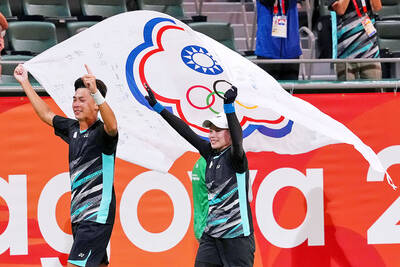
SOFT TENNIS: Yu Kai-wen and Huang Shih-yuan narrowly defeated their Japanese rivals to capture Taiwan’s first gold at the Asian Games in Nagoya Yu Kai-wen (余凱文) and Huang Shih-yuan (黃詩媛) won Taiwan’s first gold of this year’s Asian Games, defeating a Japanese duo in a nail-biter in the soft tennis mixed doubles final in Nagoya, Japan, while Johnny Sun (孫家閎) won silver in wushu and Shih Cheng-chung (石政中) won bronze in men’s kumite. Yu and Huang narrowly defeated Japan’s Toshiki Uematsu and Rena Temma 5-4 (2-4, 5-3, 4-2, 1-4, 1-4, 4-0, 1-4, 4-1, 7-5) to give Taiwan its first gold in soft tennis mixed doubles at an Asian Games since 2018. Sun secured Taiwan’s first wushu medal at this year’s game, with a combined score
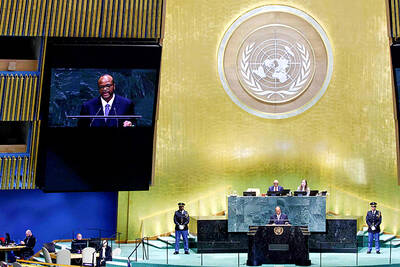
UNITY: Lai thanked the nations who spoke up for Taiwan, saying that democracies must stand together to face global authoritarian expansion Taiwan yesterday thanked eight European and Indo-Pacific countries for opposing unilateral changes to the “status quo” in the Taiwan Strait in a joint statement earlier this week, as well as three of Taiwan’s allies for speaking up for the nation’s participation in the UN at the body’s General Assembly in New York. Minister of Foreign Affairs Lin Chia-lung (林佳龍) welcomed the support and expressed his appreciation for the countries’ stance, the Ministry of Foreign Affairs said in a statement. Foreign ministers and senior representatives of Australia, France, Germany, Japan, New Zealand, Poland, South Korea and the UK issued a statement on Tuesday
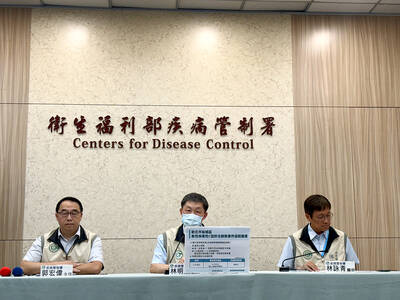
AT-RISK GROUPS: Of the accumulated 1,586 severe cases and 304 related deaths in this flu season, 65.8% were older people and 83.2% had chronic diseases, an official said The Centers for Disease Control (CDC) yesterday said that 165 severe flu cases and 30 flu-related deaths were reported last week, the highest weekly numbers in this flu season, and that cases might continue to increase, urging people to take precautions. Medical visits for flu-like illnesses increased by 1.4 percent to 141,374 last week, with 11.8 percent being emergency visits, showing that the seasonal flu is still in its epidemic period, CDC Epidemic Intelligence Center Director Guo Hung-wei (郭宏偉) said. From Tuesday last week to Monday, 165 severe flu cases and 30 flu-related deaths were confirmed, the highest weekly numbers
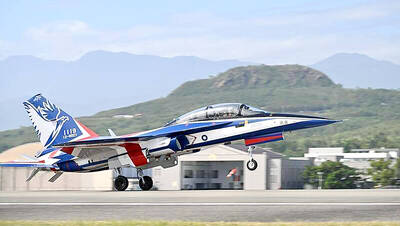
Aerospace Industrial Development Corp (AIDC, 漢翔航空工業) has finished production of the nation’s T-5 Brave Eagle (勇鷹) advanced jet trainers, with the final aircraft scheduled to be formally delivered at a ceremony on Thursday. The delivery of the trainer jets marks the end of the program, which dates back to 2017, with the first prototypes completed in 2019. Fifty-six of the 66 trainers had been delivered as of May. The Brave Eagle was developed and produced by AIDC and the National Chungshan Institute of Science and Technology. The program has provided a foundation for the development of a domestically produced next-generation primary trainer and


 RSS
RSS