


Several groups yesterday came out in support of a care facility for HIV/AIDS sufferers which the Taipei District Court has said must relocate from its current site in a Taipei apartment complex.
The court ruled on Wednesday that the facility for those who are infected with either HIV or full-blown AIDS must relocate from the Chaihsing apartment complex in Taipei's Wenshan District (
Expressing regret over the ruling, the Department of Health said yesterday that it would offer legal assistance to the care facility so that it could appeal the ruling.

PHOTO: FANG PIN-CHAO, TAIPEI TIMES
The court made the ruling on the grounds that residents of the home posed a threat to the psychological health of other people living in the complex.
Dismissing the court ruling as "outrageous and discriminatory against AIDS patients," Nicole Yang (楊捷), founder of the Harmony Home Association which operates the facility, said the association would appeal the case.
The care facility was set up in June last year in an apartment rented to the association by Wang Chi-tong (
After learning that the care facility provides shelter and care for more than 10 HIV-infected children and adults, the complex's management committee called two rounds of meetings in July and August of last year, in which it was agreed that the care facility be relocated within three months.
However, Yang refused to relocate the facility on the grounds that the committee's decision lacked any legal basis and that the building's code of conduct which bans its residents from sheltering any patients with a contagious disease runs against Article 10 of the Constitution which protects freedom of residence and the right to move at will.
The committee then filed a lawsuit to seek a court order for the care facility to be relocated. After four rounds of hearings, the court ruled in the committee's favor.
In the ruling, the court said the committee's demand that the facility be relocated did not violate residential apartment block management regulations.
As to the constitutional provision regarding freedom of residence, the verdict said the Constitution defines relations between the government and private citizens, rather than regulating relations among private citizens.
Moreover, the verdict said that allowing patients with contagious diseases to live in a densely populated community could pose a health threat.
Yang expressed deep regret over the court's failure to send its judge to conduct a field survey before making its ruling. In the course of the hearings, Yang recalled, a judge even suggested that the facility be relocated to a remote or sparsely populated area to avoid "scaring" others or causing anxiety in the neighborhood.
"I disagree with such a suggestion because it would deprive HIV-carriers and AIDS patients of their freedom of residence," Yang said, adding that the verdict simply reflects society's ignorance about HIV/AIDS transmission.
Saying that HIV can only be contracted through sexual intercourse, blood transfusions or breast feeding, Yang said people are not at risk of contracting HIV by simply having an AIDS patient living next door.
"I hope that the public can show some love to AIDS patients and HIV-positive people and allow them to rebuild their lives in the community," she added.

PROVOCATIVE: Chinese Deputy Ambassador to the UN Sun Lei accused Japan of sending military vessels to deliberately provoke tensions in the Taiwan Strait China denounced remarks by Japan and the EU about the South China Sea at a UN Security Council meeting on Monday, and accused Tokyo of provocative behavior in the Taiwan Strait and planning military expansion. Ayano Kunimitsu, a Japanese vice foreign minister, told the Council meeting on maritime security that Tokyo was seriously concerned about the situation in the East China and South China seas, and reiterated Japan’s opposition to any attempt to change the “status quo” by force, and obstruction of freedom of navigation and overflight. Stavros Lambrinidis, head of the EU delegation to the UN, also highlighted South China Sea

The final batch of 28 M1A2T Abrams tanks purchased from the US arrived at Taipei Port last night and were transported to the Armor Training Command in Hsinchu County’s Hukou Township (湖口), completing the military’s multi-year procurement of 108 of the tanks. Starting at 12:10am today, reporters observed more than a dozen civilian flatbed trailers departing from Taipei Port, each carrying an M1A2T tank covered with black waterproof tarps. Escorted by military vehicles, the convoy traveled via the West Coast Expressway to the Armor Training Command, with police implementing traffic control. The army operates about 1,000 tanks, including CM-11 Brave Tiger
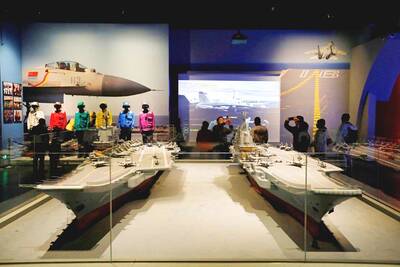
China on Wednesday teased in a video an aircraft carrier that could be its fourth, and the first using nuclear power, while making an allusion to Taiwan and vowing to further build up its islands, as it looks to boost maritime power, secure resources and bolster territorial claims. The video, issued on the eve of the 77th founding anniversary of the Chinese People’s Liberation Army Navy, featured fictional officers with names that are homophones of three commissioned aircraft carriers, the Liaoning (遼寧), Shandong (山東) and Fujian (福建). Titled Into the Deep, it showed a 19-year-old named “Hejian” (何劍) joining the group, sparking

Taiwan Semiconductor Manufacturing Co (TSMC, 台積電), the world’s largest contract chipmaker, said it expects its 2-nanometer (2nm) chip capacity to grow at a compound annual rate of 70 percent from this year to 2028. The projection comes as five fabs begin volume production of 2-nanometer chips this year — two in Hsinchu and three in Kaohsiung — TSMC senior vice president and deputy cochief operating officer Cliff Hou (侯永清) said at the company’s annual technology symposium in Silicon Valley, California, last week. Output in the first year of 2-nanometer production, which began in the fourth quarter of last year, is expected to


 RSS
RSS