


Research into stinky feet, a study on the sound of fingernails on a blackboard and a device that repels teenagers with an annoying high-pitched hum on Thursday won IgNobel prizes -- the humorous counterpart to this week's Nobel prizes.
Other winning research included a US and Israeli team's discovery that hiccups could be cured with a finger up the rectum and a study into why woodpeckers do not get headaches.
"The prizes are intended to celebrate the unusual, honor the imaginative -- and spur people's interest in science, medicine and technology," said Marc Abrahams, editor of the science humor magazine Annals of Improbable Research, which sponsors the awards together with the Harvard-Radcliffe Science Fiction Association and Harvard-Radcliffe Society of Physics Students.
All the research is real and has been published in established scientific and medical journals. However, unlike the Nobel prizes awarded this week by the Swedish Academy of Sciences, IgNobel winners receive no money, little recognition and have virtually no hope of transforming science or medicine.
But they received their awards from real Nobel winners in an event broadcast on the Internet (www.improbable.com) on Thursday evening.
The two-hour ceremony was geek-turned-chic as scientists traded their labcoats for tuxedoes and roared with laughter whenever someone uttered the word "inertia" -- the evening's theme.
Ivan Schwab of the University of California Davis and the late Philip May of the University of California Los Angeles received the ornithology prize for their pioneering work on the ability of the humble woodpecker to avoid head injury.
Wasmia Al-Houty of Kuwait University and Faten Al-Mussalam of the Kuwait Environment Public Authority, took home the nutrition prize for showing that dung beetles are in fact finicky eaters.
Winners had one minute to deliver acceptance speeches, with the time limit strictly policed by an outspoken eight-year-old girl.
Audience members bucked new security regulations intended to curb an IgNobel tradition: throwing paper aeroplanes. Over the course of the event hundreds were hurled at the stage, where Harvard physicist Roy Glauber dutifully swept them up, as he has for the last 10 years.
Glauber joined the ranks of Nobel laureates last year but still insisted on retaining his sweeping duties for the 16th annual ceremony this year.
Despite the gala's irreverent tone, the awards are taken increasingly seriously in the scientific community, with eight of the 10 winners this year paying their own way to attend the ceremony.
One of those unable to attend the ceremony for family reasons was Howard Stapleton of Merthyr Tydfil, Wales, who was awarded the peace prize for inventing an electromechanical teenager repellant.
The device makes an annoying noise designed to be audible to teenagers but not to adults. He later used the same technology to make telephone ringtones that are audible to teenagers but not to their teachers.
Three US scientists, Lynn Halpern, Randolph Blake and James Hillenbrand, won the acoustics prize for experiments to learn why people hate the sound of fingernails on a blackboard.

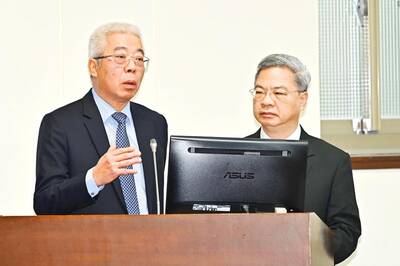
Taiwan has arranged for about 8 million barrels of crude oil, or about one-third of its monthly needs, to be shipped from the Red Sea this month to bypass the Strait of Hormuz and ease domestic supply pressures, CPC Corp, Taiwan (CPC, 台灣中油) said yesterday. The state-run oil company has worked with Middle Eastern suppliers to secure routes other than the Strait of Hormuz, through which about 20 percent of the world’s oil and liquefied natural gas typically passes, CPC chairman Fang Jeng-zen (方振仁) said at a meeting of the legislature’s Economics Committee in Taipei. Suppliers in Saudi Arabia have indicated they
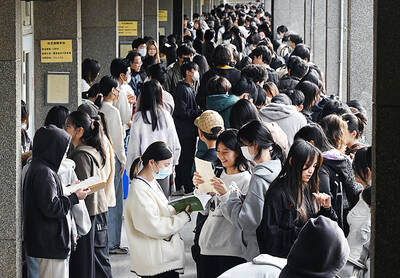
A global survey showed that 60 percent of Taiwanese had attained higher education, second only to Canada, the Ministry of the Interior said. Taiwan easily surpassed the global average of 43 percent and ranked ahead of major economies, including Japan, South Korea and the US, data from the Organisation for Economic Co-operation and Development (OECD) for 2024 showed. Taiwan has a high literacy rate, data released by the ministry showed. As of the end of last year, Taiwan had 20.617 million people aged 15 or older, accounting for 88.5 percent of the total population, with a literacy rate of 99.4 percent, the data

CCP ‘PAWN’? Beijing could use the KMT chairwoman’s visit to signal to the world that many people in Taiwan support the ‘one China’ principle, an academic said Chinese Nationalist Party (KMT) Chairwoman Cheng Li-wun (鄭麗文) yesterday arrived in China for a “peace” mission and potential meeting with Chinese President Xi Jinping (習近平), while a Taiwanese minister detailed the number of Chinese warships currently deployed around the nation. Cheng is visiting at a time of increased Chinese military pressure on Taiwan, as the opposition-dominated Legislative Yuan stalls a government plan for US$40 billion in extra defense spending. Speaking to reporters before going to the airport, Cheng said she was going on a “historic journey for peace,” but added that some people felt uneasy about her trip. “If you truly love Taiwan,

NEW LOW: The council in 2024 based predictions on a pessimistic estimate for the nation’s total fertility rate of 0.84, but last year that rate was 0.69, 17 percent lower An expected National Development Council (NDC) report expects the nation’s population to drop below 12 million by 2065, with the old-age dependency ratio to top 100 percent sooner than 2070, sources said yesterday. The council is slated to release its latest population projections in August, using an ultra-low fertility model, the sources said. The previous report projected that Taiwan’s population would fall to 14.37 million by 2070, but based on a new estimate of the total fertility rate (TFR) — the average number of children born to a woman over her lifetime — the population is expected to reach 12 million by


 RSS
RSS