

An outspoken Hong Kong legislator was mailed a death threat containing a razor blade, it was revealed yesterday, days after a vicious attack on another pro-democracy lawmaker.
Leung Kwok-hung (
The letter, postmarked July 18 but only opened on Monday, warned Leung that if he did not commit suicide within three days, he would be tracked down in the Legislative Council.
"We have received a lot of threatening letters like this in the past, but we have never been threatened with a razor blade," Foo said. Leung is currently away in Europe.
Two weeks ago Audrey Eu (余若薇), a leader of the pro-democracy Civic Party, also received a mailed death threat along with a razor blade.
The latest threat came after Legislator Albert Ho (何俊仁) was badly beaten up by several men in a crowded fast-food restaurant with wooden batons and baseball bats, leaving him with a broken nose and head and face injuries.
Ho appeared in public yesterday for the first time since he was attacked, and he said he believed the assault was linked to his work as a legislator or a lawyer who challenged gangsters.
Wearing blue pajamas and sitting in a wheelchair, Ho told reporters at a hospital that he has handled many legal cases that would "jeopardize the interests" of criminal gangs.
"I will not rule out any possibility that any of these cases might be the cause of the attack," he said.
"I personally believe it has everything to do with my public duty as a legislator or my professional duty as a lawyer," he said.
Lawmakers met with police Commissioner Dick Lee (
"We have very frequent harassment, warning letters, and also criminal damages to our properties, banners and offices,'' Democratic Party Chairman Lee Wing-tat (

PATROL PARTNERS: The ‘Chiayi’ and the ‘Penghu’ departed for a two-day joint patrol of Palau’s exclusive economic zone, the CGA’s second diplomatic visit to the country The Coast Guard Administration (CGA) set a record for its southernmost deployment of a coast guard vessel as the vessels Chiayi and the Penghu reached Palau’s Pulo Anna Island on Saturday in a cooperative exercise between the two countries. The island, about 217 nautical miles (401km) southwest of Koror in the Palauan state of Sonsorol and 1,220 nautical miles from Taiwan’s southernmost point, Oluanpi (鵝鑾鼻), is the furthest south a CGA vessel has sailed. The two vessels are in Palau for the coast guard’s second diplomatic visit to the country. They docked at Malakal Harbor on Tuesday last week. The coast guard

The government is monitoring online rumors that a pneumonic plague outbreak has spread from Russia into China, and it might enhance quarantine measures, Premier Cho Jung-tai (卓榮泰) said yesterday. During a legislative meeting, Democratic Progressive Party Legislator Wang Ting-yu (王定宇) said that rumors had circulated that the disease had spread across several Chinese provinces. He asked Cho whether the government was prepared to prevent the disease spreading to Taiwan, given the volume of traffic between the two sides, and how concerned the government was about the alleged outbreak. The Ministry of Health and Welfare had implemented border quarantine measures after briefing the Executive
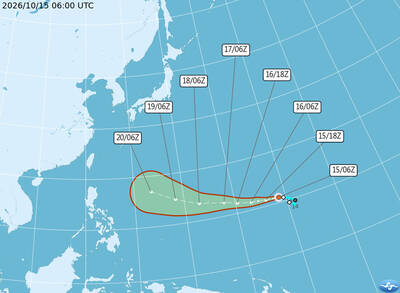
EAST OF GUAM: Tropical Storm Champi is forecast to strengthen into a typhoon, but its effect on Taiwan is uncertain due to the presence of a high-pressure system Tropical Storm Champi formed yesterday and has the potential to increase in strength, the Central Weather Administration (CWA) said yesterday. Forecasters are closely monitoring a Pacific high-pressure system that would dictate whether the storm turns north or moves toward Taiwan next week, the CWA said. The most likely scenario is that it turns northward after passing the Ryukyu Islands, CWA forecaster Cheng Chieh-jen (鄭傑仁) said. As of 8pm yesterday, Champi was east of Guam moving west-northwest at 20kph, CWA data showed. It had maximum sustained winds near the center of 72kph and gusts of up to 101kph, the data showed. If the Pacific high-pressure system
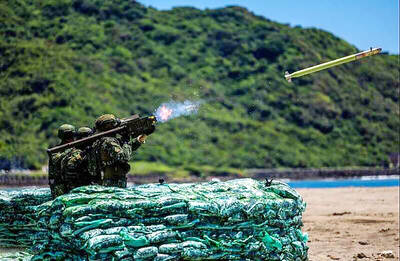
BATCH 1: The military has plans to assign the weapons to the army to defend Taiwan proper, as well as outlying islands and the navy for the Marine Corps, the official said Taiwan is to receive 500 Stinger missiles and 178 launchers from the US by the end of the year, the first batch under a planned two-stage acquisition totaling 2,621 missiles and 763 launchers, a defense official said yesterday on condition of anonymity. The portable missiles would play a vital role in the nation’s air defense capabilities, the source said. The army plans to deploy 2,235 missiles and 657 launchers to defend Taiwan proper and outlying islands, they said, citing military documents. The navy is allotted 295 missiles and 85 launchers to arm the Marine Corps and some surface vessels that lack air defense


 RSS
RSS