


The top US commander in Iraq foresees a major reduction in US forces there by the end of next year, and the first cuts in September, the New York Times reported yesterday.
"According to a classified briefing at the Pentagon this week by the commander, General George W. Casey Jr, the number of American combat brigades in Iraq is projected to decrease to five or six from the current level of 14 by December 2007," the report said, citing unnamed US officials.
"Under the plan, the first reductions would involve two combat brigades that would rotate out of Iraq in September without being replaced. Combat brigades, which generally have about 3,500 troops, do not make up the bulk of the 127,000-member American force in Iraq," it said.

PHOTO: AP
The US officials underscored that "any withdrawals would depend on continued progress, including the development of competent Iraqi security forces, a reduction in Sunni Arab hostility toward the new Iraqi government and the assumption that the insurgency will not expand beyond Iraq's six central provinces," the report said.
The withdrawals are greater than many experts and analysts had expected, the Times said on its Web site in a story to be published in yesterday's edition. The officials spoke of the Pentagon briefing on condition of anonymity, and some described the plan as more of a forecast than a hard timeline.
The number of bases in Iraq would also decline as US forces consolidated, the Times said. By the end of the year, the number of bases would shrink to 57 from the current 69, and by next June there would be 30 bases. By the end of that year, there would be 11, with the US having three principal regional military commands: in Baghdad and the surrounding area, in Anbar Province and the west and in northern Iraq.
"What this process allows is for General Casey to engage with the new Maliki government so it can go from a notional concept to a practical plan of security implementation over the next two years," the Times quoted a White House official as saying.
US Secretary of Defense Donald Rumsfeld said on Thursday that Casey had not yet made his long-awaited recommendation on future troop levels, and would do so after talks with the leaders of Iraq's new government, headed by Prime Minister Nuri al-Maliki.
The plan projects a US role involving a one-year stabilization period, followed by an emphasis on restoring the Iraqi government's authority, also expected to take about a year. The following year was cast as one in which the Iraqi government would be increasingly self-reliant, the Times said.
In Iraq, military officials, who spoke to The Associated Press on condition of anonymity because they were not authorized to disclose the information, said there were plans to start the withdrawal by pulling out two brigades in late summer or early fall. Those troops could include forces currently based in the west of Baghdad and in Salaheddin Province to the north of the capital.
also see story:
Iraqi PM offers partial amnesty
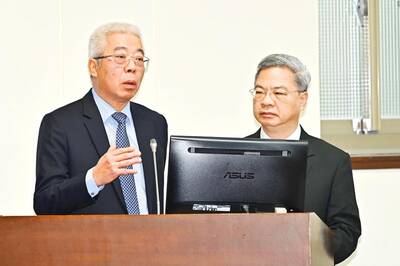
Taiwan has arranged for about 8 million barrels of crude oil, or about one-third of its monthly needs, to be shipped from the Red Sea this month to bypass the Strait of Hormuz and ease domestic supply pressures, CPC Corp, Taiwan (CPC, 台灣中油) said yesterday. The state-run oil company has worked with Middle Eastern suppliers to secure routes other than the Strait of Hormuz, through which about 20 percent of the world’s oil and liquefied natural gas typically passes, CPC chairman Fang Jeng-zen (方振仁) said at a meeting of the legislature’s Economics Committee in Taipei. Suppliers in Saudi Arabia have indicated they
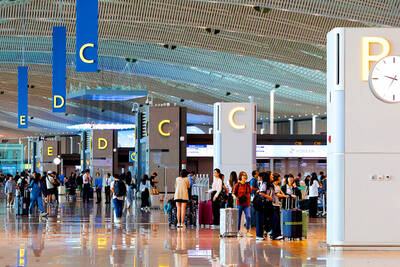
South Korea has adjusted its electronic arrival card system to no longer list Taiwan as a part of China, a move that the Ministry of Foreign Affairs said would help facilitate exchanges between the two sides. South Korea previously listed “Taiwan” as “Taiwan (China)” in the drop-down menus of its online arrival card system, where people had to fill out where they came from and their next destination. The ministry had requested South Korea make a revision and said it would change South Korea’s name on Taiwan’s online immigration system from “Republic of Korea” to “Korea (South),” should the issue not be
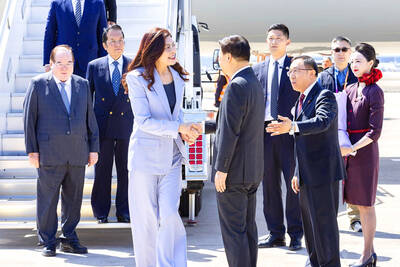
CCP ‘PAWN’? Beijing could use the KMT chairwoman’s visit to signal to the world that many people in Taiwan support the ‘one China’ principle, an academic said Chinese Nationalist Party (KMT) Chairwoman Cheng Li-wun (鄭麗文) yesterday arrived in China for a “peace” mission and potential meeting with Chinese President Xi Jinping (習近平), while a Taiwanese minister detailed the number of Chinese warships currently deployed around the nation. Cheng is visiting at a time of increased Chinese military pressure on Taiwan, as the opposition-dominated Legislative Yuan stalls a government plan for US$40 billion in extra defense spending. Speaking to reporters before going to the airport, Cheng said she was going on a “historic journey for peace,” but added that some people felt uneasy about her trip. “If you truly love Taiwan,

Tainan, Taipei and New Taipei City recorded the highest fines nationwide for illegal accommodations in the first quarter of this year, with fines issued in the three cities each exceeding NT$7 million (US$220,639), Tourism Administration data showed. Among them, Taipei had the highest number of illegal short-term rental units, with 410. There were 3,280 legally registered hotels nationwide in the first quarter, down by 14 properties, or 0.43 percent, from a year earlier, likely indicating operators exiting the market, the agency said. However, the number of unregistered properties rose to 1,174, including 314 illegal hotels and 860 illegal short-term rental


 RSS
RSS