


Security forces from rival Palestinian factions paraded through the streets of Gaza yesterday, sometimes within meters of one another, intensifying fears of a showdown between the heavily armed groups.
Bearded young men armed with AK-47s and dressed in military fatigues, part of a new 3,000-strong Hamas-backed force, held ground on many streets, while a bolstered police force loyal to Palestinian President Mahmoud Abbas paraded nearby.
For residents of Gaza City, there was a mix of confusion and concern, with some unsure exactly which armed men were loyal to which faction, and whether the extra presence would mean greater security or an inevitable showdown between the groups.
"I wonder when the zero hour will come," one passerby said as he watched the two forces maneuver through Gaza City, referring to intensifying fears of all-out conflict.
For others there was confusion.
"Are you police or are you Hamas?" an elderly man asked gunmen as they moved down one street.
"We are the executive force," one bearded young man from Hamas replied, leaving 65-year-old Abu Ahmed none the wiser.
The Hamas-backed force, formed under the authority of Interior Minister Saeed Seyam, was deployed on Wednesday in a challenge to the authority of Abbas, whose Fatah movement was defeated by the Islamic militant group in elections in January.
In response, Abbas ordered the deployment of a bolstered, Fatah-loyal police force onto the streets, a show of force that was still taking place yesterday.
The decision marked the latest step in a deepening power struggle between Abbas and Prime Minister Ismail Haniyeh, whose Hamas Islamic militant movement took power in March.
In parts of Gaza, members of the Hamas force stood within meters of regular policemen. At one point, hundreds of Fatah-loyal gunmen marched by as part of the training course. Hamas members stood in silence but showed no sign of responding.
"Force 17, Force 17," the men chanted.
Force 17 is an elite Palestinian security force loyal to Abbas.
The policemen were unarmed, but were followed by commanders in jeeps, their weapons raised.
"Jerusalem, the president, the homeland," the officers chanted, clapping and whistling.
General Suleiman Hilles, commander of Palestinian security forces in the West Bank and Gaza, said in a statement that the forces were deployed to send a message that "the Palestinian police is the only side that can maintain law and order."
Hamas men said they had no intention of sparking clashes.
"We were deployed in accordance with the decision by the minister of interior," one Hamas commander said.
"Our mission is to assist the police to do their job in ending chaos and anarchy. We will not hesitate to do so," he said.
The rival displays come amid growing insecurity in Gaza, with at least five gunmen from Fatah and Hamas killed this month, and many more injured.
"We have become a people with two heads, Abbas and Haniyeh," Abu Ahmed said as he walked past the Hamas force.
"I really do not know whether those young men are a solution to the chaos or a recipe for war," he said.
Palestinian political analyst Hani Habib said residents' fears were real and legitimate.
"I am also worried that friction between the forces will lead Gaza towards catastrophe," he said.
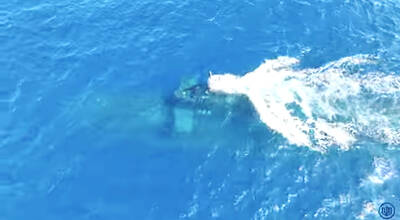
CSBC Corp, Taiwan (台灣國際造船) yesterday released the first video documenting the submerged sea trials of Taiwan’s indigenous defense submarine prototype, the Hai Kun (海鯤), or Narwhal, showing underwater navigation and the launch of countermeasures. The footage shows the vessel’s first dive, steering and control system tests, and the raising and lowering of the periscope and antenna masts. It offered a rare look at the progress in the submarine’s sea acceptance tests. The Hai Kun carried out its first shallow-water diving trial late last month and has since completed four submerged tests, CSBC said. The newly released video compiles images recorded from Jan. 29 to
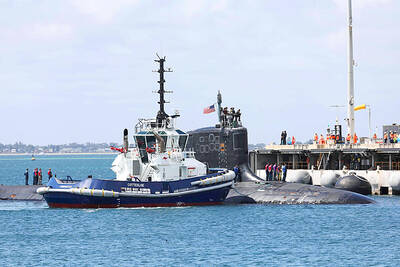
DETERRENCE EFFORTS: Washington and partners hope demonstrations of force would convince Beijing that military action against Taiwan would carry high costs The US is considering using HMAS Stirling in Western Australia as a forward base to strengthen its naval posture in a potential conflict with China, particularly over Taiwan, the Wall Street Journal reported on Saturday. As part of its Indo-Pacific strategy, Washington plans to deploy up to four nuclear-powered submarines at Stirling starting in 2027, providing a base near potential hot spots such as Taiwan and the South China Sea. The move also aims to enhance military integration with Pacific allies under the Australia-UK-US trilateral security partnership, the report said. Currently, US submarines operate from Guam, but the island could
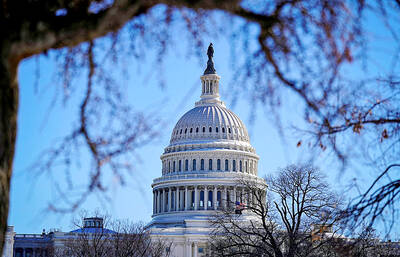
RESTRAINTS: Should China’s actions pose any threat to Taiwan’s security, economic or social systems, China would be excluded from major financial institutions, the bill says The US House of Representatives on Monday passed the PROTECT Taiwan Act, which states that Washington would exclude China from participating in major global financial organizations if its actions directly threaten Taiwan’s security. The bill, proposed by Republican Representative Frank Lucas, passed with 395 votes in favor and two against. It stipulates that if China’s actions pose any threat to Taiwan’s security, economic or social systems, the US would, “to the maximum extent practicable,” exclude Beijing from international financial institutions, including the G20, the Bank for International Settlements and the Financial Stability Board. The bill makes it clear that China must be prepared

Taiwanese trade negotiators told Washington that Taipei would not relocate 40 percent of its semiconductor production to the US, and that its most advanced technologies would remain in the nation, Vice Premier Cheng Li-chiun (鄭麗君) said on Sunday. “I told the US side very clearly — that’s impossible,” Cheng, who led the negotiation team, said in an interview that aired on Sunday night on Chinese Television System. Cheng was referring to remarks last month by US Secretary of Commerce Howard Lutnick, in which he said his goal was to bring 40 percent of Taiwan’s chip supply chain to the US Taiwan’s almost


 RSS
RSS