


It is not only Taiwanese politicians who are eager to learn Hoklo (commonly known as "Taiwanese"). An increasing number of well known international universities -- including nine institutions each in Japan and the US -- are now offering accredited Hoklo language classes.
Last year, the Hoklo language craze reached Europe, where France's Universite de Lyon III added a Hoklo language program to its Chinese department, making it the first European university to offer such a program.
Professor Liu Kuang-neng (
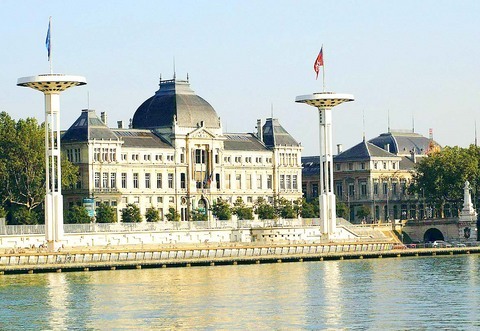
PHOTO COURTESY OF PROFESSOR LIU KUANG-NENG, NATIONAL CENTRAL UNI
Gregory Lee (
The Universite de Lyon III's post-graduate Taiwanese Studies program is divided into two parts.
The first year of the program offers classes in Taiwanese film studies, and the second year focuses on Taiwanese history classes.
Liu said that although there are not very many students in the program now, it serves as a bridge for young French students who want to learn more about Taiwan.
Lee arrived with the university's president, Guy Lavorel, on Sunday evening, for a one-week stay.
The aim of their trip is to visit the institutes for Taiwanese literature at National Central University, National Taiwan University and Tsing Hua University in order to initiate exchanges with the three schools.
The National Central Library will also present the Universite de Lyon III with books on Taiwan studies.
On Thursday, Lavorel is scheduled to give a speech at National Central University.
Liu said that the fact that the EU promotes cultural diversity will help promote attempts to set up Hoklo-language programs in Chinese departments at universities throughout the EU.
By taking advantage of this wave of interest to initiate active exchanges with European universities and build a good impression of Taiwan in the eyes of young Europeans, the nation will be able to connect with the international community.
Learning Hoklo
Overseas universities and colleges offering courses in the Hoklo language.
Japan:
Nagoya University of Foreign Studies
Aichi University
Tenri University
Tokyo University of Foreign Studies
Reitaku University
Daitobunka University
Keiyo University
Obirin University
Tsukuba University
North America:
University of Hawaii
University of California, Berkeley
Pennsylvania State University
Stanford University
Williams College
University of Michigan
Harvard University
University of Illinois
University of Colorado
Universities where student societies offer informal tuition in Hoklo: Yale University, Columbia University, Princeton University, Brown University and Massachussetts Institute of Technology.
Europe:
University de Lyon III
SourceL Professors Li Chin-an and Liu Kuang-neng.
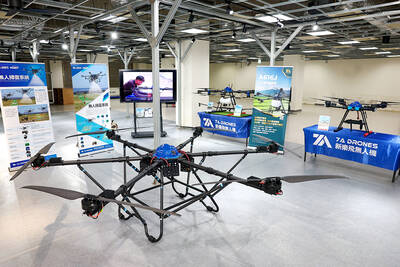
DRONE CENTRAL: Taiwan aims to become Asia’s democratic hub for drones, with most exports focused on high-quality military-grade models, an official said Taiwan’s drone industry is expected to expand significantly by 2030, producing 100,000 units per month and exporting half of them, the Ministry of Economic Affairs said yesterday. Current drone production capacity is about 15,000 units per month, but the industry can quickly scale up as demand increases, Industrial Development Administration Director-General Chiou Chyou-huey (邱求慧) told a news conference in Taipei. Taiwan’s drone output grew 2.5-fold last year to NT$12.9 billion (US$408.3 million) under a government program to develop the uncrewed vehicle sector, he said. The Executive Yuan in October last year approved plans to invest NT$44.2 billion into domestic production of uncrewed aerial
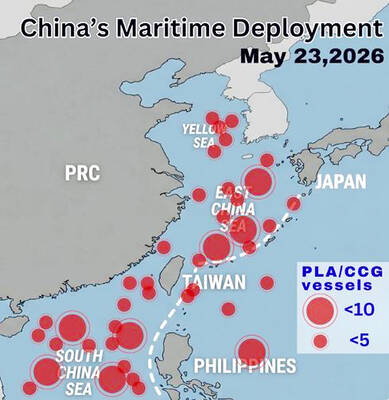
WARNING: China should stop engaging in actions that undermine regional peace and stability, as it would only build resentment among people across the Strait, the CGA said China has deployed more than 100 navy, coast guard and other vessels in waters from the Yellow Sea to the South China Sea and the western Pacific since US President Donald Trump and Chinese President Xi Jinping (習近平) met in Beijing, National Security Council Secretary-General Joseph Wu (吳釗燮) said yesterday. “In this part of the world, #China is the one & only PROBLEM wrecking the #StatusQuo & threatening regional peace & stability,” Wu wrote on X. In a separate post, he said Beijing was coercing Taiwan’s maritime domain, calling it illegal and provocative, after the Coast Guard Administration (CGA) expelled a

VERBOSE VESSELS: A CGA cutter and a China Coast Guard exchanged verbal barbs for more than a day in Taiwanese-controlled waters before the Chinese vessel left The Taiwanese and Chinese coast guards had a standoff near the strategically located Pratas Islands (Dongsha Islands, 東沙群島) in the north of the South China Sea, the Coast Guard Administration (CGA) said yesterday. The two sides engaged in intense radio exchanges over sovereignty claims during the 33-hour standoff. China Coast Guard vessel 3501 eventually left the restricted waters, 26.6 nautical miles (49.2km) west of the Pratas Islands, at 5pm yesterday, the CGA said. Lying approximately between southern Taiwan and Hong Kong, the Taiwan-controlled Pratas are seen by some security experts as vulnerable to Chinese attack due to their distance — more than
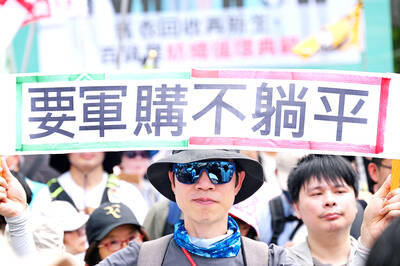
More than 8,000 people took part in a rally in Taipei yesterday to express support for more defense spending, after the opposition slashed the Cabinet’s proposed NT$1.25 trillion (US$39.6 billion) special defense budget and capped it at NT$780 billion. The demonstrators urged the Cabinet to propose another bill. Taiwan Economic Democracy Union convener Lai Chung-chiang (賴中強) said the main problem of the passed budget plan is the removal of funding for critical items, not just that the total amount is smaller. Critical budget items included purchasing or developing uncrewed vehicles, Strong Bow (強弓) missile systems, additional ammunition, artificial intelligence-powered combat systems and Taiwan-US


 RSS
RSS