


President Chen Shui-bian (
"Although the president did not tell me a specific date when the final decision will be made, my impression is that he is very determined to do it and that he cannot and will not delay the process or cancel the plan," the source said.
Chen has said that he would like to see the National Security Council come up with a report on the political and legal repercussions of the plan by the end of the month.
Sanlih Entertainment Television claimed yesterday that the final announcement would be made on March 14, the first anniversary of China's "Anti-Secession" Law.
The TV station said the date had been selected on Feb. 20 when Chen met Presidential Office Secretary-General Mark Chen (
Chen Chin-jun later dismissed the TV station's report, saying that the March 14 date was his own personal speculation.
Other sources have speculated that the announcement would be made on Feb. 28, the 59th anniversary of the 228 Incident, in which tens of thousands of Taiwanese were killed by rampaging Nationalist troops.
The Presidential Office source said Chen Shui-bian had been under tremendous pressure since announcing on Lunar New Year's Day that the time was ripe to seriously consider abolishing the unification council and guidelines.
The source said he thought the president should insist on doing whatever he feels needs to be done.
"If he flinches, the consequences would be so severe that it would hurt not only him but also the party and the country," the source said.
The administration does not expect the US government to agree to everything we say or do, but it can make every effort to make them understand, the source said.
"It is impossible for two countries, including the US and its allies such as Canada or the UK, to see eye to eye on everything," the source said. "It is useless to beat around the bush with them. It is very easy for them to look down upon us if we are not sure about what we want to do and don't speak up for ourselves."
In other developments, China yesterday issued another volley of rhetoric against Chen Shui-bian, branding his plan to kill off the unification council as a "dangerous provocation."
A signed commentary by China's state-run Xinhua news agency said the president's move was aimed at diverting attention from a listless domestic economy and consolidating power.
"Taiwan's independence forces declared some propositions, they are all dangerous signals," Chinese Foreign Ministry spokesman Liu Jianchao (
"To maintain stability across the Taiwan Strait is in the interests of China and other countries, so we hope relevant countries are on alert to the wrong actions and dangerous activities by Taiwan forces," Liu said.
also see stories:
KMT proposes censuring Chen over abolition plan
The gambit behind the NUC's removal

South Korea has adjusted its electronic arrival card system to no longer list Taiwan as a part of China, a move that the Ministry of Foreign Affairs said would help facilitate exchanges between the two sides. South Korea previously listed “Taiwan” as “Taiwan (China)” in the drop-down menus of its online arrival card system, where people had to fill out where they came from and their next destination. The ministry had requested South Korea make a revision and said it would change South Korea’s name on Taiwan’s online immigration system from “Republic of Korea” to “Korea (South),” should the issue not be

Tainan, Taipei and New Taipei City recorded the highest fines nationwide for illegal accommodations in the first quarter of this year, with fines issued in the three cities each exceeding NT$7 million (US$220,639), Tourism Administration data showed. Among them, Taipei had the highest number of illegal short-term rental units, with 410. There were 3,280 legally registered hotels nationwide in the first quarter, down by 14 properties, or 0.43 percent, from a year earlier, likely indicating operators exiting the market, the agency said. However, the number of unregistered properties rose to 1,174, including 314 illegal hotels and 860 illegal short-term rental
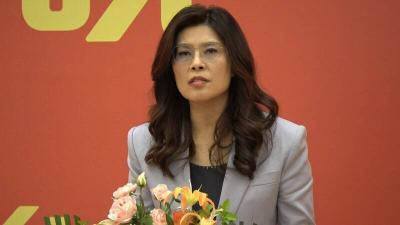
Both sides of the Taiwan Strait share a political foundation based on the “1992 consensus” and opposition to Taiwanese independence, Chinese Nationalist Party (KMT) Chairwoman Cheng Li-wun (鄭麗文) today said during her meeting with Chinese President Xi Jinping (習近平). Both sides of the Strait should plan and build institutionalized and sustainable mechanisms for dialogue and cooperation based on that foundation to make peaceful development across the Strait irreversible, she said. Peace is a shared moral value across the Strait, and both sides should move beyond political confrontation to seek institutionalized solutions to prevent war, she said. Mutually beneficial cross-strait relations are what the
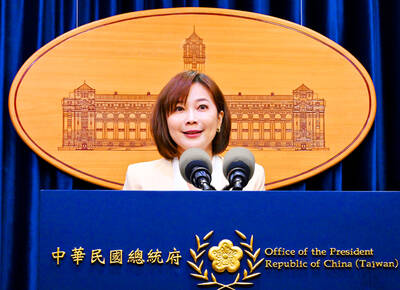
ECONOMIC COERCION: Such actions are often inconsistently applied, sometimes resumed, and sometimes just halted, the Presidential Office spokeswoman said The government backs healthy and orderly cross-strait exchanges, but such arrangements should not be made with political conditions attached and never be used as leverage for political maneuvering or partisan agendas, Presidential Office spokeswoman Karen Kuo (郭雅慧) said yesterday. Kuo made the remarks after China earlier in the day announced 10 new “incentive measures” for Taiwan, following a landmark meeting between Chinese President Xi Jinping (習近平) and Chinese Nationalist Party (KMT) Chairwoman Cheng Li-wun (鄭麗文) in Beijing on Friday. The measures, unveiled by China’s Xinhua news agency, include plans to resume individual travel by residents of Shanghai and China’s Fujian


 RSS
RSS