


Surfers, swimmers and sunbathers were outnumbered by police at Sydney beaches yesterday as road blocks were set up and most people listened to advice to stay away, heeding warnings of further riots.
Up to 2,000 police, including riot and dog squads backed by helicopters and boats, were deployed over the weekend to patrol troubled beaches in Australia's largest city and to the north and south.
The popular Cronulla beach in south Sydney, where racial violence first erupted last Sunday, was nearly deserted as police staged random vehicle searches on approach roads, national radio said.
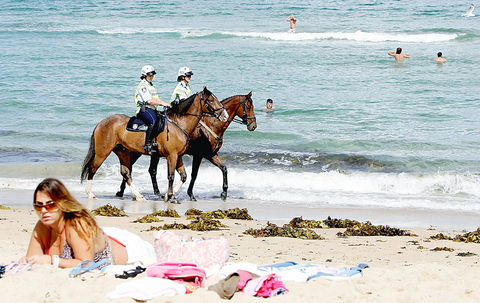
PHOTO: AP
There were no reports of violence by nightfall but police were maintaining patrols in troubled areas throughout the night and said they would turn out in force at the beaches again ontoday.
A special task force set up to crack down on the violence made 19 arrests on Friday night, including one in which swords and a dagger were found in a car.
But most were for drunk driving, traffic and drug offences, police said.
Dozens of people were injured and arrested in riots after white mobs set out to "reclaim the beach" from groups of Arab-Australians, mainly ethnic Lebanese, at Cronulla last Sunday, sparking days of revenge attacks.
The New South Wales parliament was recalled from its summer recess last week to pass legislation giving police extra powers to combat unrest, and police said intelligence indicated gangs would target the beaches again this weekend.
"I would urge people who do not live in these areas to stay away unless they have a good reason to be there," police chief Ken Moroney said.
It was a surprising call in a country that thrives on Australia's combination of sun, sea and sand, but early indications were that it was being taken seriously.
The mayor of Sutherland Shire, which includes Cronulla, had called on beachgoers to defy requests not to visit the beach, saying local businesses had been hard hit as people stayed away over the past week.
"I urge honest law-abiding people who want to spend a nice, non-violent day of fun in the sun to make their way to Cronulla and help support those innocent business operators," he said.
However, the city's media have reported throughout the week on e-mail, mobile phone and Web site messages calling for more "protests."
Visitors to one newly established Web site were asked to meet near Cronulla yesterday for a rally against "home-grown terrorist gangs" -- a reference to the people of Middle Eastern appearance targeted last weekend.
The Sydney Morning Herald reported that one neo-Nazi Web site called for fresh shows of strength in Sydney and the western city of Perth, while "on a usually laid-back surfing Web site there is a post urging protesters to set fire to a Sydney mosque."
The government announced a new A$440,000 (US$330,000) program to promote respect and understanding between ethnic groups, including encouraging non-Anglo Australians to become lifesavers.
"We want to have a program which basically educates everybody on how to behave on the beach," said Minister for Multicultural Affairs John Cobb.
Many residents of the middle-class Cronulla suburb had complained that groups of ethnic Lebanese from poorer inner-city suburbs descend on the beach at weekends and disrupt the easygoing atmosphere with aggressive behavior.
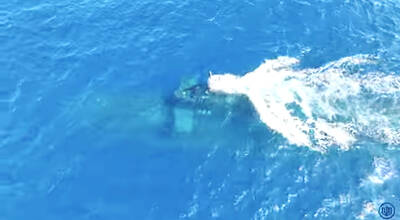
CSBC Corp, Taiwan (台灣國際造船) yesterday released the first video documenting the submerged sea trials of Taiwan’s indigenous defense submarine prototype, the Hai Kun (海鯤), or Narwhal, showing underwater navigation and the launch of countermeasures. The footage shows the vessel’s first dive, steering and control system tests, and the raising and lowering of the periscope and antenna masts. It offered a rare look at the progress in the submarine’s sea acceptance tests. The Hai Kun carried out its first shallow-water diving trial late last month and has since completed four submerged tests, CSBC said. The newly released video compiles images recorded from Jan. 29 to
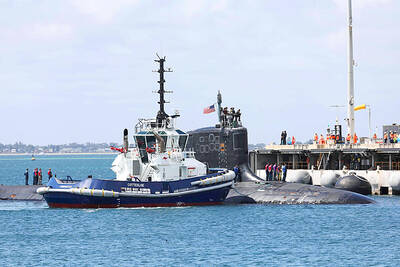
DETERRENCE EFFORTS: Washington and partners hope demonstrations of force would convince Beijing that military action against Taiwan would carry high costs The US is considering using HMAS Stirling in Western Australia as a forward base to strengthen its naval posture in a potential conflict with China, particularly over Taiwan, the Wall Street Journal reported on Saturday. As part of its Indo-Pacific strategy, Washington plans to deploy up to four nuclear-powered submarines at Stirling starting in 2027, providing a base near potential hot spots such as Taiwan and the South China Sea. The move also aims to enhance military integration with Pacific allies under the Australia-UK-US trilateral security partnership, the report said. Currently, US submarines operate from Guam, but the island could
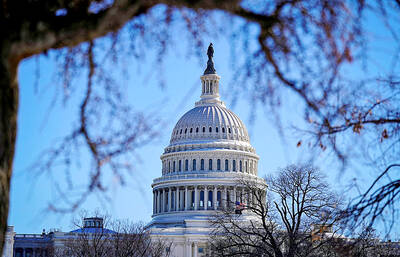
RESTRAINTS: Should China’s actions pose any threat to Taiwan’s security, economic or social systems, China would be excluded from major financial institutions, the bill says The US House of Representatives on Monday passed the PROTECT Taiwan Act, which states that Washington would exclude China from participating in major global financial organizations if its actions directly threaten Taiwan’s security. The bill, proposed by Republican Representative Frank Lucas, passed with 395 votes in favor and two against. It stipulates that if China’s actions pose any threat to Taiwan’s security, economic or social systems, the US would, “to the maximum extent practicable,” exclude Beijing from international financial institutions, including the G20, the Bank for International Settlements and the Financial Stability Board. The bill makes it clear that China must be prepared

Taiwanese trade negotiators told Washington that Taipei would not relocate 40 percent of its semiconductor production to the US, and that its most advanced technologies would remain in the nation, Vice Premier Cheng Li-chiun (鄭麗君) said on Sunday. “I told the US side very clearly — that’s impossible,” Cheng, who led the negotiation team, said in an interview that aired on Sunday night on Chinese Television System. Cheng was referring to remarks last month by US Secretary of Commerce Howard Lutnick, in which he said his goal was to bring 40 percent of Taiwan’s chip supply chain to the US Taiwan’s almost


 RSS
RSS