


Fears of avian flu spreading deepened yesterday after China reported another outbreak in poultry while India said it was testing blood samples from 10 dead migratory birds.
Croatia said yesterday that tests had confirmed the lethal H5N1 bird flu strain in dead wild swans found in eastern Croatia last week. The strain has already been confirmed in Turkey, Romania and European Russia.
There has been a spate of fresh cases in Asia and on the eastern edge of Europe ahead of the winter when H5N1 seems to thrive, experts say.
Scientists believe that migratory birds escaping the harsh northern winter are helping spread the virus, and governments around the world are nervously monitoring their borders and testing wild birds that are landing on their shores.
In China's latest case of H5N1 infection, the third since last week, hundreds of chickens and ducks died in a village in Hunan Province.
China had notified the UN of the latest outbreak near the provincial capital Changsha on Tuesday, according to a notice on the Web site of the World Organization for Animal Health.
"The outbreak has been effectively controlled," the Agriculture Daily newspaper said.
China reported another outbreak among farm geese in Anhui Province on Tuesday and said it had also been brought under control, with no reported human infections.
INDIA PROBE
In India, officials are trying to find out what had killed 10 dead migratory birds in West Bengal state, a state minister reported yesterday.
"We are not taking any chances and have sent the blood samples for avian flu tests," West Bengal Animal Resources Development Minister Anisur Rahaman said.
West Bengal forest officials said that around 40 dead birds had been found in one of the state's five bird sanctuaries over the past week.
But he added that the birds could have died after falling from their nests during a storm.
In Thailand, where 13 people have died of bird flu, the government has reactivated a network of almost 1 million health monitors to try to halt the spread of the disease after new outbreaks in poultry were confirmed in five provinces.
MINISTERS
Meanwhile, health ministers and experts from 30 countries gathered on Tuesday in Ottawa, Canada, to discuss the growing threat of avian influenza.
They agreed a coordinated international effort was needed to stop a possible pandemic, but offered no measures and little help for poorer countries.
At the end of two days of meetings, delegates said in a statement that they had taken "important steps towards security and long-term, sustained political and institutional engagement to address global pandemic influenza preparedness."
In fact, the countries yielded to the World Health Organization (WHO) to lead the charge against the H5N1 virus, with others playing only supporting roles.
A proposal by Mexico and Thailand for wealthy countries to share 5 to 10 percent of their flu vaccine stockpiles with developing countries gained too little support to proceed.
Instead, Canada and the US pressed for developing countries to rely on the WHO's stockpile of anti-viral drugs and vaccines to stop future outbreaks -- amounting to about 30 million doses for 3 million people.
India and Taiwan said on Monday that they might allow their drug-makers to copy Tamiflu without obtaining a license from Roche, the Swiss maker of the anti-viral drug believed to be the best human defense against bird flu, according to reports.
But Roche cautioned countries against producing their own generic versions of the popular drug. Its patent is protected until 2016.
Australian Health Minister Tony Abbott said the proposal would not alleviate the dearth of manufacturing capacity.
"This idea that we could have as much Tamiflu as we want if only Roche would allow people is just not right," he said.
US Health and Human Services Secretary Michael Leavitt agreed and said the US "will be respecting intellectual property and patents."
"It should be universally understood that this shortage of vaccines manufacturing is likely to persist for some time because it is impossible to dramatically increase vaccine production overnight," Leavitt said.
The two-day Ottawa conference was the first to bring together both health ministers and experts from around the world, including Britain, China, Indonesia, Kazakhstan, Mexico, Nigeria, South Africa and the US, as well as representatives from the WHO, the UN Food and Agriculture Organization, and the World Organization for Animal Health, to discuss avian influenza.
also see story:
Groups demand new WTO rules
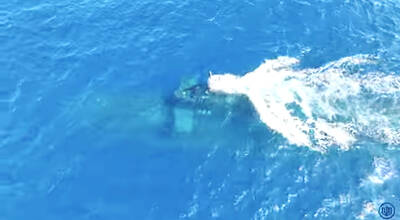
CSBC Corp, Taiwan (台灣國際造船) yesterday released the first video documenting the submerged sea trials of Taiwan’s indigenous defense submarine prototype, the Hai Kun (海鯤), or Narwhal, showing underwater navigation and the launch of countermeasures. The footage shows the vessel’s first dive, steering and control system tests, and the raising and lowering of the periscope and antenna masts. It offered a rare look at the progress in the submarine’s sea acceptance tests. The Hai Kun carried out its first shallow-water diving trial late last month and has since completed four submerged tests, CSBC said. The newly released video compiles images recorded from Jan. 29 to
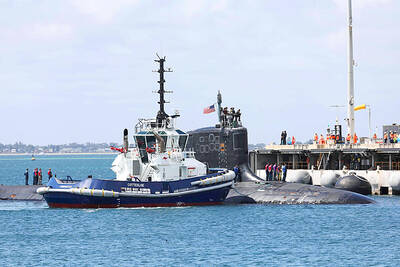
DETERRENCE EFFORTS: Washington and partners hope demonstrations of force would convince Beijing that military action against Taiwan would carry high costs The US is considering using HMAS Stirling in Western Australia as a forward base to strengthen its naval posture in a potential conflict with China, particularly over Taiwan, the Wall Street Journal reported on Saturday. As part of its Indo-Pacific strategy, Washington plans to deploy up to four nuclear-powered submarines at Stirling starting in 2027, providing a base near potential hot spots such as Taiwan and the South China Sea. The move also aims to enhance military integration with Pacific allies under the Australia-UK-US trilateral security partnership, the report said. Currently, US submarines operate from Guam, but the island could
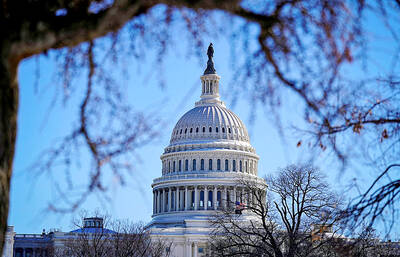
RESTRAINTS: Should China’s actions pose any threat to Taiwan’s security, economic or social systems, China would be excluded from major financial institutions, the bill says The US House of Representatives on Monday passed the PROTECT Taiwan Act, which states that Washington would exclude China from participating in major global financial organizations if its actions directly threaten Taiwan’s security. The bill, proposed by Republican Representative Frank Lucas, passed with 395 votes in favor and two against. It stipulates that if China’s actions pose any threat to Taiwan’s security, economic or social systems, the US would, “to the maximum extent practicable,” exclude Beijing from international financial institutions, including the G20, the Bank for International Settlements and the Financial Stability Board. The bill makes it clear that China must be prepared

Taiwanese trade negotiators told Washington that Taipei would not relocate 40 percent of its semiconductor production to the US, and that its most advanced technologies would remain in the nation, Vice Premier Cheng Li-chiun (鄭麗君) said on Sunday. “I told the US side very clearly — that’s impossible,” Cheng, who led the negotiation team, said in an interview that aired on Sunday night on Chinese Television System. Cheng was referring to remarks last month by US Secretary of Commerce Howard Lutnick, in which he said his goal was to bring 40 percent of Taiwan’s chip supply chain to the US Taiwan’s almost


 RSS
RSS