


The Bank of China and two banks based in Macau are under US scrutiny for possible connections to North Korea's illicit fundraising network, which Washington believes finances Pyongyang's nuclear program, the Wall Street Journal reported yesterday.
A Hong Kong spokeswoman for Bank of China, Clarina Man (
In a written response to faxed questions from the Journal, she added that the bank has "always been attaching great importance to anti-money-laundering activities."
The banks, which could face stiff sanctions, are caught up in a US operation to shut down lucrative North Korean enterprises producing narcotics, counterfeit US currency and fake cigarettes, the newspaper said.
It said law-enforcement officials from several countries described the wide-ranging US operation, while several North Korean defectors gave accounts of Pyongyang's financial network.
The operation comes as multilateral negotiations aimed at dismantling North Korea's nuclear-weapons program are set to resume next week, with China playing a key role.
PUBLIC OFFERING
It also comes amid plans for an initial public offering next year by Bank of China, which recently hired the Goldman Sachs Group of New York, to prepare the move. Recently, Bank of China secured a pledge of US$3.1 billion in investment from a consortium that includes Royal Bank of Scotland Group, Merrill Lynch & Co and Hong Kong billionaire Li Ka-shing (
The affair is also likely to reverberate in Asia because of the wealthy players behind the two Macau banks, the report said.
One of the Macau lenders, Banco Delta Asia, is controlled by Stanley Au (區宗傑), a major player in the Hong Kong financial markets who is also a legislator in Macau and serves as an adviser to the Chinese government.
The other bank, Seng Heng Bank, is controlled by billionaire gambling tycoon Stanley Ho (何鴻燊), who started a casino in Pyongyang and has close ties to Pyongyang and Beijing.
The Journal said that executives at Banco Delta Asia had no comment.
A spokesman for Seng Heng Bank told the newspaper: "We have nothing to provide you. We have no comment."
UNDER SCRUTINY
Banco Delta Asia, a unit of Delta Asia Financial Group, has been under scrutiny by the US Secret Service and other US agencies since a publicly disclosed 1994 counterfeiting case by the Secret Service and Macau police that led to the arrests of North Korean officials in Macau, the Journal said.
The bank is a top candidate for being placed on a Treasury Department blacklist of entities allegedly involved in money laundering, people familiar with the matter said. Inclusion on the blacklist, which could be proposed shortly, could make it difficult for the bank to do business internationally.
Talks with North Korea on dismantling its nuclear program will resume next week, China said yesterday, but Pyongyang raised a possible obstacle to progress by renewing its demands for the withdrawal of US troops from the Korean Peninsula as a sign of good faith.
Talks are due to resume this Tuesday, Chinese Foreign Ministry spokesman Qin Gang (

‘NO SECURITY RISK’: The Railway Bureau reassured the public that the technicians’ activities were limited to technical guidance and did not involve sensitive systems The Railway Bureau yesterday said it had invited eight Chinese technicians to assist with an airport MRT construction project. The bureau issued the confirmation after an Internet user said Chinese nationals had entered the construction zone of Taiwan Taoyuan International Airport’s Terminal 3 project. They asked why “individuals from an enemy state” were allowed access to such a major national infrastructure project, which raised serious concerns over Taiwan’s industrial safety, sensitive systems and information security. The bureau’s Northern Region Engineering Branch Office said subcontractor Taiwan Handle Industrial Co (台灣手把工業) of the Taoyuan airport MRT’s “Contract No. CU05 Project A14 Station Civil, MEP &

The National Chungshan Institute of Science and Technology yesterday showcased its locally developed variants of the Vision 60 robotic patrol dog, which it plans to deploy on the nation’s outlying territories in the South China Sea. The variants were produced under the Joint Lab project — created by the institute and domestic companies — and assembled with domestically produced motors, lenses and artificial intelligence (AI) systems alongside licensed tech from the US, Missile and Rocket Systems Research Division deputy director Jen Kuo-kang (任國光) told the media event at a military base in Taipei’s Dazhi (大直) area. Taiwan has built up its strengths
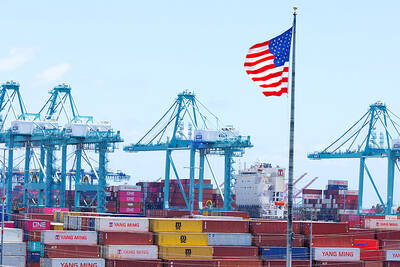
NOT IMMEDIATE: Taiwan has a chance to appeal the proposed 10 percent tariff before it starts, while other countries face a 12.5 percent tariff from the trade office Taiwan is among 60 economies determined by the US to have failed to impose or enforce a ban on the importation of goods produced with forced labor, according to a notice released on Tuesday by the Office of the US Trade Representative (USTR), which proposed imposing an additional 10 percent or more tariff on them. The USTR in a statement said that following an investigation, it had determined under Section 301 of the Trade Act of 1974 that the failure of the 60 economies to impose and effectively enforce a prohibition on the importation of goods produced with forced labor is
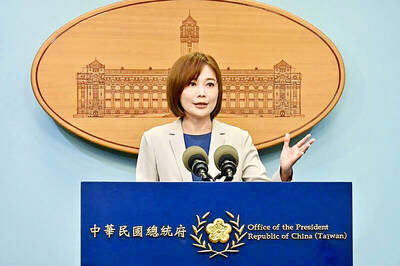
TIT-FOR-TAT: The US allegedly revoked the visa of a Chinese national working at Xinhua News Agency in the US in response to Beijing’s expulsion of Vivian Wang The Presidential Office yesterday condemned China for expelling a New York Times correspondent from Beijing following the newspaper’s interview with President William Lai (賴清德), saying the move highlighted Beijing’s suppression of press freedom and its threat to international news media. Taiwan has noted a series of recent incidents in which Beijing used similar tactics to “threaten and pressure international media outlets and journalists,” Presidential Office spokeswoman Karen Kuo (郭雅慧) said in a statement. “This concerns not only press freedom and freedom of expression, but also the safety of journalists, and Taiwan and relevant partners are paying close attention to the situation,” she


 RSS
RSS