


The Executive Yuan yesterday committed US$50 million in aid to tsunami-devastated Asian countries, up from the US$5 million it had previously pledged.
"Hopefully Taiwan's love can reach out to South Asia," Vice Premier Yeh Chu-lan (
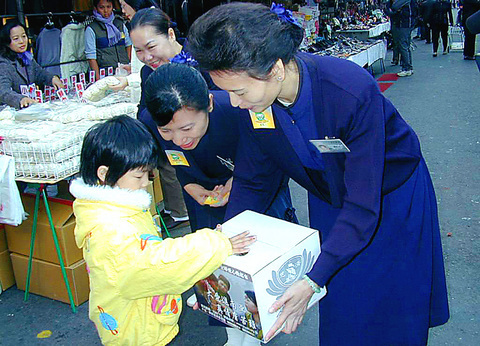
PHOTO:HSU HSIA-LIEN, TAIPEI TIMES
Details of the aid have not been finalized, but a foreign ministry official said a possible breakdown could include US$20 million worth of food, US$15 million of medicine and US$15 million in cash.
"It's time for Taiwan to give back, considering the aid we had received from international society following the Sept. 21 earthquake," foreign ministry spokesman Michel Lu (
"This aid volume would make Taiwan one of the top 10 donor countries in the world ... Taiwan people should feel proud for this," Deputy Foreign Minister Michael Kau (
The level of aid would help Taiwan's visibility in the international community, he said.
"As you may know, we are striving to join the World Health Organization. Our relief efforts are expected to be affirmed by the international community," Kau said.
Under pressure from Beijing, the WHO's assembly in May rejected Taiwan's request for a debate on it obtaining observer status at the UN agency.
Taiwan was forced out of the WHO in 1972, a year after it lost its UN seat to China.
Since 1997, Taipei's annual efforts for WHO observer status have failed due to objections from China, which regards Taiwan as part of its territory awaiting unification.
The aid from Taiwan is expected to keep rising as donations collected by the ministry have increased to NT$40 million (US$1.24 million), it said.
Various charitable organizations have also stepped up money raising efforts for tsunami relief, expecting to raise at least US$10 million.
One of Taiwan's leading Buddhist organizations, Tzu Chi, has launched a program to mobilize at least 500,000 followers here and elsewhere in the world to raise money in a campaign called "Let Love Flow into South Asia; Let Sympathy Sooth Painful Suffering."
Two relief teams from Taiwan flew to Indonesia and Thailand earlier last week, taking with them tons of medical and relief supplies.
Health Minister Chen Chien-jen (
Kuo Yao-chi (
At least two Taiwanese were killed and one was missing in the massive waves, officials said.
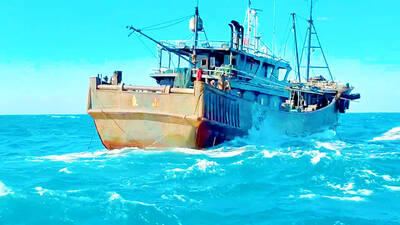
MAKING WAVES: China’s maritime militia could become a nontraditional threat in war, clogging up shipping lanes to prevent US or Japanese intervention, a report said About 1,900 Chinese ships flying flags of convenience and fishing vessels that participated in China’s military exercises around Taiwan last month and in January have been listed for monitoring, Coast Guard Administration (CGA) Deputy Director-General Hsieh Ching-chin (謝慶欽) said yesterday. Following amendments to the Commercial Port Act (商港法) and the Law of Ships (船舶法) last month, the CGA can designate possible berthing areas or deny ports of call for vessels suspected of loitering around areas where undersea cables can be accessed, Oceans Affairs Council Minister Kuan Bi-ling (管碧玲) said. The list of suspected ships, originally 300, had risen to about 1,900 as
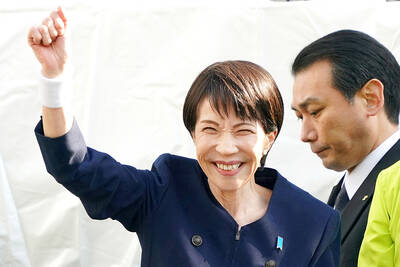
Japan’s strategic alliance with the US would collapse if Tokyo were to turn away from a conflict in Taiwan, Japanese Prime Minister Sanae Takaichi said yesterday, but distanced herself from previous comments that suggested a possible military response in such an event. Takaichi expressed her latest views on a nationally broadcast TV program late on Monday, where an opposition party leader criticized her for igniting tensions with China with the earlier remarks. Ties between Japan and China have sunk to the worst level in years after Takaichi said in November that a hypothetical Chinese attack on Taiwan could bring about a Japanese
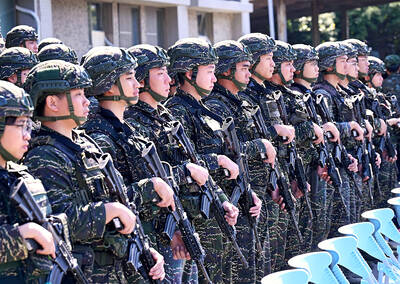
MORE RESPONSIBILITY: Draftees would be expected to fight alongside professional soldiers, likely requiring the transformation of some training brigades into combat units The armed forces are to start incorporating new conscripts into combined arms brigades this year to enhance combat readiness, the Executive Yuan’s latest policy report said. The new policy would affect Taiwanese men entering the military for their compulsory service, which was extended to one year under reforms by then-president Tsai Ing-wen (蔡英文) in 2022. The conscripts would be trained to operate machine guns, uncrewed aerial vehicles, anti-tank guided missile launchers and Stinger air defense systems, the report said, adding that the basic training would be lengthened to eight weeks. After basic training, conscripts would be sorted into infantry battalions that would take
DEEP-STRIKE CAPABILITY: The scenario simulated a PLA drill that turned into an assault on Taiwan’s critical infrastructure, with the launchers providing fire support Taiwan yesterday conducted this year’s first military exercises at Longsiang Base in Taichung, demonstrating the newly acquired High Mobility Artillery Rocket System’s (HIMARS) ability to provide fire support and deep-strike capabilities. The scenario simulated an attack on Penghu County, with HIMARS trucks immediately rolling into designated launch areas and firing barrages at the Wangan (望安) and Cimei (七美) islands, simulating the provision of fire support against invading forces. The HIMARS are supposed to “fire and leave,” which would significantly increase personnel and equipment survivability, a military official said. The drill simulated an exercise launched by the Chinese People’s Liberation Army (PLA) Eastern


 RSS
RSS