


Thousands of activists and farmers are to rally next week in support of the so-called "rice bomber," who is accused of mounting a bombing campaign to protest rice imports, organizers said yesterday.
The activists and farmers, claiming that membership in the WTO is harming local rice producers, will take to the streets of the alleged bomber's hometown of Erlin in Changhua County to draw attention to his "plight."
"The government has ignored the welfare of farmers for a long time and has sacrificed their interests to join the WTO," said Lin Shen-ching (
He said alleged bomber Yang Ju-men (楊儒門), arrested last month, was forced to resort to extreme measures to attract the government's attention.
The Council of Agriculture yesterday urged civic groups not to stage a rally to support Yang lest they send "the wrong message" to the public.
Council Vice Chairman Lee Chien-chuan (
The civic groups attempting to raise Yang's status to that of a tragic hero have distorted social values, he said.
Lee said the council welcomes civic groups to contact it, and hoped that the groups would gain a better understanding of the positives and negatives of WTO membership.
"Rashly mobilizing the public will definitely send the wrong message," Lee said.
Yang is accused of planting a bomb in a Taipei park in November last year with a note accusing the government of threatening the survival of local farmers.
Fifteen more bombs were found in parks, telephone booths and commuter trains in Taipei over the following months.

South Korea has adjusted its electronic arrival card system to no longer list Taiwan as a part of China, a move that the Ministry of Foreign Affairs said would help facilitate exchanges between the two sides. South Korea previously listed “Taiwan” as “Taiwan (China)” in the drop-down menus of its online arrival card system, where people had to fill out where they came from and their next destination. The ministry had requested South Korea make a revision and said it would change South Korea’s name on Taiwan’s online immigration system from “Republic of Korea” to “Korea (South),” should the issue not be

Tainan, Taipei and New Taipei City recorded the highest fines nationwide for illegal accommodations in the first quarter of this year, with fines issued in the three cities each exceeding NT$7 million (US$220,639), Tourism Administration data showed. Among them, Taipei had the highest number of illegal short-term rental units, with 410. There were 3,280 legally registered hotels nationwide in the first quarter, down by 14 properties, or 0.43 percent, from a year earlier, likely indicating operators exiting the market, the agency said. However, the number of unregistered properties rose to 1,174, including 314 illegal hotels and 860 illegal short-term rental
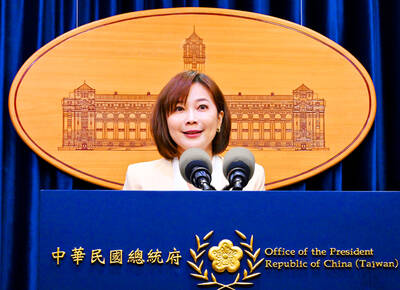
ECONOMIC COERCION: Such actions are often inconsistently applied, sometimes resumed, and sometimes just halted, the Presidential Office spokeswoman said The government backs healthy and orderly cross-strait exchanges, but such arrangements should not be made with political conditions attached and never be used as leverage for political maneuvering or partisan agendas, Presidential Office spokeswoman Karen Kuo (郭雅慧) said yesterday. Kuo made the remarks after China earlier in the day announced 10 new “incentive measures” for Taiwan, following a landmark meeting between Chinese President Xi Jinping (習近平) and Chinese Nationalist Party (KMT) Chairwoman Cheng Li-wun (鄭麗文) in Beijing on Friday. The measures, unveiled by China’s Xinhua news agency, include plans to resume individual travel by residents of Shanghai and China’s Fujian

Chinese President Xi Jinping (習近平) and Chinese Nationalist Party (KMT) Chairwoman Cheng Li-wun (鄭麗文) met in Beijing yesterday, where they vowed to bring people on both sides of the Taiwan Strait closer to facilitate the “great rejuvenation of the Chinese nation.” The meeting was held in the East Hall of the Great Hall of the People, a venue typically reserved for meetings between Xi and foreign heads of state. In public remarks prior to a closed-door meeting, Xi, in his role as head of the Chinese Communist Party (CCP), said that Taiwan is historically part of China, and remains an “inalienable” and


 RSS
RSS