


Iran has suspended uranium enrichment and all related activities, state-run radio reported yesterday, honoring an agreement with Europe designed to head off possible UN sanctions.
"To build confidence and in line with implementing the Paris Agreement, Iran suspended uranium enrichment [and related activities] as of today," said the brief radio announcement.
In Vienna, the head of the UN nuclear watchdog agency, said the suspension was confirmed.
"I think pretty much everything has come to a halt," Mohamed ElBaradei, the head of the International Atomic Energy Agency (IAEA), told reporters.
ElBaradei said he expected to have a definitive ruling by Thursday on whether Iran has honored its pledge made earlier this month and frozen the activities, which can be used to make nuclear weapons.
After negotiations with Britain, France and Germany, Iran agreed to suspend uranium enrichment and related activities to dispel suspicions it is trying to build nuclear arms. In turn, EU nations have agreed not to have Iran hauled before the UN Security Council for allegedly contravening the Nuclear Nonproliferation Treaty.
Iran portrays the agreement as European support for what it sees as its right to pursue a peaceful nuclear program.
The US accuses Iran of secretly pursuing nuclear weapons and has pushed the international community to take a hard line. US Secretary of State Colin Powell said last week that Washington has intelligence indicating Iran is trying to fit missiles to carry nuclear weapons.
Britain, France and Germany have spearheaded efforts to find a diplomatic solution. They plan fresh negotiations with Iran early next month to reach a long term agreement.
ElBaradei confirmed Iran had produced several tonnes of uranium hexafluoride (UF6), the form of uranium used in the enrichment process. Enrichment is a process of purifying uranium for use as fuel in atomic power plants or weapons.
He said Iran had produced around two tonnes of UF6 which would not have been enough for a weapon. Iran had previously denied the reports that it had produced UF6.
IAEA inspectors currently in Iran are expected to verify that Iran has halted all such activities and to seal the facilities where they are carried out.
Iran agreed to suspend uranium enrichment as part of a deal similar to one it made with Britain, Germany and France in October last year.
But that deal subsequently unraveled and Iran resumed building and assembly key nuclear parts.
That behavior, coupled with the fact that the IAEA still has several outstanding questions about an atomic program which Iran kept secret for nearly two decades, means many diplomats fear Iran will find a reason to resume uranium enrichment again in the future.
"We don't know yet whether they have taken a decision to stop pursuing nuclear weapons but their past behaviour is not very encouraging," said a Western diplomat in Tehran.
In an interview with the BBC on Monday ElBaradei said Iran's promise to suspend enrichment was a positive step.
"They need to build confidence and the suspension of uranium enrichment is a good step in the right direction."
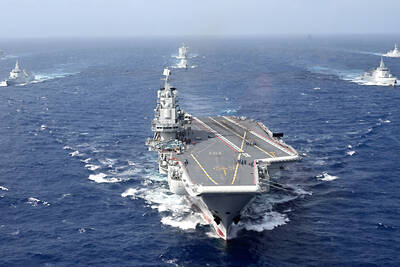
PROVOCATIVE: Chinese Deputy Ambassador to the UN Sun Lei accused Japan of sending military vessels to deliberately provoke tensions in the Taiwan Strait China denounced remarks by Japan and the EU about the South China Sea at a UN Security Council meeting on Monday, and accused Tokyo of provocative behavior in the Taiwan Strait and planning military expansion. Ayano Kunimitsu, a Japanese vice foreign minister, told the Council meeting on maritime security that Tokyo was seriously concerned about the situation in the East China and South China seas, and reiterated Japan’s opposition to any attempt to change the “status quo” by force, and obstruction of freedom of navigation and overflight. Stavros Lambrinidis, head of the EU delegation to the UN, also highlighted South China Sea
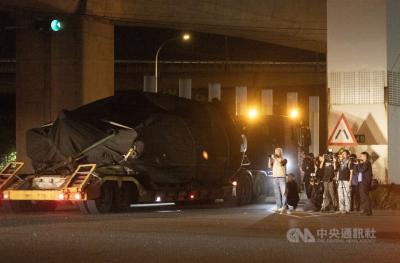
The final batch of 28 M1A2T Abrams tanks purchased from the US arrived at Taipei Port last night and were transported to the Armor Training Command in Hsinchu County’s Hukou Township (湖口), completing the military’s multi-year procurement of 108 of the tanks. Starting at 12:10am today, reporters observed more than a dozen civilian flatbed trailers departing from Taipei Port, each carrying an M1A2T tank covered with black waterproof tarps. Escorted by military vehicles, the convoy traveled via the West Coast Expressway to the Armor Training Command, with police implementing traffic control. The army operates about 1,000 tanks, including CM-11 Brave Tiger
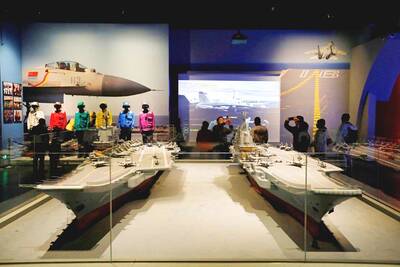
China on Wednesday teased in a video an aircraft carrier that could be its fourth, and the first using nuclear power, while making an allusion to Taiwan and vowing to further build up its islands, as it looks to boost maritime power, secure resources and bolster territorial claims. The video, issued on the eve of the 77th founding anniversary of the Chinese People’s Liberation Army Navy, featured fictional officers with names that are homophones of three commissioned aircraft carriers, the Liaoning (遼寧), Shandong (山東) and Fujian (福建). Titled Into the Deep, it showed a 19-year-old named “Hejian” (何劍) joining the group, sparking
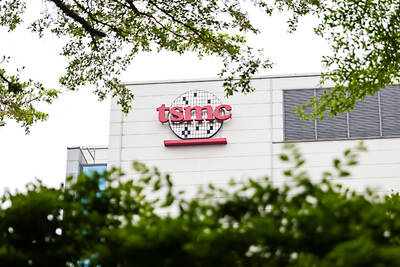
Taiwan Semiconductor Manufacturing Co (TSMC, 台積電), the world’s largest contract chipmaker, said it expects its 2-nanometer (2nm) chip capacity to grow at a compound annual rate of 70 percent from this year to 2028. The projection comes as five fabs begin volume production of 2-nanometer chips this year — two in Hsinchu and three in Kaohsiung — TSMC senior vice president and deputy cochief operating officer Cliff Hou (侯永清) said at the company’s annual technology symposium in Silicon Valley, California, last week. Output in the first year of 2-nanometer production, which began in the fourth quarter of last year, is expected to


 RSS
RSS