


Israel is set on a collision course with the EU and could turn into a pariah state, like South Africa during the apartheid years, if the Mideast conflict is not resolved, Israel's Foreign Ministry warns in a confidential 10-year forecast obtained by reporters.
The 25-page document, put together by the ministry's Center for Political Research, says the EU is pushing to become a major global player in the next decade, and that as a result, the US, Israel's main ally, could lose international influence. Reporters obtained a copy on Wednesday.
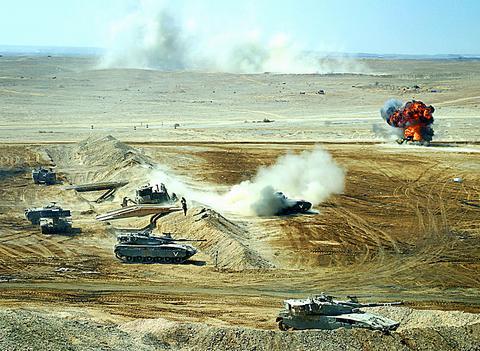
PHOTO: AP
The analysts wrote that if the EU, a 25-nation alliance, overcomes internal divisions and speaks in one voice, its global influence would grow, and be more in line with its powerful economy.
Up to now, Europe has rarely been able to unite on major foreign policy issues.
A more influential Europe would likely demand greater Israeli compliance with international conventions and could try to limit Israel's freedom of action in its conflict with the Palestinians, the document said. Israel might also have to pay a price for growing competition between the EU and the US.
Israel-EU relations have long been shaky, and Israeli Foreign Minister Silvan Shalom has repeatedly warned that Israel has to work to strengthen ties with Europe. However, Israel also accuses the Europeans of pro-Palestinian bias, and complains of a growing wave of anti-Semitism in parts of Europe.
EU officials in Brussels said that while the EU and Israel have sound relations in the areas of trade and scientific research, they have very definite differences of opinion over Mideast peacemaking.
They also said the alliance is seeking more of a say.
"Regarding the Middle East peace process and our relations with Israel and the Palestinians, there is no doubt that the role of the EU has increased," said Christina Gallach, a spokeswoman for EU foreign policy chief Javier Solana.
The EU says Israel's planned withdrawal from the Gaza Strip next year must be followed by major troop withdrawals in the West Bank, and pave the way for Palestinian statehood.
Also See Story:
Israel sweats over holy mosques' vulnerability
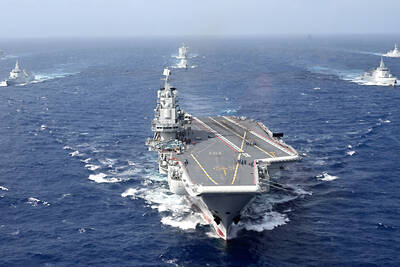
PROVOCATIVE: Chinese Deputy Ambassador to the UN Sun Lei accused Japan of sending military vessels to deliberately provoke tensions in the Taiwan Strait China denounced remarks by Japan and the EU about the South China Sea at a UN Security Council meeting on Monday, and accused Tokyo of provocative behavior in the Taiwan Strait and planning military expansion. Ayano Kunimitsu, a Japanese vice foreign minister, told the Council meeting on maritime security that Tokyo was seriously concerned about the situation in the East China and South China seas, and reiterated Japan’s opposition to any attempt to change the “status quo” by force, and obstruction of freedom of navigation and overflight. Stavros Lambrinidis, head of the EU delegation to the UN, also highlighted South China Sea
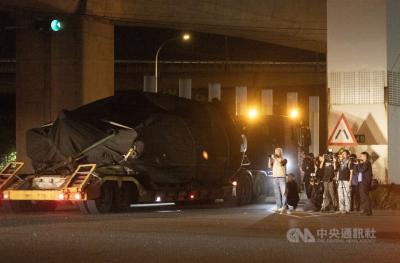
The final batch of 28 M1A2T Abrams tanks purchased from the US arrived at Taipei Port last night and were transported to the Armor Training Command in Hsinchu County’s Hukou Township (湖口), completing the military’s multi-year procurement of 108 of the tanks. Starting at 12:10am today, reporters observed more than a dozen civilian flatbed trailers departing from Taipei Port, each carrying an M1A2T tank covered with black waterproof tarps. Escorted by military vehicles, the convoy traveled via the West Coast Expressway to the Armor Training Command, with police implementing traffic control. The army operates about 1,000 tanks, including CM-11 Brave Tiger
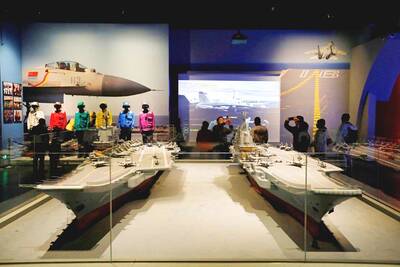
China on Wednesday teased in a video an aircraft carrier that could be its fourth, and the first using nuclear power, while making an allusion to Taiwan and vowing to further build up its islands, as it looks to boost maritime power, secure resources and bolster territorial claims. The video, issued on the eve of the 77th founding anniversary of the Chinese People’s Liberation Army Navy, featured fictional officers with names that are homophones of three commissioned aircraft carriers, the Liaoning (遼寧), Shandong (山東) and Fujian (福建). Titled Into the Deep, it showed a 19-year-old named “Hejian” (何劍) joining the group, sparking
Taiwan Semiconductor Manufacturing Co (TSMC, 台積電), the world’s largest contract chipmaker, said it expects its 2-nanometer (2nm) chip capacity to grow at a compound annual rate of 70 percent from this year to 2028. The projection comes as five fabs begin volume production of 2-nanometer chips this year — two in Hsinchu and three in Kaohsiung — TSMC senior vice president and deputy cochief operating officer Cliff Hou (侯永清) said at the company’s annual technology symposium in Silicon Valley, California, last week. Output in the first year of 2-nanometer production, which began in the fourth quarter of last year, is expected to


 RSS
RSS