


Addressing concerns that there have been changes in the relationship between Taiwan and the US, President Chen Shui-bian (
Chen made the remarks while attending a banquet held in his honor by Taiwanese expatriates in Seattle. Concluding his Central American trip, Chen and his entourage on Friday arrived in Seattle for a stopover before returning to Taipei early today.
"Some said that Taiwan's treatment by the US [this time] had gone backward in comparison with last year," Chen said, referring to his high-profile stopover in New York on his way to Panama last year. On that occasion, Chen received an international human-rights award, delivered a speech and was interviewed by the media during a cruise on the East River.
Chen kept a lower profile this time in his stopovers in Hawaii and Seattle on his way to and back from Central America, and the stops had been cut short to between seven and nine hours from original planned overnight stays.
Regarding the trip this time, Chen said that he appreciated the treatment he received during his transits in Hawaii and Seattle and cited examples to demonstrate the US' friendliness.
Chen said that during his travels in Hawaii, the US government had cleared the traffic for his motorcade, "which was unprecedented during the past four years."
Chen also said that editorials published by the Seattle Times and the Seattle Post Intelligencer were encouraging -- the former welcomed his visit and the latter commended his announcement on Monday to cancel Taiwan's annual live-fire military drills as a gesture of goodwill for cross-strait peace.
"Taiwan and the US are best friends, and being friends, we have to have empathy, comprehend our friend's situation and not bother them when they are occupied with other important events," Chen said, referring to the US' Nov. 2 election.
"As a national leader, I have the responsibility not to let our children go to the battlefields," Chen said, reiterating that he would not accept the unification law which China intended to enact.
"Not only Taiwan can't accept such a law, but the US and the rest of the peace-loving world would not find the unification law acceptable either," Chen said, adding that he hopes to build Taiwan "to be a complete, normal, great and beautiful country."
Chen also said that for the sake of national unity, the Democratic Progressive Party (DPP) is ready to cede some power and resources to other parties.
"For the sake of unifying Taiwan, the DPP will release some of its power and resources and let a non-DPP person serve as the Control Yuan president," Chen said.
Current Control Yuan President Fredrick Chien (
On criticism that this decision by Chen demonstrates conniving on his part, Chen said that when the Chinese Nationalist Party (KMT) was in power, it never occurred to them to give the post of head of one of the five yuans to a member of another party.
Claiming that "the DPP is broad-minded," the president said democracy requires checks and balances to prevent the accumulation of absolute power and thus corruption.
He stressed that the DPP will not adopt a "winner takes all" approach, adding that in the next three or four years, he will lead Taiwan in this spirit to enable the country to shed its tragic past and move toward becoming a "normal, complete, great and beautiful country."
Other important public figures at the banquet included the chairman of the American Institute in Taiwan, William Brown, the acting Governor of Washington State and Taiwan's representative to the US, David Lee (
Chen also met with Democratic representatives Jim McDermott and Rick Larson of Washington.
Also See Story:
Chang in spotlight since Chen talk

Right-wing political scientist Laura Fernandez on Sunday won Costa Rica’s presidential election by a landslide, after promising to crack down on rising violence linked to the cocaine trade. Fernandez’s nearest rival, economist Alvaro Ramos, conceded defeat as results showed the ruling party far exceeding the threshold of 40 percent needed to avoid a runoff. With 94 percent of polling stations counted, the political heir of outgoing Costa Rican President Rodrigo Chaves had captured 48.3 percent of the vote compared with Ramos’ 33.4 percent, the Supreme Electoral Tribunal said. As soon as the first results were announced, members of Fernandez’s Sovereign People’s Party
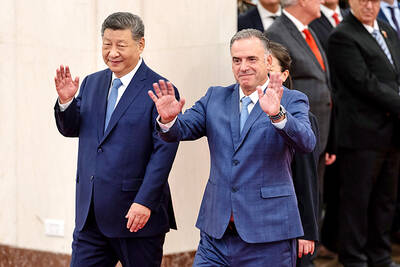
EMERGING FIELDS: The Chinese president said that the two countries would explore cooperation in green technology, the digital economy and artificial intelligence Chinese President Xi Jinping (習近平) yesterday called for an “equal and orderly multipolar world” in the face of “unilateral bullying,” in an apparent jab at the US. Xi was speaking during talks in Beijing with Uruguayan President Yamandu Orsi, the first South American leader to visit China since US special forces captured then-Venezuelan president Nicolas Maduro last month — an operation that Beijing condemned as a violation of sovereignty. Orsi follows a slew of leaders to have visited China seeking to boost ties with the world’s second-largest economy to hedge against US President Donald Trump’s increasingly unpredictable administration. “The international situation is fraught
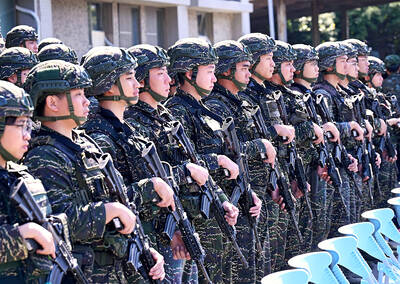
MORE RESPONSIBILITY: Draftees would be expected to fight alongside professional soldiers, likely requiring the transformation of some training brigades into combat units The armed forces are to start incorporating new conscripts into combined arms brigades this year to enhance combat readiness, the Executive Yuan’s latest policy report said. The new policy would affect Taiwanese men entering the military for their compulsory service, which was extended to one year under reforms by then-president Tsai Ing-wen (蔡英文) in 2022. The conscripts would be trained to operate machine guns, uncrewed aerial vehicles, anti-tank guided missile launchers and Stinger air defense systems, the report said, adding that the basic training would be lengthened to eight weeks. After basic training, conscripts would be sorted into infantry battalions that would take
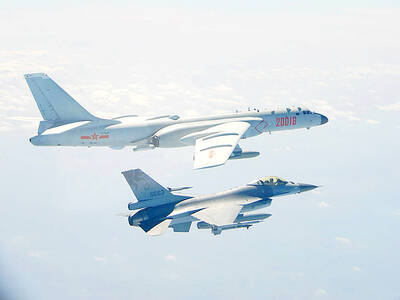
GROWING AMBITIONS: The scale and tempo of the operations show that the Strait has become the core theater for China to expand its security interests, the report said Chinese military aircraft incursions around Taiwan have surged nearly 15-fold over the past five years, according to a report released yesterday by the Democratic Progressive Party’s (DPP) Department of China Affairs. Sorties in the Taiwan Strait were previously irregular, totaling 380 in 2020, but have since evolved into routine operations, the report showed. “This demonstrates that the Taiwan Strait has become both the starting point and testing ground for Beijing’s expansionist ambitions,” it said. Driven by military expansionism, China is systematically pursuing actions aimed at altering the regional “status quo,” the department said, adding that Taiwan represents the most critical link in China’s


 RSS
RSS