


Former president Lee Teng-hui (李登輝) yesterday predicted at the Taiwan Solidarity Union's (TSU) national congress that the party, of which he is the spiritual leader, has a good chance of boosting its number of Legislative Yuan members to 50 by 2007. This would be expected, he said, under the current favorable international situation where China is preoccupied with its own growing domestic problems while the US continues its war on terrorism.
Lee, who founded the TSU in 2001, said that the party has promising prospects to expand its presence in the legislature as, to his mind, there wouldn't be any major cross-strait conflicts by 2007 because the Chinese leadership is preoccupied with internal power struggles ahead of the Communist Party's 17th National Congress.
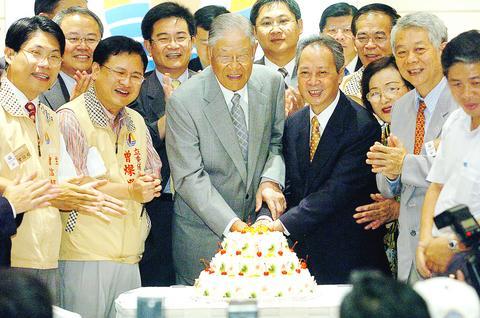
PHOTO: SEAN CHAO, TAIPEI TIMES
The small party currently holds 12 legislative seats and is aiming to enlarge that number to 30 at the legislative elections at the end of the year.
Lee said it does not matter whether US President George W. Bush or his challenger John Kerry becomes the next US president, America will still continue with its anti-terrorism strategies, making Middle East problems a critical item on its foreign policy agenda and cross-strait relations a less urgent issue to grapple with.
Lee said that, in the run-up to 2007, China will be facing a series of domestic problems including the decrease of economic growth, labor problems and power struggles ahead of the Chinese Communist Party's 17th National Congress, which altogether will leave Beijing too preoccupied to take further hostile action against Taiwan.
"China, like I used to put it, is just a barking dog that doesn't bite. From 1996 to 2000, it had constantly threatened to use force against Taiwan in an attempt to influence Taiwan's presidential elections. But they never succeeded. This year, we saw China almost unable to do anything for the same purpose.
"Given the future development of China's domestic situation and international relations, it will be to Taiwan's advantage to exert its strategic leverage more freely," Lee said yesterday.
Lee also endorsed the announcement of the party's campaign platform which aims to create a new constitution for Taiwan through a national referendum.
A long-term goal to be achieved, Lee said the TSU is capable of increasing its legislative seats to 50 by 2007, as a change in the political landscape has taken place since the March 20 presidential election.
"A Taiwan-centered consciousness has begun to take root in Taiwanese society, while the party-state institution run by the former Chinese Nationalist Party (KMT) regime has been terminated. The opposition parties, which staged the post-election protests from March 20 to May 20, reflected their ignorance of this trend. They claimed to deal with China in peace while advocating unification, but, as a matter of fact, Taiwan has become an independent and sovereign country after March 20," Lee said.
Apart from pushing a campaign platform to create a new Taiwan constitution and change the official title of the country to Taiwan, Lee urged TSU members to propagandize the party's policies in education, public safety, the economy and national defense, and their relevance to Taiwan-centered values and interests.
Meanwhile, the former president, a member of the Presbyterian church, advised the TSU to boost its ties with Taiwan's Aboriginals, including extending support to Aboriginal communities through church-based networks, as well as cultivating support from Mainlanders.
TSU Chairman Huang Chu-wen (黃主文) yesterday said in order to achieve the goal of boosting public support for a Taiwanese national identity by 2008, the TSU and the Democratic Progressive Party (DPP) will work together to enlarge this political force in Taiwan.
The TSU and DPP will cooperate and compete with each other in the year-end legislative elections in order to ultimately harvest a comprehensive victory, Huang said.

‘NO SECURITY RISK’: The Railway Bureau reassured the public that the technicians’ activities were limited to technical guidance and did not involve sensitive systems The Railway Bureau yesterday said it had invited eight Chinese technicians to assist with an airport MRT construction project. The bureau issued the confirmation after an Internet user said Chinese nationals had entered the construction zone of Taiwan Taoyuan International Airport’s Terminal 3 project. They asked why “individuals from an enemy state” were allowed access to such a major national infrastructure project, which raised serious concerns over Taiwan’s industrial safety, sensitive systems and information security. The bureau’s Northern Region Engineering Branch Office said subcontractor Taiwan Handle Industrial Co (台灣手把工業) of the Taoyuan airport MRT’s “Contract No. CU05 Project A14 Station Civil, MEP &

The National Chungshan Institute of Science and Technology yesterday showcased its locally developed variants of the Vision 60 robotic patrol dog, which it plans to deploy on the nation’s outlying territories in the South China Sea. The variants were produced under the Joint Lab project — created by the institute and domestic companies — and assembled with domestically produced motors, lenses and artificial intelligence (AI) systems alongside licensed tech from the US, Missile and Rocket Systems Research Division deputy director Jen Kuo-kang (任國光) told the media event at a military base in Taipei’s Dazhi (大直) area. Taiwan has built up its strengths

NOT IMMEDIATE: Taiwan has a chance to appeal the proposed 10 percent tariff before it starts, while other countries face a 12.5 percent tariff from the trade office Taiwan is among 60 economies determined by the US to have failed to impose or enforce a ban on the importation of goods produced with forced labor, according to a notice released on Tuesday by the Office of the US Trade Representative (USTR), which proposed imposing an additional 10 percent or more tariff on them. The USTR in a statement said that following an investigation, it had determined under Section 301 of the Trade Act of 1974 that the failure of the 60 economies to impose and effectively enforce a prohibition on the importation of goods produced with forced labor is

TIT-FOR-TAT: The US allegedly revoked the visa of a Chinese national working at Xinhua News Agency in the US in response to Beijing’s expulsion of Vivian Wang The Presidential Office yesterday condemned China for expelling a New York Times correspondent from Beijing following the newspaper’s interview with President William Lai (賴清德), saying the move highlighted Beijing’s suppression of press freedom and its threat to international news media. Taiwan has noted a series of recent incidents in which Beijing used similar tactics to “threaten and pressure international media outlets and journalists,” Presidential Office spokeswoman Karen Kuo (郭雅慧) said in a statement. “This concerns not only press freedom and freedom of expression, but also the safety of journalists, and Taiwan and relevant partners are paying close attention to the situation,” she


 RSS
RSS