

The furor raging over Taiwan's advertisements at Athens' international airport continued yesterday, as a number of senior government officials weighed in on the matter.
Minister of Foreign Affairs Mark Chen (
Details regarding the nature of the request -- which was reportedly made to an as-of-yet unnamed private advertising company -- and the manner in which it was delivered were sketchy.
The Government Information Office (GIO) reported on Thursday that the "National Olympic Committee in Athens" had asked that advertisements and publicity posters be removed. The office said it believed that the request came after "pressure from China."
The ads are part of the GIO's publicity campaign, "Taiwan on the Starting Line" which is designed to coincide with the Olympic Games on Aug 13.
The GIO also plans on having large outdoor billboards erected along major thoroughfares in Athens, as well as placing posters featuring images of Taiwan on the exteriors of electric trams.
Publicity posters have also been placed on 500 luggage carts at the Athens International Airport.
Despite the committee's request, the ads have not been removed. Chen said it is still unclear whether China is behind the committee's move.
"No matter who is behind this action, such behavior is unwelcome in Taiwan," he added.
Meanwhile, Vice President Annette Lu (
"In the future, just as women carry mace with them all the time, when Taiwanese travel abroad they should carry with them signs reading `Taiwan, Go Go Go!' and `Shame on China!'" Lu said during a radio interview yesterday.
"`Taiwan Go Go Go!' can be used to cheer Taiwan on at the appropriate time. But when one encounters Chinese intimidation, the `Shame on China' sign can be used," Lu added.
In addition to offering travel advice, Lu also said that the establishment of a "Friends of Taiwan International" group would allow for an immediate response to be made whenever Taiwan is threatened or insulted.
Lu said that she was very angry upon learning of China's alleged use of intimidation tactics to try to remove the promotional posters, but added that she was not surprised.
"Although Taiwan is small, Taiwanese people have big hearts. Although China is big, it is a stingy nation," Lu said.
Chen, however, thought that the problem required a different approach. He said Taiwan's representative office in Athens must supplement the Government Information Office's efforts in safeguarding Taiwan's sovereignty in the Olympic Games.
"Getting together peacefully to exhibit sportsmanship is the central spirit of the Games. This is also the key spirit for people living in the global village," he said.
Mainland Affairs Council (MAC) Chairman Joseph Wu (
"With regards to the Olympics posters, Taiwan has used peaceful means to spread a positive image of itself. If China wants to bully Taiwan on this issue as well, this will only cause the citizens on both sides of the strait to drift apart and lead to Taiwanese resentment," Wu said.
MAC Vice Chairman Chiu Tai-san (
In related news, the country's representative office in Athens cautioned Taiwanese watching the Games in the city against waving any flag apart from the Taiwanese delegation's official flag, which was approved by the International Olympic Committee.
Differing from the national flag of the Republic of China, the Taiwanese delegation's official flag consists of five rings and a plum blossom, the country's national flower. The delegation is formally registered as the "Chinese Taipei" team.
"If our citizens wave other flags to cheer our up team in the Games, security guards may stop their behavior or even drive them out," the representative office warned in a statement.
To serve Taiwanese tourists in Athens during the Olympic Games, the representative office will have staff fluent in Chinese, English and Greek on duty every day until Sept. 2.
The representative office's has three phone lines to serve Taiwanese: (+30-210) 677-6750, 677-5121, 677-5122.

The Presidential Office today condemned China's transnational repression after an alleged Chinese foreign agent was arrested in California yesterday on suspicion of surveilling President William Lai's (賴清德) son, Lai Ting-yu (賴廷與), the FBI said. The 34-year-old woman, named Wanying Heather Zhang (張婉瑩), was arrested on suspicion of acting as an unregistered foreign agent, US news agency CBS reported. She was apprehended at Los Angeles International Airport yesterday attempting to fly to Shanghai, it said. This represents a “typical case” of China’s transnational repression, Presidential Office spokeswoman Karen Kuo (郭雅慧) said today. "Our country expresses the strongest condemnation of such barbaric conduct that
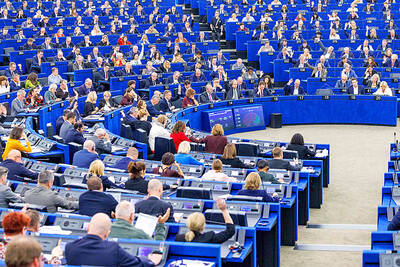
The European Parliament on Wednesday adopted a recommendation on EU-China political relations that rejected China’s efforts to restrict Taiwan’s participation in international organizations and exchanges. The recommendation, addressed to the European Council, the European Commission and EU High Representative for Foreign Affairs and Security Policy Kaja Kallas, includes several references to EU-Taiwan relations and expresses support for closer ties, saying they would bring positive benefits and have strategic importance. Describing Taiwan as a valuable partner in trade and technology, the European Parliament said it “rejects China’s attempts to coerce international organizations, third countries and other actors into restricting Taiwan’s international participation and
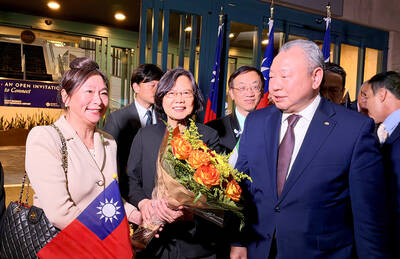
Former president Tsai Ing-wen (蔡英文) on Monday arrived in San Francisco, receiving a warm welcome from hundreds of overseas Taiwanese as she launched a week-long visit. Accompanied by Representative to the US Alexander Yui (俞大?), and head of Taiwan’s San Francisco office Wu Chih-hsiang (伍志翔), Tsai arrived at her hotel, waving, smiling and giving high-fives to Taiwanese compatriots amid cheers of “Taiwan’s democracy involves you and me” to welcome her to the San Francisco Bay Area. It is Tsai’s first visit to the US since she left office in May 2024 after serving two four-year terms as president. Tsai is today to deliver
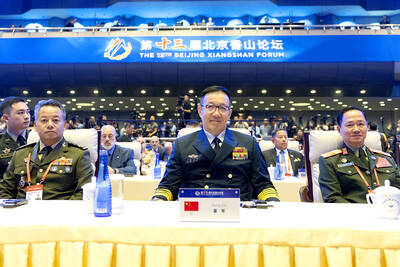
Light attack aircraft and military vehicles have arrived at a new China-Laos joint training facility announced on Tuesday last week, according to satellite images reviewed by Reuters. The images, taken by commercial satellite provider Vantor, show what security analysts believe are eight K-8 light attack jets and more than two dozen support vehicles on a runway that is still being built — China’s latest expansion of its overseas military presence. Taken on Wednesday last week — the day after the Chinese Ministry of National Defense announced it had set up the facility at Ban Keun outside the capital, Vientiane — the images


 RSS
RSS