


A car bomb hit a Baghdad hotel used by foreigners and US tanks fought Shiite militia yesterday.
The holiest Shiite Muslim shrine, the Imam Ali mosque in Najaf, was slightly damaged by what appeared to be rockets or mortars. Anti-American militia said several people were hurt in an incident that will upset believers across the Middle East.
Around nearby Kufa, at least 11 people died in early morning fighting, hospital staff said.
US tanks were in action before dawn south of the capital, battling Shiite Mahdi Army fighters around the town of Kufa.
At least 11 people were killed and 22 wounded, hospital staff in Kufa and the nearby holy city of Najaf said.
Radical Shiite cleric Moqtada al-Sadr launched an uprising last month against the US occupation. A sharp US offensive in recent days has contained the fighting to the Najaf area.
Damage to the Imam Ali shrine, dedicated to the 7th-century leader whose followers founded the Shiite branch of Islam, is a sensitive issue for the Shiite majorities in Iraq and Iran.
It was not clear which side fired the explosives. US commanders say they are doing all they can to spare holy sites.
At least two people were wounded in Baghdad, police said, when a car blew up outside the Karma hotel, frequented by foreigners and near the embassy of Australia, a close US ally in Iraq.
Iraqi witnesses also said a US military convoy had been attacked near the turbulent Sunni Muslim city of Fallujah. There was no US comment. It was not clear if there were casualties.
A soldier whose death on Monday was announced yesterday was at least the 580th American to die in combat since the invasion.
A leader of Iraq's Turkmen minority was assassinated in a drive-by shooting in the northern city of Kirkuk, police said.
Meanwhile, Iraqi interim defense minister Ali Allawi said in London yesterday that Iraq expects foreign troops to remain in the country for "months rather than years."
"In terms of time for the presence of the international forces to help us establish security and stability, I think it will be a question of months rather than years," Allawi told a joint press conference with British counterpart Geoff Hoon.
"The multinational force, in as much as its presence is needed to maintain security, will need ... to be replaced by indigenous forces, by Iraqi forces," Allawi said.
He was responding to a question about how long foreign troops might remain in the country following the handover of sovereignty by the US-led coalition on June 30.
Also see story:
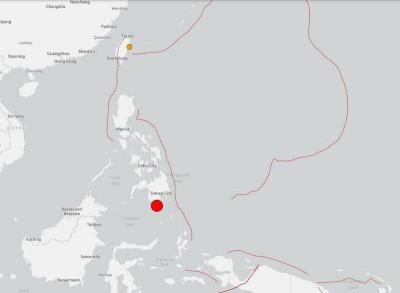
A magnitude 7.8 earthquake struck off the southern coast of Mindanao in the Philippines at 7:38am today, prompting the US Tsunami Warning System to issue an alert for neighboring countries, including Taiwan. The system issued a purple alert indicating a "tsunami threat." The potential threat zone includes Taiwan, the Philippines, Papua New Guinea, Yap and Palau. Philippine authorities were assessing the damage from the quake, with the office of civil defense seeking to verifying initial reports that 15 people had been killed and 129 injured in the region, mostly from falling debris. Arlene Hollero, disaster chief of Maasim town in the Philippines' Sarangani Province,
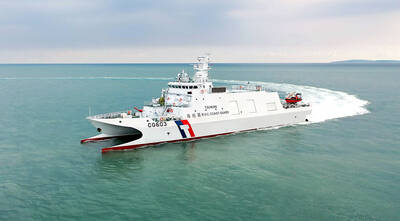
‘GRAY ZONE’ PRESSURE: Beijing’s activities are intended to create the deceitful impression that China has jurisdiction over the area around Taiwan, the CGA said Taiwan’s rights over its territorial waters and exclusive economic zone must not be violated by any country, the Mainland Affairs Council said yesterday, adding that it will not accept any unprovoked actions. The council issued the remarks in response to the China Coast Guard conducting maritime enforcement drills near eastern Taiwan and claiming to fully exercise China’s maritime administrative law enforcement authority. The Coast Guard Administration (CGA) has been closely monitoring the situation and is taking concrete steps to defend the nation’s sovereignty and secure its waters, the council said. China has no sovereign rights over the waters off eastern
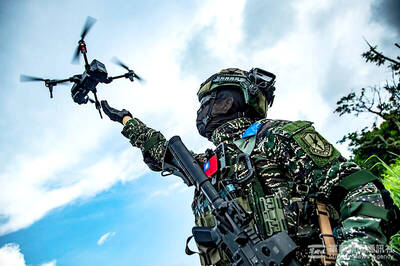
RESILIENCE: Taiwan plays a key role in semiconductors, energy, information infrastructure and advanced manufacturing, AIT Director Raymond Greene said Taiwan’s continued investment in deterrence and resilience remains vital, especially in uncrewed systems and other emerging technologies, American Institute in Taiwan (AIT) Director Raymond Greene said yesterday. Greene made the remarks at the annual National Strategic Summit on Supply Chain Resilience held by the Research Institute for Democracy, Society and Emerging Technology (DSET), a government-backed think tank. As Taiwan last year became the US’ fourth-largest trading partner and supply chain security is becoming more important, cooperation in emerging technologies continues to deepen between the two countries, he said. The US is committed to accelerating innovation, building key infrastructure, strengthening cooperation

The National Chungshan Institute of Science and Technology yesterday showcased its locally developed variants of the Vision 60 robotic patrol dog, which it plans to deploy on the nation’s outlying territories in the South China Sea. The variants were produced under the Joint Lab project — created by the institute and domestic companies — and assembled with domestically produced motors, lenses and artificial intelligence (AI) systems alongside licensed tech from the US, Missile and Rocket Systems Research Division deputy director Jen Kuo-kang (任國光) told the media event at a military base in Taipei’s Dazhi (大直) area. Taiwan has built up its strengths


 RSS
RSS