


A stash of cocaine and heroin was found aboard the Colombian navy's main training ship shortly before it was to sail for the US, the navy said on Friday, in a fresh embarrassment for the nation's scandal-plagued security forces.
The government said it had suspended the boat's 75 crew members after officials found 16.5kg of heroin and 10kg of cocaine hidden in the engine room of the historic sailing ship the Gloria.
"The government would rather see the ship rot than let this type of crime continue rotting our national dignity," the government said in a news release, adding that the crew would remain suspended until those responsible were found.
The Gloria, which takes trainees on round-the-world trips designed to improve Colombia's image, was due to sail for the US and Europe next month.
The drugs found would have been worth several million dollars on US or European streets.
Navy commander Admiral Mauricio Soto said three crew members were under investigation over the find, which is an embarrassment for a country which receives hundreds of millions of dollars of US aid a year to fight illegal drugs and a rebel insurgency.
The discovery follows a string of scandals for the security forces. Over the past month or so, army patrols have killed at least six fellow soldiers, seven policemen and nine civilians by mistake, prompting a public apology from President Alvaro Uribe.
Last year, the head of the national police force resigned after accusations that officers had taken more than US$1 million in bribes to allow a huge cocaine shipment.
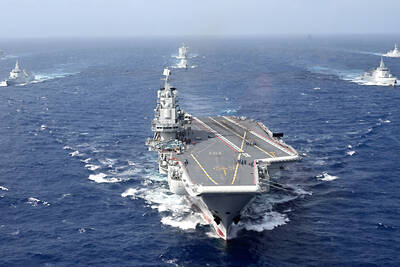
PROVOCATIVE: Chinese Deputy Ambassador to the UN Sun Lei accused Japan of sending military vessels to deliberately provoke tensions in the Taiwan Strait China denounced remarks by Japan and the EU about the South China Sea at a UN Security Council meeting on Monday, and accused Tokyo of provocative behavior in the Taiwan Strait and planning military expansion. Ayano Kunimitsu, a Japanese vice foreign minister, told the Council meeting on maritime security that Tokyo was seriously concerned about the situation in the East China and South China seas, and reiterated Japan’s opposition to any attempt to change the “status quo” by force, and obstruction of freedom of navigation and overflight. Stavros Lambrinidis, head of the EU delegation to the UN, also highlighted South China Sea
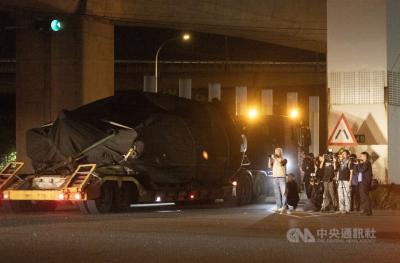
The final batch of 28 M1A2T Abrams tanks purchased from the US arrived at Taipei Port last night and were transported to the Armor Training Command in Hsinchu County’s Hukou Township (湖口), completing the military’s multi-year procurement of 108 of the tanks. Starting at 12:10am today, reporters observed more than a dozen civilian flatbed trailers departing from Taipei Port, each carrying an M1A2T tank covered with black waterproof tarps. Escorted by military vehicles, the convoy traveled via the West Coast Expressway to the Armor Training Command, with police implementing traffic control. The army operates about 1,000 tanks, including CM-11 Brave Tiger
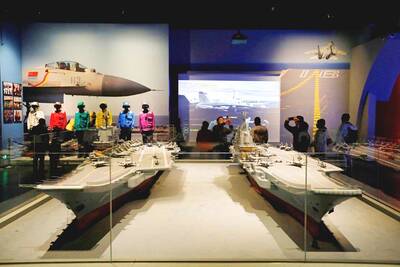
China on Wednesday teased in a video an aircraft carrier that could be its fourth, and the first using nuclear power, while making an allusion to Taiwan and vowing to further build up its islands, as it looks to boost maritime power, secure resources and bolster territorial claims. The video, issued on the eve of the 77th founding anniversary of the Chinese People’s Liberation Army Navy, featured fictional officers with names that are homophones of three commissioned aircraft carriers, the Liaoning (遼寧), Shandong (山東) and Fujian (福建). Titled Into the Deep, it showed a 19-year-old named “Hejian” (何劍) joining the group, sparking
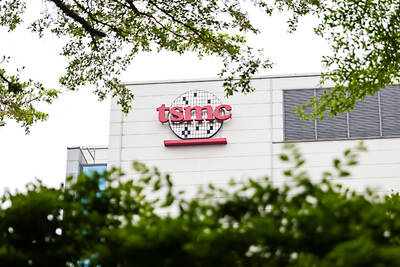
Taiwan Semiconductor Manufacturing Co (TSMC, 台積電), the world’s largest contract chipmaker, said it expects its 2-nanometer (2nm) chip capacity to grow at a compound annual rate of 70 percent from this year to 2028. The projection comes as five fabs begin volume production of 2-nanometer chips this year — two in Hsinchu and three in Kaohsiung — TSMC senior vice president and deputy cochief operating officer Cliff Hou (侯永清) said at the company’s annual technology symposium in Silicon Valley, California, last week. Output in the first year of 2-nanometer production, which began in the fourth quarter of last year, is expected to


 RSS
RSS