


US troops fought Sunni insurgents in Fallujah yesterday and stood ready to strike at a rebel cleric in Najaf, one of Iraq's holiest Shiite cities.
A hospital official said 15 people were killed and 20 wounded in overnight clashes that erupted in Fallujah just hours after America's top general said truce talks could not go on for ever and more military action might be necessary.
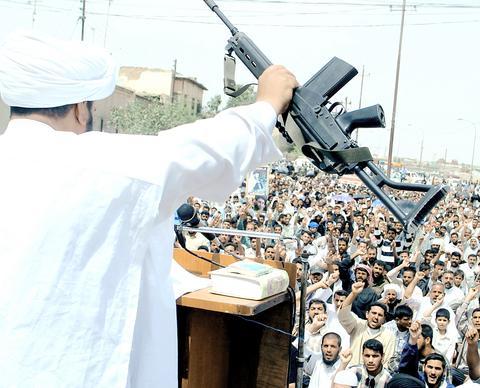
PHOTO: REUTERS
Chairman of the Joint Chiefs of Staff Richard Myers said Iraq's US administrator Paul Bremer was using "multiple channels" in talks to pacify Falluja and avoid fighting in Najaf, where militiamen loyal to anti-US Shiite cleric Moqtada al-Sadr control the city center.
Polish officers commanding international troops in the Najaf region were unhappy at the prospect of an assault on the holy city by 2,500 US troops poised outside, Polish media said.
Sadr, who is in Najaf, said Iraqis would hit back with unimaginable "force and severity" if US forces carried out their threat to kill or capture him.
"Their threats to kill or detain me are a result of their weakness and collapse in the face of what has happened, and is happening, in Iraq," he told Lebanon's as-Safir newspaper.
American warplanes attacked targets in Fallujah and a US armored vehicle was destroyed in the fighting, witnesses said.
US Marines launched their assault on the city west of Baghdad on April 5 after the killing and mutilation of four US private security guards there the previous week. Doctors say more than 600 Iraqis have died in fighting in Fallujah since.
A week ago, the US military said it had suspended offensive operations in Falluja but would hit back if attacked. Talks to stabilize a shaky truce have led to relative calm interspersed with intense bouts of fighting and air strikes.
In the holy city of Kerbala, where Sadr's folowers have also taken control, three Iraqi policeman were killed in clashes with Shiite militiamen yesterday, witnesses said.
British Prime Minister Tony Blair said ahead of talks with US President George W. Bush that they shared the goal of creating a stable, democratic and self-ruled Iraq, but refused to discuss whether they differed on how to achieve this.
"How we get there is obviously the difficult issue, particularly with security at the moment. But our determination to get there remains undimmed," Blair said after meeting UN Secretary-General Kofi Annan in New York.
A Danish businessman in Iraq to set up a sewage business has joined the hostage list. Danish Broadcasting News said the man, in his 30s, was taken during a highway robbery, probably late on Tuesday, in Taji, north of Baghdad.
Kidnappers demanding an end to the siege of Fallujah and the withdrawal of foreign troops from Iraq have seized more than 40 foreigners, although many have been released.
Italy has vowed to keep its troops in Iraq despite the videotaped execution of one of four Italian hostages held there.
Scores of workers from Russia and ex-Soviet states waited for a flight from Baghdad airport on the second day of an evacuation organized after the kidnap and swift release of eight Russians and Ukrainians earlier this week.
The US-led administration is due to hand power to an as yet undefined interim Iraqi government on June 30 and senior UN envoy Lakhdar Brahimi has been in Iraq to consult on the transition.
Brahimi, due in New York soon to report back, said this week he was confident a caretaker government could be formed next month, but stressed that security must improve before planned elections could be held in January.
April has been Iraq's bloodiest month since former Iraqi president Saddam Hussein was ousted a year ago. The US military has lost at least 92 troops in combat since March 31 -- more than the total killed in the three-week war that toppled Saddam.
Also see story:
Blair says UN will be key for Iraq's transition to sovereignty
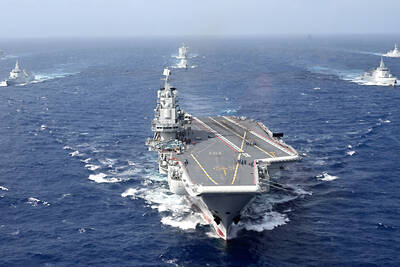
PROVOCATIVE: Chinese Deputy Ambassador to the UN Sun Lei accused Japan of sending military vessels to deliberately provoke tensions in the Taiwan Strait China denounced remarks by Japan and the EU about the South China Sea at a UN Security Council meeting on Monday, and accused Tokyo of provocative behavior in the Taiwan Strait and planning military expansion. Ayano Kunimitsu, a Japanese vice foreign minister, told the Council meeting on maritime security that Tokyo was seriously concerned about the situation in the East China and South China seas, and reiterated Japan’s opposition to any attempt to change the “status quo” by force, and obstruction of freedom of navigation and overflight. Stavros Lambrinidis, head of the EU delegation to the UN, also highlighted South China Sea
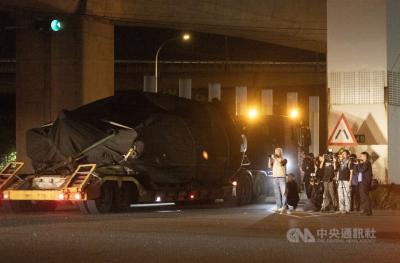
The final batch of 28 M1A2T Abrams tanks purchased from the US arrived at Taipei Port last night and were transported to the Armor Training Command in Hsinchu County’s Hukou Township (湖口), completing the military’s multi-year procurement of 108 of the tanks. Starting at 12:10am today, reporters observed more than a dozen civilian flatbed trailers departing from Taipei Port, each carrying an M1A2T tank covered with black waterproof tarps. Escorted by military vehicles, the convoy traveled via the West Coast Expressway to the Armor Training Command, with police implementing traffic control. The army operates about 1,000 tanks, including CM-11 Brave Tiger
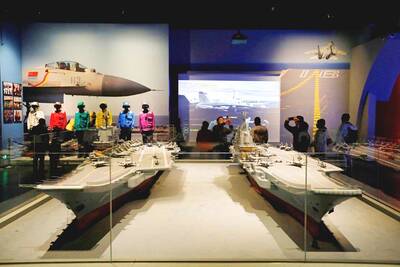
China on Wednesday teased in a video an aircraft carrier that could be its fourth, and the first using nuclear power, while making an allusion to Taiwan and vowing to further build up its islands, as it looks to boost maritime power, secure resources and bolster territorial claims. The video, issued on the eve of the 77th founding anniversary of the Chinese People’s Liberation Army Navy, featured fictional officers with names that are homophones of three commissioned aircraft carriers, the Liaoning (遼寧), Shandong (山東) and Fujian (福建). Titled Into the Deep, it showed a 19-year-old named “Hejian” (何劍) joining the group, sparking
Taiwan Semiconductor Manufacturing Co (TSMC, 台積電), the world’s largest contract chipmaker, said it expects its 2-nanometer (2nm) chip capacity to grow at a compound annual rate of 70 percent from this year to 2028. The projection comes as five fabs begin volume production of 2-nanometer chips this year — two in Hsinchu and three in Kaohsiung — TSMC senior vice president and deputy cochief operating officer Cliff Hou (侯永清) said at the company’s annual technology symposium in Silicon Valley, California, last week. Output in the first year of 2-nanometer production, which began in the fourth quarter of last year, is expected to


 RSS
RSS