


The pan-green and pan-blue camps will resume their fight in the legislature today over how legislative reforms are to proceed.
An earlier consensus reached by the legislature's Constitutional Amendment Committee said that all nine amendments should be reviewed by the committee before proceeding to the second and third readings and then to the National Assembly.

PHOTO: REUTERS
The National Assembly convenes only when constitutional reforms or national boundary changes have been passed by the legislature by a three-quarters majority or when a move to impeach the president or vice president has been passed by a two-thirds majority.
Determined to pass before the presidential election the constitutional amendment to halve the number of legislative seats, the Democratic Progressive Party (DPP) and Taiwan Solidarity Union (TSU) caucuses said yesterday that they are set to propose a change to today's legislative agenda.
They would like to see an additional plenary meeting on March 18 for the second and third reading of the constitutional revision to halve the number of seats.
Although the Chinese Nationalist Party (KMT) and People First Party (PFP) caucuses said they welcome the plan, they want to bundle the seat-reduction plan with eight other constitutional changes.
The Constitutional Amendment Committee approved during its first preliminary review session on Wednesday reducing the number of seats from 225 to 113 by 2008 and to lengthen legislative terms from three years to four.
They also agreed to change the way legislators are chosen from the current multi-member district, one-vote electoral system to the single-member district, two-vote system.
The remaining eight constitutional amendment issues include adjusting the terms of Control Yuan members, lowering the voting age and revoking compulsory military service.
DPP caucus leader Tsai Huang-liang (
"I hope they mean it this time when they pledge to push for legislative reforms. We'd really hate to see them boycott the initiative again," Huang said.
Huang said it would make sense to push through the constitutional amendments on which the rival camps agree and continue to negotiate over those they do not.
TSU caucus leader Chen Chien-ming (
"The only explanation I can think of is that they want to stall the process of [passing] constitutional amendments as long as possible and make legislative reform difficult for everyone," he said.
KMT caucus leader Liao Feng-te (
PFP caucus leader Hsieh Chang-chieh (

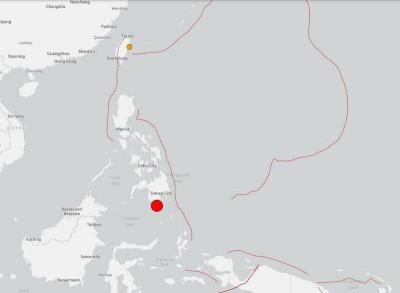
A magnitude 7.8 earthquake struck off the southern coast of Mindanao in the Philippines at 7:38am today, prompting the US Tsunami Warning System to issue an alert for neighboring countries, including Taiwan. The system issued a purple alert indicating a "tsunami threat." The potential threat zone includes Taiwan, the Philippines, Papua New Guinea, Yap and Palau. Philippine authorities were assessing the damage from the quake, with the office of civil defense seeking to verifying initial reports that 15 people had been killed and 129 injured in the region, mostly from falling debris. Arlene Hollero, disaster chief of Maasim town in the Philippines' Sarangani Province,

RESILIENCE: Taiwan plays a key role in semiconductors, energy, information infrastructure and advanced manufacturing, AIT Director Raymond Greene said Taiwan’s continued investment in deterrence and resilience remains vital, especially in uncrewed systems and other emerging technologies, American Institute in Taiwan (AIT) Director Raymond Greene said yesterday. Greene made the remarks at the annual National Strategic Summit on Supply Chain Resilience held by the Research Institute for Democracy, Society and Emerging Technology (DSET), a government-backed think tank. As Taiwan last year became the US’ fourth-largest trading partner and supply chain security is becoming more important, cooperation in emerging technologies continues to deepen between the two countries, he said. The US is committed to accelerating innovation, building key infrastructure, strengthening cooperation

The National Chungshan Institute of Science and Technology yesterday showcased its locally developed variants of the Vision 60 robotic patrol dog, which it plans to deploy on the nation’s outlying territories in the South China Sea. The variants were produced under the Joint Lab project — created by the institute and domestic companies — and assembled with domestically produced motors, lenses and artificial intelligence (AI) systems alongside licensed tech from the US, Missile and Rocket Systems Research Division deputy director Jen Kuo-kang (任國光) told the media event at a military base in Taipei’s Dazhi (大直) area. Taiwan has built up its strengths

RIGHT DIRECTION: Taiwan’s efforts to prevent forced labor include a proposal to ‘fully prohibit’ employers from withholding workers’ documents, an official said Taiwan is to establish a mechanism to restrict imports of goods linked to forced labor, the Executive Yuan said yesterday, after the US proposed imposing additional tariffs on Taiwanese goods over labor concerns. “The Ministry of Labor and the Ministry of Economic Affairs are to establish an interministerial review procedure,” Executive Yuan spokesperson Michelle Lee (李慧芝) said at a news briefing in Taipei. “The government is to use the Foreign Trade Act [貿易法] as the legal basis to restrict imports of goods produced with forced labor” and bring its supply chain governance more in line with international standards on human rights, resilience


 RSS
RSS