

Accusations by one of the nation's 10 most wanted fugitives that President Chen Shui-bian (陳水扁) had accepted his donations in the run-up to the presidential election in 2000 and the Taipei City mayoral election in 1998 were shrugged off by the Presidential Office and the Democratic Progressive Party (DPP) yesterday.
"It's vile to accuse the president with such an obscure insinuation. We strongly suspect the allegation is a political maneuver deliberately staged by someone with an evil mindset," said Presidential Office spokesman James Huang (
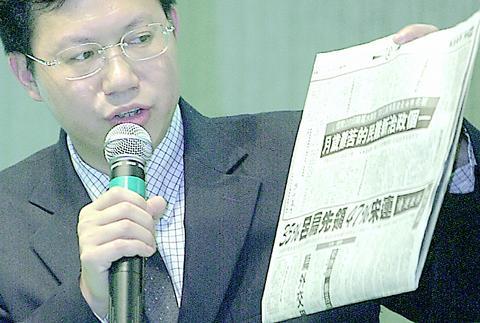
PHOTO: YEH CHIH-MING, TAIPEI TIMES
The former chairman of the Tuntex Group Chen You-hao (
Chen You-hao was indicted on charges of breach of trust and reportedly left Taiwan in August 2002. He has been accused of stealing about NT$800 million from the Tuntex Group's subsidiary Tunghua Development in 1995 and investing the money in China.
Chen You-hao said that the president has completely disappointed him with his campaign against "black gold" politics. He also implicated Deputy Secretary-General to the Presidential Office Chen Che-nan (
Describing himself as a "political refugee," Chen You-hao questioned the DPP-led government's motive to include him in the list of the 10 most wanted fugitives, saying the move was politically motivated.
"I've learned that it was a political decision made by those higher up," Chen You-hao said in one of the statements. "The charge against me is false according to the report released by the Investigation Bureau in July 2002 ? The investment in China, totaling US$2 million, was legal because it was approved by the government."
Chen You-hao also likened the president to Adolf Hitler.
"What you've done over the years has reminded me of Germany's dictator Hitler," he said. "His whole life tells a story to the world of how the power of the people can lift a politician up to the sky and how a despot can bring catastrophe to his own country."
"It takes rationality and legality to deepen democracy, but I have seen you incite the public to hate China and Chinese people," Chen You-hao said in the statement.
Speaking on behalf of Chen Che-nan, Huang said that the Presidential Office deputy secretary-general has never taken the initiative to meet Chen You-hao and has not been involved in any deals with him, although he did meet Chen You-hao several times over the years.
Chang faxed a statement to the Presidential Office to dismiss Chen You-hao's allegations. According to Chang, he did meet Chen You-hao in 1999, but did not engage in anything illegal.
"While I welcome a judicial investigation into the matter, I'm calling on Chen You-hao to return home immediately to offer his testimony. I also don't rule out the possibility of filing a defamation suit against him in future," Chang said in his statement.
DPP campaign spokesman Wu Nai-jen (
"It's obvious that Chen You-hao enjoys a close relationship with the pan-blue camp, because according to the Control Yuan's investigation report on the Chung Hsiung Bills Finance scandal, the NT$100 million contribution made by Chen You-hao ended up in Soong's bank account," Wu said.
In the Chung Hsiung Bills Finance scandal, which was uncovered in 1999 in the run-up to the 2000 presidential election, Soong was alleged to have embezzled funds from the KMT. The case was generally believed to have led to Soong losing the election.
Cabinet Spokesman Lin Chia-lung (
"There are four different categories of people included in the 10 most wanted list, and Chen You-hao is one of those accused of committing financial crimes," he said.
Additional reporting by Lin Chieh-yu
Also see story:
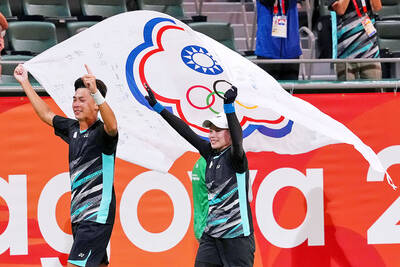
SOFT TENNIS: Yu Kai-wen and Huang Shih-yuan narrowly defeated their Japanese rivals to capture Taiwan’s first gold at the Asian Games in Nagoya Yu Kai-wen (余凱文) and Huang Shih-yuan (黃詩媛) won Taiwan’s first gold of this year’s Asian Games, defeating a Japanese duo in a nail-biter in the soft tennis mixed doubles final in Nagoya, Japan, while Johnny Sun (孫家閎) won silver in wushu and Shih Cheng-chung (石政中) won bronze in men’s kumite. Yu and Huang narrowly defeated Japan’s Toshiki Uematsu and Rena Temma 5-4 (2-4, 5-3, 4-2, 1-4, 1-4, 4-0, 1-4, 4-1, 7-5) to give Taiwan its first gold in soft tennis mixed doubles at an Asian Games since 2018. Sun secured Taiwan’s first wushu medal at this year’s game, with a combined score
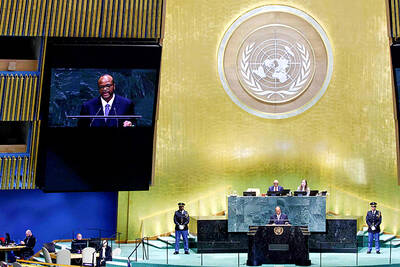
UNITY: Lai thanked the nations who spoke up for Taiwan, saying that democracies must stand together to face global authoritarian expansion Taiwan yesterday thanked eight European and Indo-Pacific countries for opposing unilateral changes to the “status quo” in the Taiwan Strait in a joint statement earlier this week, as well as three of Taiwan’s allies for speaking up for the nation’s participation in the UN at the body’s General Assembly in New York. Minister of Foreign Affairs Lin Chia-lung (林佳龍) welcomed the support and expressed his appreciation for the countries’ stance, the Ministry of Foreign Affairs said in a statement. Foreign ministers and senior representatives of Australia, France, Germany, Japan, New Zealand, Poland, South Korea and the UK issued a statement on Tuesday
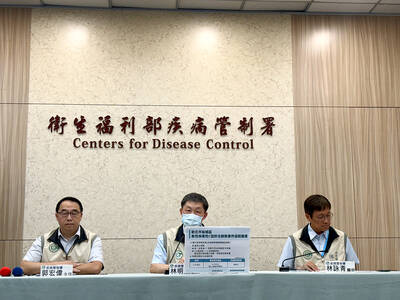
AT-RISK GROUPS: Of the accumulated 1,586 severe cases and 304 related deaths in this flu season, 65.8% were older people and 83.2% had chronic diseases, an official said The Centers for Disease Control (CDC) yesterday said that 165 severe flu cases and 30 flu-related deaths were reported last week, the highest weekly numbers in this flu season, and that cases might continue to increase, urging people to take precautions. Medical visits for flu-like illnesses increased by 1.4 percent to 141,374 last week, with 11.8 percent being emergency visits, showing that the seasonal flu is still in its epidemic period, CDC Epidemic Intelligence Center Director Guo Hung-wei (郭宏偉) said. From Tuesday last week to Monday, 165 severe flu cases and 30 flu-related deaths were confirmed, the highest weekly numbers
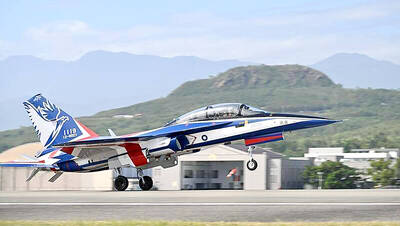
Aerospace Industrial Development Corp (AIDC, 漢翔航空工業) has finished production of the nation’s T-5 Brave Eagle (勇鷹) advanced jet trainers, with the final aircraft scheduled to be formally delivered at a ceremony on Thursday. The delivery of the trainer jets marks the end of the program, which dates back to 2017, with the first prototypes completed in 2019. Fifty-six of the 66 trainers had been delivered as of May. The Brave Eagle was developed and produced by AIDC and the National Chungshan Institute of Science and Technology. The program has provided a foundation for the development of a domestically produced next-generation primary trainer and


 RSS
RSS