


The bird flu virus spread deeper into Asia yesterday and claimed its first human victim in Thailand, a six-year-old boy who caught a disease that is creating fears reminiscent of SARS.
Pakistan said two million chickens had died of a mild form of the disease and Taiwan reported a new outbreak of the mild H5N2 virus which cannot, unlike the H5N1 strain, pass to humans as it has in Vietnam, where it killed six people, and Thailand.
Thailand expanded its bird flu crisis zone to 10 of its 76 provinces from just two as it grappled with a virus the World Health Organization fears might mate with human influenza and unleash a flu pandemic.
Indonesia said at least 400 farms across the vast archipelago suffered outbreaks. But officials said they would only know by the end of the week, when laboratory test results were available, whether it was the less dangerous of two avian flu strains.
The WHO said it had seen no evidence its greatest fear, people-to-people transmission, had been realized yet.
But it fears the potentially deadly H5N1 strain could jump into Myanmar and Laos from stricken farms just over the border in Thailand.
Hans Wagner, a senior official of the UN Food and Agricultural Organization, said 700 chickens had died on a farm in Vientiane, the Lao capital, and a Thai laboratory was trying to find out why.
The results would not be known before today, he said.
"Laos also has a very poor public health infrastructure," WHO spokesman Peter Cordingley said in Manila. "If the virus became embedded in Laos, we'll have very serious problems."
The spread of bird flu, which has also struck in Japan, South Korea and Cambodia, has emerged with a rapidity the WHO calls "historically unprecedented" and the Thai and Indonesian governments have been criticized for not revealing it sooner.
"We don't know how this virus is spreading and so it's safe to presume that nowhere can consider itself safe," Cordingley said. "The challenge is growing by the day."
The Thai boy's death means all but one of at least seven confirmed human bird flu victims have been children, leaving scientists trying to find why the young are vulnerable.
Another Thai boy was confirmed to have contracted bird flu yesterday. The country also has 10 suspected cases, of whom five have died, and tests are underway to determine whether bird flu was the cause.
So far, all the victims have contracted the disease from sick fowl and not from other people.
But a vaccine for people is months away because the virus has mutated since it made the leap from animals to humans in Hong Kong in 1997.
"We have to start again from the drawing board to create a prototype vaccine from this virus, and then we have to go into commercial development and this is a slow business with many clinical trials and other obstacles along the way," Cordingley said.
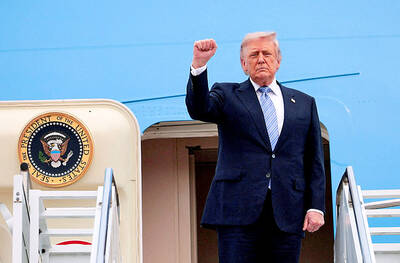
US-CHINA SUMMIT: MOFA welcomed US reassurance of no change in its Taiwan policy; Trump said he did not comment when Xi talked of opposing independence US President Donald Trump yesterday said he has not made a decision on whether to move forward with a major arms package for Taiwan after hearing concerns about it from Chinese President Xi Jinping (習近平). Trump’s comments on Taiwan came as he flew back to Washington after wrapping up critical talks in which both leaders said important progress was made in stabilizing US-China relations even as deep differences persist between the world’s two biggest powers on Iran and Taiwan. “I will make a determination,” Trump said, adding: “I’ll be making decisions. But, you know, I think the last thing we need right
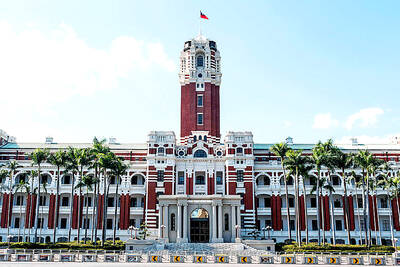
SECURITY: Taipei presses the US for arms supplies, saying the arms sales are not only a reflection of the US security commitment to Taiwan but also serve as a mutual deterrent against regional threats Taiwan is committed to preserving the cross-strait “status quo” and contributing to regional peace and stability, the Presidential Office said yesterday. “It is an undeniable fact that the Republic of China is a sovereign and independent democratic nation,” Presidential Office spokeswoman Karen Kuo (郭雅慧) reiterated, adding that Beijing has no right to claim sovereignty over Taiwan. The statements came after US President Donald Trump warned against Taiwanese independence. Trump wrapped up a state visit to Beijing on Friday, during which Chinese President Xi Jinping (習近平) had pressed him not to support Taiwan. Taiwan depends heavily on US security backing to deter China from carrying
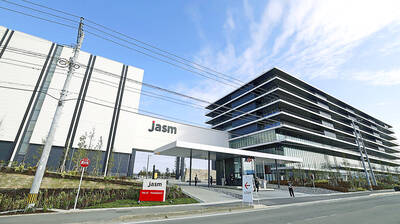
The subsidiary of Taiwan Semiconductor Manufacturing Co (TSMC, 台積電) in Kumamoto, Japan, turned a profit in the first quarter of this year, marking the first time the first fab of the unit has become profitable since mass production started at the end of 2024. According to the contract chipmaker’s financial statement released on Friday, Japan Advanced Semiconductor Manufacturing Inc (JASM), a joint venture running the fab in Kumamoto, posted NT$951 million (US$30.19 million) in profit in the January-to-March period, compared with a loss of NT$1.39 billion in the previous quarter, and a loss of NT$3.25 billion in the first quarter of
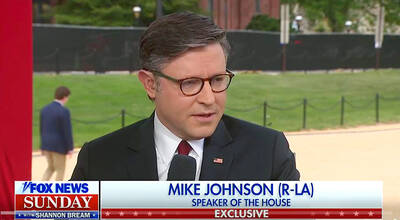
RESOLUTE BACKING: Two Republican senators are planning to introduce legislation that would impose immediate sanctions on China if it attempts to invade Taiwan US House of Representatives Speaker Mike Johnson on Sunday reaffirmed US congressional support for Taiwan, saying the US and “all freedom-loving people” have a stake in preventing China from seizing Taiwan by force. Johnson made the remarks in an interview with Fox News Sunday on US President Donald Trump’s summit with Chinese President Xi Jinping (習近平) last week. In an interview that aired on Friday on Fox News, just as Trump wrapped up a high-stakes visit to China, he said he has yet to green-light a new US$14 billion arms package to Taiwan and that it “depends on China.” “It’s a very good


 RSS
RSS