


Taiwan supporters in the US Congress are preparing to introduce a sweeping resolution in support of Taiwan when they reassemble later this month after an extended year-end holiday break.
Prospects for such a bill have unnerved China, prompting its US ambassador last month to send a letter to all members of Congress urging them to reject the planned legislation.
The resolution will endorse President Chen Shui-bian's (
The measure will be based on a bill approved nearly unanimously by the House of Representatives in July 1998 in response to then president Bill Clinton's declaration of his "three noes" policy during a visit to Shanghai the previous month.
Many in Washington at the time felt that Clinton's declaration marked a sharp departure in America's underlying support for Taiwan and a basic shift in US policy.
The "three noes" rejected Taiwan independence, a "one China, one Taiwan" policy and Taiwan membership in international bodies requiring statehood for membership.
The planned bill will respond to President George W. Bush's public personal rebuke of Chen and his referendum plan after his Dec. 9 White House meeting with visiting Chinese premier Wen Jiabao (
That statement, many Taiwan backers in Washington -- including Bush's conservative supporters -- felt, marked an unsavory accommodation of Beijing's wishes at the expense of Taiwan. Many saw parallels between Bush's and Clinton's pronouncements.
What will be different from the 1998 resolution will be a statement of support for the referendum and the condemnation of the Chinese missile buildup across the Strait from Taiwan, which were not present as issues in 1998.
While the wording of the planned referendum is not yet finalized, the 1998 measure recognized that at no time since the People's Republic of China was established in 1949 has Taiwan been under its control.
It affirmed US commitment to Taiwan under the Taiwan Relations Act, called for settlement of cross-strait relations by peaceful means, committed Washington to supply Taiwan with arms sufficient for its self defense, sought a renunciation of the use of force by China and supported Taiwan's membership in international organizations. The 1998 bill also referred to Taiwan as "one of the world's premier democracies."
In addition to the planned resolution, a separate resolution introduced last November in support of the referendum is now before the House International Relations Committee, but it's fate is uncertain.
In his letter, dated Dec. 30, Chinese Ambassador Yang Jiechi (
He said the bill "runs counter to the relevant commitment of the United States Government" in its "one China" policy, and its commitments in the three US-China communiques.
"Facts have shown," Yang wrote, "that Chen Shui-bian is a trouble-maker. He cares about nothing but his own political agenda, ie `Taiwan independence' and his own re-election."
The letter appears to be unprecedented. No previous Chinese ambassador is known to have made such a direct lobbying effort to Congress to reject a legislative initiative involving Taiwan.
Yang also made reference to a possible meeting with members of Congress, but the Chinese Embassy's spokesman, Sun Weide (
Meanwhile, a group of House members are expected to clarify US policy toward Taiwan when they visit Taipei next week to attend an international parliamentary exchange meeting that is expected to bring legislators from some 50 countries to the city.
Florida Democrat Robert Wexler, a co-chairman of the Congressional Taiwan Caucus, will lead the group and will present an address to the assembly at a luncheon with Vice President Annette Lu on Wednesday. In addition to Wexler, Ohio Republican Steve Chabot, another caucus co-chairman, will be part of the delegation, as will Gary Acker-man, a New York Democrat.
Congress reconvenes on Jan. 20.
Also see story:
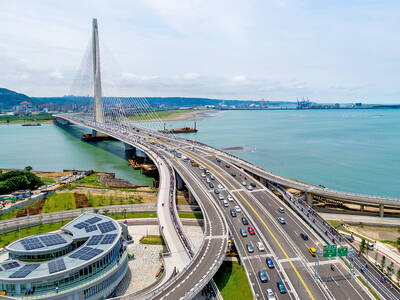
The Ministry of Transportation and Communications yesterday inaugurated the Danjiang Bridge across the Tamsui River in New Taipei City, saying that the structure would be an architectural icon and traffic artery for Taiwan. Feted as a major engineering achievement, the Danjiang Bridge is 920m long, 211m tall at the top of its pylon, and is the longest single-pylon asymmetric cable-stayed bridge in the world, the government’s Web site for the structure said. It was designed by late Iraqi-British architect Zaha Hadid. The structure, with a maximum deck of 70m, accommodates road and light rail traffic, and affords a 200m navigation channel for boats,
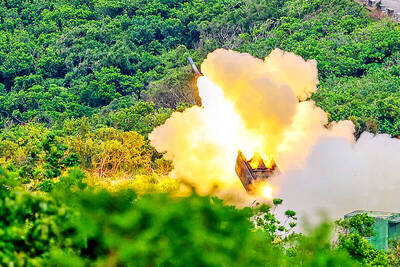
PRECISION STRIKES: The most significant reason to deploy HIMARS to outlying islands is to establish a ‘dead zone’ that the PLA would not dare enter, a source said A High Mobility Artillery Rocket System (HIMARS) would be deployed to Penghu County and Dongyin Island (東引) in Lienchiang County (Matsu) to force the Chinese military to retreat at least 100km from the coastline, a military source said yesterday. Taiwan has been procuring HIMARS and Army Tactical Missile Systems (ATACMS) from the US in batches. Once all batches have been delivered, Taiwan would possess 111 HIMARS units and 504 ATACMS, which have a range of 300km. Considering that “offense is the best defense,” the military plans to forward-deploy the systems to outlying islands such as Penghu and Dongyin so that

Taiwan Semiconductor Manufacturing Co (TSMC, 台積電), the world’s largest foundry service provider, yesterday said that global semiconductor revenue is projected to hit US$1.5 trillion in 2030, after the figure exceeds US$1 trillion this year, as artificial intelligence (AI) demand boosts consumption of token and compute power. “We are still at the beginning of the AI revolution, but we already see a significant impact across the whole semiconductor ecosystem,” TSMC deputy cochief operating officer Kevin Zhang (張曉強) said at the company’s annual technology symposium in Hsinchu City. “It is fair to say that in the past decade, smartphones and other mobile devices were
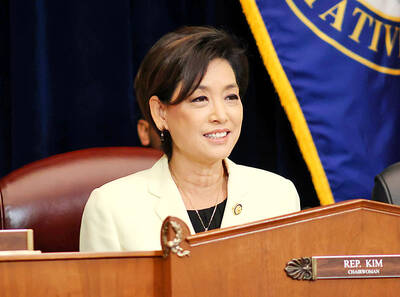
‘CLEAR MESSAGE’: The bill would set up an interagency ‘tiger team’ to review sanctions tools and other economic options to help deter any Chinese aggression toward Taiwan US Representative Young Kim has introduced a bill to deter Chinese aggression against Taiwan, calling for an interagency “tiger team” to preplan coordinated sanctions and economic measures in response to possible Chinese military or political action against Taiwan. “[Chinese President] Xi Jinping [習近平] has directed the People’s Liberation Army to be ready to invade Taiwan by 2027. China has a plan. America should have one too,” Kim said in a news release on Thursday last week. She introduced the “Deter PRC [People’s Republic of China] aggression against Taiwan act” to “ensure the US has a coordinated sanctions strategy ready should


 RSS
RSS