


Hardline nationalists led by a jailed war crimes suspect won Serbia's general election yesterday, putting pressure on feuding pro-Western reformers to unite if they are to form a stable government.
In a bitter blow for the politicians who toppled Slobodan Milosevic as Yugoslav president in 2000, the ultra-nationalist Radicals of former paramilitary leader Vojislav Seselj became the biggest party in parliament, initial results showed.
The Radicals won nearly 28 percent of Sunday's vote, underlining how disappointed many Serbs are with three years of Western-style economic and political change, feuding among former reform allies and allegations of government corruption.
Outgoing Deputy Prime Minister Nebojsa Covic said the result showed Serbs wanted to punish the government for failing to raise living standards faster in a country that had been battered by years of international isolation under Milosevic.
"We got what we asked for," Covic said, although some reformers have blamed the EU for not providing more development aid to help Serbia restructure its economy and create jobs.
The outcome was a setback for Western leaders hoping Serbia had turned its back on aggressive nationalism after a decade of Balkan conflicts under Milosevic, who, like Seselj, is facing war crimes charges at the UN tribunal in The Hague.
"We won this victory for Vojislav Seselj and other Hague indictees and for Serbia's citizens who had enough of being humiliated," acting Radical Party chief Tomislav Nikolic said.
Together with Milosevic's once-mighty Socialists, who ruled Serbia during the violent break-up of old Yugoslavia in the 1990s but have since lost much of their support, the Radicals would have more than 100 deputies in the 250-seat legislature.
Both Seselj and Milosevic headed the candidate lists of their respective parties.
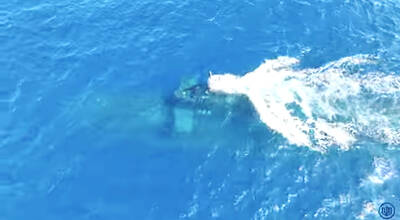
CSBC Corp, Taiwan (台灣國際造船) yesterday released the first video documenting the submerged sea trials of Taiwan’s indigenous defense submarine prototype, the Hai Kun (海鯤), or Narwhal, showing underwater navigation and the launch of countermeasures. The footage shows the vessel’s first dive, steering and control system tests, and the raising and lowering of the periscope and antenna masts. It offered a rare look at the progress in the submarine’s sea acceptance tests. The Hai Kun carried out its first shallow-water diving trial late last month and has since completed four submerged tests, CSBC said. The newly released video compiles images recorded from Jan. 29 to
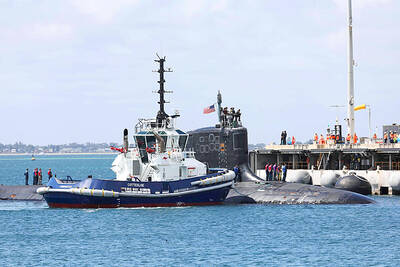
DETERRENCE EFFORTS: Washington and partners hope demonstrations of force would convince Beijing that military action against Taiwan would carry high costs The US is considering using HMAS Stirling in Western Australia as a forward base to strengthen its naval posture in a potential conflict with China, particularly over Taiwan, the Wall Street Journal reported on Saturday. As part of its Indo-Pacific strategy, Washington plans to deploy up to four nuclear-powered submarines at Stirling starting in 2027, providing a base near potential hot spots such as Taiwan and the South China Sea. The move also aims to enhance military integration with Pacific allies under the Australia-UK-US trilateral security partnership, the report said. Currently, US submarines operate from Guam, but the island could
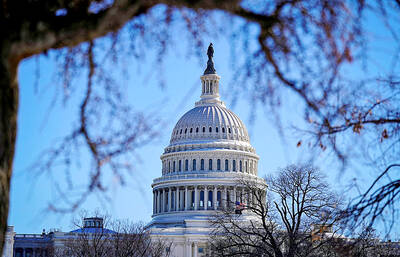
RESTRAINTS: Should China’s actions pose any threat to Taiwan’s security, economic or social systems, China would be excluded from major financial institutions, the bill says The US House of Representatives on Monday passed the PROTECT Taiwan Act, which states that Washington would exclude China from participating in major global financial organizations if its actions directly threaten Taiwan’s security. The bill, proposed by Republican Representative Frank Lucas, passed with 395 votes in favor and two against. It stipulates that if China’s actions pose any threat to Taiwan’s security, economic or social systems, the US would, “to the maximum extent practicable,” exclude Beijing from international financial institutions, including the G20, the Bank for International Settlements and the Financial Stability Board. The bill makes it clear that China must be prepared

Taiwanese trade negotiators told Washington that Taipei would not relocate 40 percent of its semiconductor production to the US, and that its most advanced technologies would remain in the nation, Vice Premier Cheng Li-chiun (鄭麗君) said on Sunday. “I told the US side very clearly — that’s impossible,” Cheng, who led the negotiation team, said in an interview that aired on Sunday night on Chinese Television System. Cheng was referring to remarks last month by US Secretary of Commerce Howard Lutnick, in which he said his goal was to bring 40 percent of Taiwan’s chip supply chain to the US Taiwan’s almost


 RSS
RSS