


Taiwan's top diplomat in Washing-ton, Chen Chien-jen (程建人), said Thursday that US officials had not indicated to him that the George W. Bush administration had changed its position on Taiwan independence, but he conceded that he did not know whether Bush would make any concessions on Taiwan during his meeting next Tuesday with Chinese Premier Wen Jiabao (溫家寶).
Chen, head of the Taipei Economic and Cultural Representative Office, said the information given to him was that the US would continue to say it "does not support" Taiwan independence, instead of bowing to Chinese wishes that the administration say it "opposes" independence.
"I think the US government and its spokesmen in the last few days have been emphasizing it will continue to use the words, `do not support' Taiwan independence," he said
He made his comments during a luncheon address to the Asia Society in Washington.
However, just before he spoke, White House spokesman Scott McClellan, in his regular daily press briefing, said that the administration "opposes any unilateral attempts to change Taiwan's status."
"That would apply," McClellan said, "to both Beijing's possible use of force and any moves by Taiwan itself that would change the status quo on independence or unification."
The administration continues "to urge both sides to refrain from actions or statements that increase tensions or make dialogue more difficult to achieve," he said.
Asked about those statements, Chen said that "my impression and my information is that the policy hasn't changed. I think the United States wants to assure peace and stability in the Taiwan Strait.
"But I think that the United States fully understands the importance of having a viable and vibrant democracy survive, grow and prosper."
In his speech, Chen pointed to the planned referendum and new constitution as part of the democratization process in Taiwan.
He also noted that opinion polls in recent years have shown that the lion's share of Taiwan's population support the status quo.
"The government must listen to the people. If the people want status quo, we have to achieve status quo," Chen said.
In his speech, Chen said Taiwan "is not seeking to cause trouble or antagonize anyone else, but only to better meet the needs of the people by further improving its own political system."
He also cited President Chen Shui-bian's (
Also Thursday, US Senator George Allen, the co-chairman of the Senate Taiwan Caucus, sent a letter to Secretary of State Colin Powell urging the State Department not to make statements opposing a referendum in Taiwan, saying such statements "could seriously damage the longtime friendship between the United States and Taiwan."
"There is serious concern that State Department officials will make a statement in the coming days in opposition to Taiwan independence," Allen said, echoing rumors circulating in Washington among conservative think tank members about a possible change in US policy.
Meanwhile, Taiwanese-American groups are mobilizing in advance of Wen's visit to Washington with plans for a mass rally at the Chinese Embassy Tuesday afternoon followed by a protest demonstration that evening outside a hotel where Wen will deliver a major policy address. Similar protests will be held in New York Sunday when Wen arrives there, and in Boston where Wen will address a Harvard audience later in the week.
The US headquarters of the World United Formosans for Independence has started a letter-writing campaign among Taiwanese-American groups to National Security Advisor Condoleezza Rice urging her to "support Taiwan by insisting on the American values of freedom and democracy."
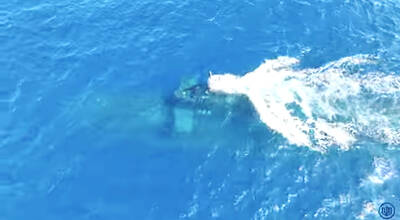
CSBC Corp, Taiwan (台灣國際造船) yesterday released the first video documenting the submerged sea trials of Taiwan’s indigenous defense submarine prototype, the Hai Kun (海鯤), or Narwhal, showing underwater navigation and the launch of countermeasures. The footage shows the vessel’s first dive, steering and control system tests, and the raising and lowering of the periscope and antenna masts. It offered a rare look at the progress in the submarine’s sea acceptance tests. The Hai Kun carried out its first shallow-water diving trial late last month and has since completed four submerged tests, CSBC said. The newly released video compiles images recorded from Jan. 29 to
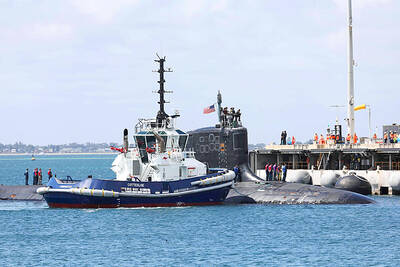
DETERRENCE EFFORTS: Washington and partners hope demonstrations of force would convince Beijing that military action against Taiwan would carry high costs The US is considering using HMAS Stirling in Western Australia as a forward base to strengthen its naval posture in a potential conflict with China, particularly over Taiwan, the Wall Street Journal reported on Saturday. As part of its Indo-Pacific strategy, Washington plans to deploy up to four nuclear-powered submarines at Stirling starting in 2027, providing a base near potential hot spots such as Taiwan and the South China Sea. The move also aims to enhance military integration with Pacific allies under the Australia-UK-US trilateral security partnership, the report said. Currently, US submarines operate from Guam, but the island could
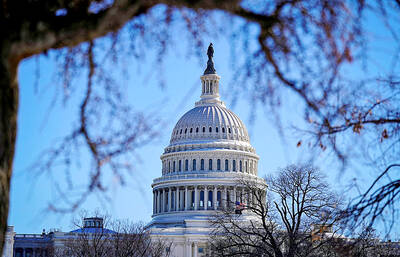
RESTRAINTS: Should China’s actions pose any threat to Taiwan’s security, economic or social systems, China would be excluded from major financial institutions, the bill says The US House of Representatives on Monday passed the PROTECT Taiwan Act, which states that Washington would exclude China from participating in major global financial organizations if its actions directly threaten Taiwan’s security. The bill, proposed by Republican Representative Frank Lucas, passed with 395 votes in favor and two against. It stipulates that if China’s actions pose any threat to Taiwan’s security, economic or social systems, the US would, “to the maximum extent practicable,” exclude Beijing from international financial institutions, including the G20, the Bank for International Settlements and the Financial Stability Board. The bill makes it clear that China must be prepared
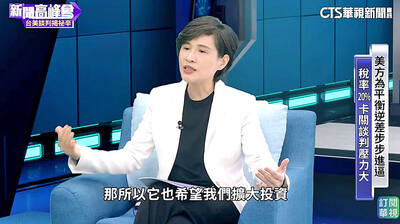
Taiwanese trade negotiators told Washington that Taipei would not relocate 40 percent of its semiconductor production to the US, and that its most advanced technologies would remain in the nation, Vice Premier Cheng Li-chiun (鄭麗君) said on Sunday. “I told the US side very clearly — that’s impossible,” Cheng, who led the negotiation team, said in an interview that aired on Sunday night on Chinese Television System. Cheng was referring to remarks last month by US Secretary of Commerce Howard Lutnick, in which he said his goal was to bring 40 percent of Taiwan’s chip supply chain to the US Taiwan’s almost


 RSS
RSS