


The press office of Georgian President Eduard Shevardnadze denounced as an "armed coup d'etat" the seizure of parliament by opposition activists yesterday.
Shevardnadze vowed not to resign as he was hustled out of the parliament building after opposition supporters broke in and seized the speaker's podium.
"I will not resign. I will resign when the presidential term expires, according to the constitution," Shevardnadze said before he was driven away from the parliament, accompanied by armed guards in riot gear.
Shevardnadze was whisked away after opposition leader Mikhail Saakashvili led hundreds of his supporters into the chamber. They overturned desks and chairs and leapt onto the podium just after the president officially convened the body. It was not immediately clear where he was taken.
"The velvet revolution has taken place in Georgia," Saakashvili said, as the hall applauded him. "We are against violence."
Saakashvili ordered the pro-government lawmakers to leave the hall, and handed over the speaker's podium to opposition leader Nino Burdzhanadze.
The move came as tens of thousands of opposition protesters marched in Georgia's capital, Tbilisi. They have pledged not to leave until Shevardnadze is ousted.
Earlier yesterday, Shevardnadze said that he was ready for dialogue with the opposition, but "without any ultimatums. Parliament was elected and ... parliament should begin work today."
This poverty-stricken ex-Soviet republic had slid into its biggest political crisis in years after the Nov. 2 parliamentary elections, which the opposition and many foreign observers claimed were rigged. The election has fueled popular anger against Shevardnadze's government and led this impoverished nation into its biggest political crisis in years.
Both pro- and anti-Shevardnadze forces had vowed to avoid bloodshed but also refused to budge from their increasingly intractable positions.
Police, covered in body armor and holding shields, have been posted in front of all the main government buildings.
"We are giving the president one last chance," said protest leader Mikhail Saakashvili, as he addressed thousands of his supporters on Freedom Square earlier yesterday. "Within one hour, either he comes to the people or the people will come to him."
The crowd, which has swelled by the minute, carried placards reading, "Georgia without Shevardnadze" and "Shevardnadze, your century was the 20th. Now it is the 21st."
Pro-Shevardnadze forces are camped out in front of the parliament, along with heavily armed police but the police gave little resistance as the opposition advanced.
As tension escalated, Shevardnadze appeared to soften his position. He acknowledged that there had been some breaches in the election, which the pro-Shevardnadze party won according to the official results.
"About 8 to 10 percent of the ballots were invalid," he said, but added that this should be dealt with in the courts.
US State Department spokesman Adam Ereli said the election results reflect "massive vote fraud" in some regions and "do not accurately reflect the will of the Georgian people." On Friday, the State Department called on Georgia's government to conduct an independent investigation into the results.
Georgia's top security official, Tedo Dzhaparidze, also acknowledged Friday that the vote -- which independent exit pollers said the opposition appeared to have won -- had been tarnished by fraud. He said a new parliament should be considered temporary, until a new vote can be held.
According to final results, the pro-Shevardnadze For a New Georgia bloc came in first with 21.32 percent of the vote, while the Revival party, which sometimes has been critical of the government but sided with Shevardnadze in the present crisis, finished second with 18.84 percent.
Saakashvili's National Movement came in a very close third with 18.08 percent of the vote, while the Democrats who allied with Saakashvili got 8.8 percent.
Russia, which remains a key power in the region, also acknowledged that the election was marred and called for the "mistakes to be corrected, but in the realm of the law."
"The alternative is chaos," the Russian Foreign Ministry warned.
Shevardnadze criticized the opposition yesterday for calling for civil disobedience, saying "Is this your country or not? If you have a program, talk as much as you want. Gather 20,000 or 100,000. I also will come to listen, if it is an interesting program."
Also See Story:
Georgians lament 10 lost years

Right-wing political scientist Laura Fernandez on Sunday won Costa Rica’s presidential election by a landslide, after promising to crack down on rising violence linked to the cocaine trade. Fernandez’s nearest rival, economist Alvaro Ramos, conceded defeat as results showed the ruling party far exceeding the threshold of 40 percent needed to avoid a runoff. With 94 percent of polling stations counted, the political heir of outgoing Costa Rican President Rodrigo Chaves had captured 48.3 percent of the vote compared with Ramos’ 33.4 percent, the Supreme Electoral Tribunal said. As soon as the first results were announced, members of Fernandez’s Sovereign People’s Party
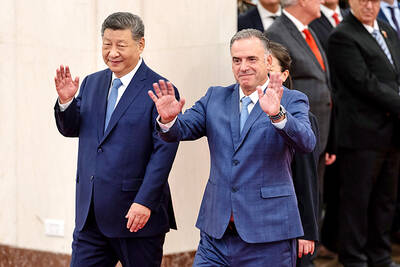
EMERGING FIELDS: The Chinese president said that the two countries would explore cooperation in green technology, the digital economy and artificial intelligence Chinese President Xi Jinping (習近平) yesterday called for an “equal and orderly multipolar world” in the face of “unilateral bullying,” in an apparent jab at the US. Xi was speaking during talks in Beijing with Uruguayan President Yamandu Orsi, the first South American leader to visit China since US special forces captured then-Venezuelan president Nicolas Maduro last month — an operation that Beijing condemned as a violation of sovereignty. Orsi follows a slew of leaders to have visited China seeking to boost ties with the world’s second-largest economy to hedge against US President Donald Trump’s increasingly unpredictable administration. “The international situation is fraught
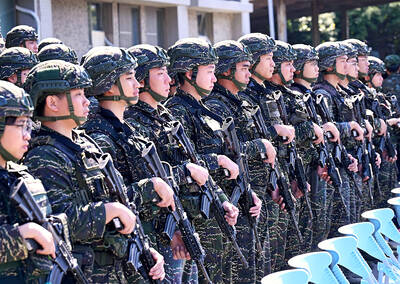
MORE RESPONSIBILITY: Draftees would be expected to fight alongside professional soldiers, likely requiring the transformation of some training brigades into combat units The armed forces are to start incorporating new conscripts into combined arms brigades this year to enhance combat readiness, the Executive Yuan’s latest policy report said. The new policy would affect Taiwanese men entering the military for their compulsory service, which was extended to one year under reforms by then-president Tsai Ing-wen (蔡英文) in 2022. The conscripts would be trained to operate machine guns, uncrewed aerial vehicles, anti-tank guided missile launchers and Stinger air defense systems, the report said, adding that the basic training would be lengthened to eight weeks. After basic training, conscripts would be sorted into infantry battalions that would take
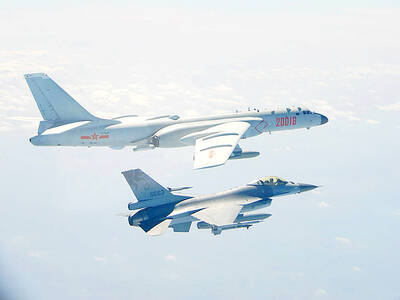
GROWING AMBITIONS: The scale and tempo of the operations show that the Strait has become the core theater for China to expand its security interests, the report said Chinese military aircraft incursions around Taiwan have surged nearly 15-fold over the past five years, according to a report released yesterday by the Democratic Progressive Party’s (DPP) Department of China Affairs. Sorties in the Taiwan Strait were previously irregular, totaling 380 in 2020, but have since evolved into routine operations, the report showed. “This demonstrates that the Taiwan Strait has become both the starting point and testing ground for Beijing’s expansionist ambitions,” it said. Driven by military expansionism, China is systematically pursuing actions aimed at altering the regional “status quo,” the department said, adding that Taiwan represents the most critical link in China’s


 RSS
RSS