


On the three-year anniversary of the Palestinian uprising, the outgoing Palestinian security chief said militants made a mistake in using arms against Israel and failed to understand that the world had changed after Sept. 11.
Violence has been "detrimental to our national struggle," the security chief, Mohammed Dahlan, said in remarks published Sunday, as thousands of Palestinians marked the anniversary with marches in the West Bank.
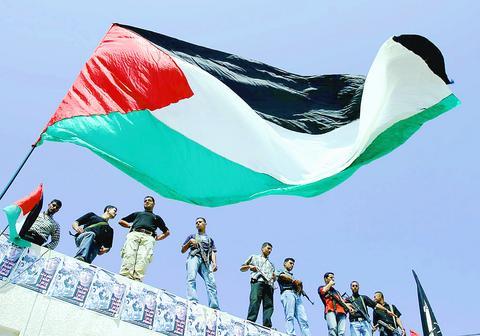
PHOTO: REUTERS
In the West Bank city of Nablus, militants wearing fake explosive belts and burning a miniature Israeli bus led a crowd of several thousand.
The intifada began Sept. 28, 2000, after Israel's then-opposition leader Ariel Sharon, now prime minister, visited the hotly contested Jerusalem holy site known to Muslims as Haram as-Sharif and to Jews as the Temple Mount.
Palestinians called the visit a provocation, because Sharon emphasized Israel's claim of sovereignty. Violent clashes followed, and grew into three years of violence marked by repeated terror attacks against Israelis and Israeli military strikes into Palestinian areas. A total of 2,477 people have been killed on the Palestinian side and 860 on the Israeli side.
Today, the US-backed "road map" peace plan, stalled but still on the table, offers the Palestinians a state by 2005 if the violence ends.
Hamas, responsible for scores of suicide bombings against Israel, marked the anniversary Sunday with a pledge to continue the uprising nonetheless. Hamas reiterated its opposition to the road map and called on the Palestinian Authority and an incoming Cabinet to uphold the Palestinians' right to resist the occupation.
In the latest attack on Friday night, an Islamic Jihad gunman burst into a Jewish holiday dinner at a West Bank settlement, shooting to death a seven-month-old baby and a 27-year-old Israeli man.
On Monday, Israel eased a tight closure it had imposed on the West Bank and Gaza Strip during the two-day New Year's holiday that ended Sunday night. However, travel restrictions remained largely in place.
Palestinians have been living with such restrictions since the uprising erupted, with checkpoints zigzagging around their towns and villages in the West Bank and Gaza Strip, hindering travel and devastating their fledgling economy.
Dahlan, who served as security chief for four months under outgoing Prime Minister Mahmoud Abbas, said the militant groups have been misreading the situation.
"Resorting to armed violence in certain phases of the Palestinian intifada, the way it was done in the past three years, proved to be detrimental to our national struggle," Dahlan told the Lebanese English-language newspaper Daily Star in an e-mail interview.
"We had hoped that the various Palestinian factions would understand the new world that emerged after the events of Sept. 11, 2001, and learn from their outcome," Dahlan said.
"Each era of national struggle has its own characteristics and means. What is positive at a certain time might be counterproductive in other times," Dahlan added.
Dahlan was security chief under Abbas, who stepped down after Arafat failed to relinquish control over security forces. Dahlan, who had the support of the US, will not be in the new government of Prime Minister-designate Ahmed Qureia.
The new Cabinet was presented to Arafat's Fatah movement on Saturday. An Arafat loyalist, Nasser Yousef, will serve as interior minister, a job that grants him control over part of the security branches, with the rest commanded directly by Arafat, who also presides over a new 12-member National Security Council.
The composition of the Cabinet was relatively smooth, though Saeb Erekat, an Arafat stalwart, turned down the portfolio he was offered, as minister of negotiations with Israel, Palestinian officials said.
Qureia, who says he wants as broad a Cabinet as possible, was also rebuffed by a radical PLO faction, the Popular Front for the Liberation of Palestine, or PFLP.
On Sunday, Qureia met with the group's leader, Ahmed Saadat, in a West Bank jail, where Saadat is being held under US and British supervision, for his alleged role in the assassination of an Israeli Cabinet minister in October 2001.
Saadat told Qureia his group would not join the Cabinet, officials said. The Palestinian opposition groups, including Hamas, Islamic Jihad and the PFLP, say they want no part of the Palestinian Authority because it is a product of interim peace deals with Israel they oppose.
Israel initially said it would not do business with an Arafat-controlled Cabinet. However, officials have softened their tone in recent days, saying they would judge Qureia by his deeds. Israel insists that the Palestinian Authority begin dismantling Palestinian militant groups.
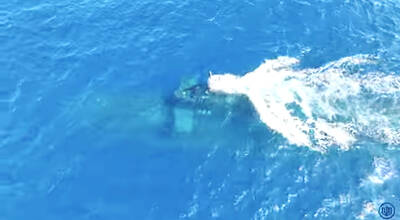
CSBC Corp, Taiwan (台灣國際造船) yesterday released the first video documenting the submerged sea trials of Taiwan’s indigenous defense submarine prototype, the Hai Kun (海鯤), or Narwhal, showing underwater navigation and the launch of countermeasures. The footage shows the vessel’s first dive, steering and control system tests, and the raising and lowering of the periscope and antenna masts. It offered a rare look at the progress in the submarine’s sea acceptance tests. The Hai Kun carried out its first shallow-water diving trial late last month and has since completed four submerged tests, CSBC said. The newly released video compiles images recorded from Jan. 29 to
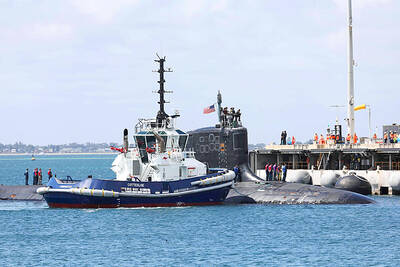
DETERRENCE EFFORTS: Washington and partners hope demonstrations of force would convince Beijing that military action against Taiwan would carry high costs The US is considering using HMAS Stirling in Western Australia as a forward base to strengthen its naval posture in a potential conflict with China, particularly over Taiwan, the Wall Street Journal reported on Saturday. As part of its Indo-Pacific strategy, Washington plans to deploy up to four nuclear-powered submarines at Stirling starting in 2027, providing a base near potential hot spots such as Taiwan and the South China Sea. The move also aims to enhance military integration with Pacific allies under the Australia-UK-US trilateral security partnership, the report said. Currently, US submarines operate from Guam, but the island could
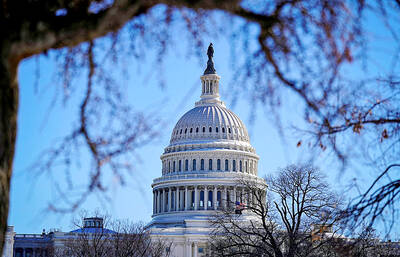
RESTRAINTS: Should China’s actions pose any threat to Taiwan’s security, economic or social systems, China would be excluded from major financial institutions, the bill says The US House of Representatives on Monday passed the PROTECT Taiwan Act, which states that Washington would exclude China from participating in major global financial organizations if its actions directly threaten Taiwan’s security. The bill, proposed by Republican Representative Frank Lucas, passed with 395 votes in favor and two against. It stipulates that if China’s actions pose any threat to Taiwan’s security, economic or social systems, the US would, “to the maximum extent practicable,” exclude Beijing from international financial institutions, including the G20, the Bank for International Settlements and the Financial Stability Board. The bill makes it clear that China must be prepared

Taiwanese trade negotiators told Washington that Taipei would not relocate 40 percent of its semiconductor production to the US, and that its most advanced technologies would remain in the nation, Vice Premier Cheng Li-chiun (鄭麗君) said on Sunday. “I told the US side very clearly — that’s impossible,” Cheng, who led the negotiation team, said in an interview that aired on Sunday night on Chinese Television System. Cheng was referring to remarks last month by US Secretary of Commerce Howard Lutnick, in which he said his goal was to bring 40 percent of Taiwan’s chip supply chain to the US Taiwan’s almost


 RSS
RSS